Sunday, 4 August 2019

A visit to the Annual Nick Drake Gathering

Summer 2019 - Last weekend, I was invited by a friend to the annual 'Gathering' at Tanworth-In-Arden, a small village in rural Warwickshire. It's a celebration of Nick Drake's music, with musicians from across the world volunteering their versions of Nick's tunes.

I am a fairly committed fan of Nick Drake's music, which is to say I have the three albums he made during his short life, a couple of posthumous compilations and I've read his sister Gabrielle's companion book, Remembered For A While. I've also learnt a few of his songs on the guitar. Nick was, above all, a very talented guitarist, so I understand how daunting it might be to perform his songs in front of an audience that knows them well.

The Nick Drake Gathering, held over a weekend and now in its 14th year, remains a low-key affair. It is held just a few yards from his family's former home - the place where he wrote and demo'd many of his songs - and where he died, aged 26, in November 1974.

The local villagers are largely tolerant of the intrusion, since this is not a profit-making venture. The organisers and the people who attend do it out of love and admiration for Nick Drake's music.

On Friday evening, the village hall at Tanworth is packed out with people who have come from all over the country, and some from abroad, to pay their respects in song.

Many of them have also been drawn in by the introspective nature of Nick - the shy man from a well-to-do background - the guitar prodigy whose mental health suffered, in part at least, from a failure to gain widespread recognition for his undoubted talent.

The three albums he released in his lifetime failed commercially and Nick withdraw from live performance very early in his career, which made it very difficult for his music to reach a wider audience.

There are several books about Nick's life and music, the most detailed of which is 'Remembered For A While' a document of his life and a compendium of his music, compiled by his sister Gabrielle with Cally Callomon, who manages Nick's estate.  (EDIT. this was written before the publication of Richard Morton Jack's excellent book, Nick Drake - The Life).

Remembered For A While is a window on Nick's early life and the travels that helped nurture his musical talent. Articles by friends and acquaintances, and by Gabrielle herself, reveal facets of his character, often contradictory, which only adds to the intrigue. 

The book also contains some heartbreaking diary entries and correspondence from his parents. The letters where his father Rodney tries to convince Nick not to drop out of Cambridge, nine months before graduation, are particularly poignant in the light of subsequent events.

'Far Leys' - where Nick lived with his family

Visiting Nick's home town, you realise he must have had a fairly idyllic upbringing amongst the grand houses and the surrounding fields.

We drove past Far Leys, the impressive red brick mansion that was the Drake family home. We then paid a visit to Nick's grave in the village churchyard. A modest headstone sits beneath a mature oak tree.

A polite noticeboard on the tree asks that people respect that this is a family grave site and to be mindful not to clutter it with fan tributes. Most people are respectful of this but there have been reports in the past of people chipping bits off the headstone.

The village of Tanworth-In-Arden

Back at the village hall, the evening's performances begin, with each artist allowed to play two songs. Most choose to play one of Nick's and one of their own. Some of the performers are accomplished players and singers; some less so, but that just adds to the charm of the evening.

Nick's guitar playing was often quite complicated, so it is no mean feat for any musician to get up and try to play it in front of an audience that knows the music intimately.

Among the highlights is a beautiful rendition of Place To Be by 27 year-old George Boomsma, similar in style to Nick's early home demo version (tuned drop D rather than Nick's CGCFGE) that has the arpeggiated guitar figure, instead of the strummed version that appeared on the Pink Moon album. George played and sang it very well, receiving the loudest ovation of the evening and drawing a few tears from those around me.  


At the interval, I spoke to George about his version, and we agreed it is a mystery why Nick didn't play the song like this on the album. He was accompanied at the Gathering by his friend and fellow singer/songwriter Katherine Priddy. Here they are, duetting on the Bert Jansch tune Black Water Side.

The band hazeyjane do an imaginative interpretation of the track Know (from Pink Moon) which emphasises the underlying beat of the song by the simple expedient of the guitar player stamping his foot.

A couple from Brazil (pictured here) also choose Know but with a very different rhythmic style that I thought quite amusing, but I think it baffled a lot of people. Generally it is the performances that stay faithful to the spirit of the originals that goes down best with the audience.

At the last, a first-time performance of  I Was Made To Love Magic (from Time Of No Reply) brings the evening to a satisfactory close.

Sound man Peter Rice, who was at Cambridge with Nick, told the audience that 'Magic' was the first song he ever heard of Nick's and it remains one of his favourites.

It is a strange feeling, to be sitting in a hall so close to where Nick had lived and to be listening to his songs being played to a devoted audience all these years later. But at the same time, it is in keeping with the romanticism and the innocence evoked by much of his music.

On Saturday, a second concert is held at the church
I found the whole experience gave me a deeper appreciation of what a gifted musician Nick was, and how his music lives on through all these different interpretations.

In this video about the annual Nick Drake Gathering, made in 2012, Peter Rice (at 7 mins 30) revisits the site of Nick's first recital as a solo artist, performing with a string quartet orchestrated by Robert Kirby, who did many of the arrangements on Nick's first two albums.

The 2020 Nick Drake Gathering was cancelled because of COVID-19. The organisers made the best of the situation though, and invited people to contribute to an online festival. This was aired on the 26th July 2020. It contains some newly contributed videos and some of the best performances from previous years.

Here's the link to The Virtual Nick Drake Gathering

The live Gathering returned in 2022 and I took my daughter along. When she was six or seven years old, Pink Moon was one of her favourite songs, so we always had to have the album in the car.

On this visit to Tanworth, we went on the Saturday for the concert in the village church of St Mary Magdalene, where Nick had played the organ as a boy. 

It was a particular treat to see that a few of the performers had mastered the more complex guitar parts of songs such as Three Hours, the unreleased Far Leys and the aforementioned Hampstead demo of Place To Be. Robert Barnett deserves a special mention for, I think, capturing the most precise notation and indeed spirit of the songs. Here is his performance at the 2022 Gathering.

I hope to return to the Gathering one day. If you have the opportunity, it's well worth a visit. 

IF YOU LIKE MY BLOG, PLEASE HIT THE FOLLOW BUTTON ON THE SIDE PANEL THANKS

See also on this blog: 

The Making of Five Leaves Left - a worthy Grammy winner 

Nick Drake - Heaven In A Wild Flower

Duncan Browne's Journey - and comparisons with Nick Drake


Wednesday, 31 July 2019

Bob and Joan and Scarlett and Joni... Bob Dylan's Rolling Thunder Revue

Jack Elliott, Joan Baez, Dylan, Mick Ronson, Ronee Blakley, David Mansfield
Martin Scorsese's Rolling Thunder Revue movie is a magical snapshot of a musical legend. How can something so special have been kept under wraps for so long?

The film footage of Bob Dylan's 1975/76 Rolling Thunder Revue tour has been available in unofficial rough-looking clips in the Youtube era. Some of it was even included in Dylan's obscure and quite awful 1978 film 'Renaldo and Clara'.

But it's taken over 40 years for the full treatment to be given to this unique gathering. Thankfully, Scorsese was at hand to work his magic on it. It's not perfect, and on second viewing I skipped over the fake narrative bits. But the concert footage is just so vivid it's almost breathtaking.

Just as he did with 'No Direction Home', his documentary on Dylan's early career, Scorsese has collated this amazingly vibrant footage to showcase Dylan's remarkable artistry and charisma.

Rolling Thunder Revue contains some of the most thrilling performances of Dylan's long career. If you liked the 'Desire' album, it's a kick seeing many of those songs performed by the same band, with the same intensity and warmth. On stage, Dylan is more animated than he's ever been.

It's a lot of fun to watch. The up-to-date Dylan is as enigmatic as ever and there's a lot of his customary misdirection in the narrative. But the real riches lie in the onstage and backstage interactions. You get a strong sense of the collective spirit among the musicians involved.

Joan Baez has a strong supporting role, as do several other women on the tour, such as violinist Scarlett Rivera, singer Ronee Blakley and the amazing Joni Mitchell.

Bob and Joan in the early 1960s
The relationship between Bob and Joan Baez has an enduring fascination. It is one of the great examples of unrequited love in the history of art. 

Bob used Joan as his jumping off platform early in his career - she invited him to share her stage and became his muse and his musical sidekick.

But, as we saw in the movie Don't Look Back ten years earlier, Joan’s love for Bob goes way beyond the music and it's really not clear how far Bob's love for Joan extends. 

The interaction in Rolling Thunder Revue, where they discuss how their lives diverged in the mid-60s, is poignant because it's clear even then that Joan still holds a candle for him.

"You went and got married without telling me"
Dylan acknowledged the debt he owed to Baez, but he did a poor job of repaying it in 1965, when Joan accompanied him to the UK. It was fairly obvious he didn't want her there. The circus that surrounded him just made her feel even more marginalised.

Bob would later say he was just trying to deal with the craziness of his life at that point; and it was crazy. Joan should never have gone with him to the UK. 

She described it as hell (everyone else was on drugs - she was straight). And Bob didn't - as she had expected - reciprocate Joan's generosity by inviting her onstage to perform with him.

For more insight into their complex relationship, I'd recommend David Hadju's excellent book 'Positively 4th Street'. It interweaves Bob and Joan's lives and their relationship, with Joan's sister Mimi and her partner Richard FariƱa.For her part, Joan was guilty only of blind devotion. 

As Hadju's book notes: "This gorgeous woman, who is an icon in her own right, latches onto you and says, 'I'll be your everything, including being your lover'. She adopted him. She found this guy who gave voice to all that powerful stuff, and she nurtured him in that role. He made out on every level."

Hadju's book also gives a glimpse of their happier side, noting how they had a similar sense of the absurd and at times it appeared as if they were having a private joke against the world. "A lovely thing was happening and I didn't want it to end," she said later.

Joni not easily intimidated
The most noteworthy cameo in Scorsese's Rolling Thunder Revue comes from Joni Mitchell. We see her playing an early version of Coyote - which appeared on her next album Hejira - in an upstairs room at Gordon Lightfoot's house in Toronto. 

She had just written the song and the words are ever so slightly different, on the section "he's got a woman at home...". It's astonishing that all these years later we get to see it like this. Joni handles the situation with such assurance. How many other artists could have done that - come into Dylan's world and match him stride for stride?
Joni said, "I joined Rolling Thunder as a spectator. I would have been content to follow it for three cities just as an observer, but since I was there I was asked to participate. Then, for mystical reasons of my own, I made a pact with myself that I would stay on until it was over. 

"It was a trial of sorts for me. I went out in a foot soldier position. I made up songs onstage. I sang in French, badly. I did a lot of things to prevent myself from getting in the way. What was in it for me hadn’t anything to do with applause or the performing aspect. It was simply to be allowed to remain an observer and a witness to an incredible spectacle."

Sensibly, she requested that any footage of her not be used in Renaldo & Clara. "I preferred to be invisible. I’ve got my own reasons why."

Although Joni obviously enjoyed the experience, it took a toll on her health and caused her to cancel some of her own shows soon after. She said, "Rolling Thunder was mad. Heavy drama, no sleep – a circus. (Afterwards) I had bronchitis. A bone in my spine was out of place and was pinching like crazy. So I was in physical pain."
Dylan and Scarlett Rivera
The other key female interaction among the musicians on the tour was the mysterious violinist Scarlett Rivera. She provides wonderful accompaniment to Dylan on stage, showing a fine sense of taste in her playing on several of the featured performances.

She describes their meeting in the movie as an audition followed by a surreal evening jamming with Muddy Waters at the Bottom Line club in New York.

Dylan had such faith in Rivera's ability that she became the foil for all his recording and live dates during this highly productive time, including a memorable performance of Simple Twist of Fate, Hurricane and Oh Sister at a tribute TV show for legendary CBS executive, John Hammond, the man who signed Dylan.

The recording of the album Desire involved the other core musicians on the Rolling Thunder Tour, bassist Rob Stoner, drummer Howie Wyeth and guitarist singer Bob Neuwirth. But it was Rivera who captivated everyone, by virtue of the amazing musical understanding she had with Dylan. 

The song 'One More Cup of Coffee', for example, was recorded in one take. Emmylou Harris was caught off-guard by this and had wanted another run-through to get her vocal right. But that was it. Bob was happy with the first one. Onto the next song. 

The insight and magic shown in the Rolling Thunder Revue movie is quite unbelievable for those of us who have lived with the music and legend for over 40 years. I still have my copy of Sam Shepherd's Rolling Thunder Logbook and the movie fills in a lot of the gaps in Shepherd's sketches of the tour, like Dylan and Allen Ginsberg visiting Jack Kerouac's grave.

As a follow-on from Scorsese's No Direction Home, which finished after Bob's 1966 tour of the UK - and his withdrawal from music - the Rolling Thunder Revue is a perfect complement.

A bonus item this, from Acoustic Guitar magazine (see my recommended blogs at the side here) is a clip of Bob and Joan in 1976 on the second leg of the Rolling Thunder Revue, duetting on Blowin' In The Wind.

Joan Baez talks about Dylan and her activist life on Desert Island Discs.

For more on life on the road with the Rolling Thunder Revue, check out this interview with tour manager Chris O'Dell.  

IF YOU LIKE MY BLOG, PLEASE HIT THE FOLLOW BUTTON ON THE SIDE PANEL THANKS

ALSO ON THIS BLOG:
Blonde On Blonde - Bob Dylan's artistic peak in the 1960s 

Bob Dylan and Eric Clapton at Blackbushe, UK 1978

A Complete Unknown - The Life and Times of Bob and Joan

Idiot Wind marks Dylan's re-emergence in 1975

Sunday, 28 July 2019

Why Powerage is AC/DC's best album

What is the definitive AC/DC album? Most casual fans probably think Back In Black or Highway To Hell is their best. Purists, and especially those who consider Bon Scott era the best vintage, will tell you that Powerage is the winner.

And they'd be right.

All the great rock bands reach a point where they are locked in tight and rocking at their majestic best - but it doesn’t last forever. It may not even coincide with their most successful period commercially.

Powerage came out in 1978, just as AC/DC had their first big hit single in the UK, Rock n Roll Damnation. I bought the 12” single and found I preferred the b-side, Sin City. It led me to one of the greatest rock albums ever.

I got Powerage when it came out and instantly fell in love with its perfect mix of riff-rockin boogie and tall tales from the pen of legendary singer Bon Scott. As a collection of songs, especially the UK vinyl version that kicks off with Gimme A Bullet, it is programmed to perfection. 

Powerage was the last AC/DC album produced by Vanda and Young and marks the point at which the marketing people at Atlantic Records started to really push them, getting them on Top Of The Pops to promote their hit single and making plans to hire a top name producer for their next album.

I remember one of the music papers (Carol Clerk? Sylvie Simmons? definitely a woman anyway) gave Powerage a 5-star review, hailing it as the point at which AC/DC had hit the nail firmly on the head.

As a rock album, it has just the right combination of ballsy energy and production values - not quite as polished as Highway or BIB but with better quality material over the entire album. And the band are tight, almost funky at times on this. With new bass player Cliff Williams and the great Phil Rudd on drums, the band moved up several notches in the quality of their delivery.

Later versions of the album put Rock N Roll Damnation as the lead-off track. But the first pressings of Powerage in the UK, the core market for AC/DC as they were breaking through, led with Gimme A Bullet, followed by Downpayment Blues, Gone Shootin' and Riff Raff. Side two was Sin City, Up To My Neck in You, What's Next To The Moon, Cold-hearted Man and Kicked In The Teeth.

It's a rocking album from first to last, but with just a hint of blues, a bounce from the rhythm section and a real step-up in the lyrics front from Bon.

It wasn’t as successful sales-wise as the following albums and was rather unfairly dismissed for years because of the subsequent success of Highway to Hell and Back in Black. But if you want to hear that point where AC/DC are at their majestic best, give Powerage a listen. From beginning to end, it just rocks.

IF YOU LIKE MY BLOG, PLEASE HIT THE FOLLOW BUTTON ON THE SIDE PANEL THANKS

Thursday, 25 July 2019

Nick Drake - Heaven In A Wild Flower

As this weekend marks the annual pilgrimage of Nick Drake’s most devoted fans to Tanworth-In-Arden - the village in Warwickshire where his family lived - I thought I would explain how I came to love his music.

It was the guitar playing that caught me first, specifically the harmonic richness of his sound through the use of alternate tunings. I don't think enough was made of his pure talent as a guitarist during his short career.

In the mid-80s I bought a cassette copy of an Island Records retrospective called ‘Heaven In A Wild Flower - An Exploration Of Nick Drake‘. I played it constantly (you remember how cassettes in your car stereo would loop continuously). It is pretty much ‘The Best Of Nick Drake’, cherry-picking tracks from the three albums in roughly chronological order.

It also, from the outset, highlights Nick Drake the guitarist. His first album, Five Leaves Left, begins with the song Time Has Told Me. I've never understood why this song was featured so prominently, here and on subsequent sampler albums. To me it's a lacklustre plod and a rather old-fashioned arrangement. It certainly doesn't highlight Nick's guitar playing at all.

Heaven In A Wild Flower begins instead with Fruit Tree, a beguiling introduction to Nick Drake’s world, previously hidden away on side two of Five Leaves Left.

After he died, in November 1974, I had read Nick Kent’s NME long-form obituary, ‘Requiem For A Solitary Man’, which familiarised many people with his story, if not his music. Even that excellent piece wasn’t enough to generate significant sales of Nick’s three albums, Five Leaves Left (1969), Bryter Layter (1970) and Pink Moon (1972). For myself, I knew them then, but I only grew to love them later.  

My copy of Nick's first album
For me, the key to this new appreciation was the sequencing - the order of the songs. Heaven In A Wild Flower works so well as a compilation because there's a seamless musical arc created by the first few songs. 

His voice draws you in, masterfully recorded by engineer John Wood. Above all else though, Nick was an excellent and original composer for acoustic guitar. His playing was clean and often highly technical. That slightly hesitant, exploratory guitar line at the beginning of Fruit Tree is your doorway into his world.  

Cello Song was track 2 on ‘Heaven…’ upping the tempo and building the intrigue with a more assertive (and tricky) guitar figure, and some inspired accompaniment from bassist Danny Thompson and conga player Rocky Dzidzornu. Then comes ‘Thoughts Of Mary Jane’, with its lilting pastoral melody. Over the first three tracks, a variety of moods have already been created.

Not taking anything away from the individual songs on Five Leaves Left ; River Man and Three Hours especially are astonishingly accomplished pieces. But it's important, with an artist like Nick, to set the scene properly. Song programming is so important on records. I genuinely believe that if Five Leaves Left had been programmed differently, it would have been more successful.

And it very nearly was.

The original master tape box for Five Leaves Left has a suggested alternative numbering for the tracks, as follows:

Side One

Fruit Tree
Cello Song
Thoughts of Mary Jane.......

River Man is suggested as track 5, instead of track 2 as it appears on Five Leaves Left.

I’d like to believe that is why Heaven In A Wildflower is programmed as it is, because Joe Boyd, or someone at Island, decided to try the sequencing suggested on the original tape box. 
 
Having said all the above, this new bid to gain acceptance for Nick Drake in the 1980s made not the slightest difference to his sales numbers. You'd think the sheer quality of the songs would have been enough to gain wider recognition. But the world still wasn't ready. Heaven In A Wildflower was actually deleted by the time Drake's music started to really become popular in the late 1990s. 
 
An original pressing of the second album, Bryter Layter,
with the two posthumous compilations on cassette, all quite rare today
At about the same time as Heaven In A Wildflower in the mid-1980s, I bought a compilation issued by Joe Boyd's Hannibal Records, called Time Of No Reply. This contains early demos, outtakes from Five Leaves Left and some songs that might have made it onto a fourth album. They were recorded as far back as 1968 in some cases. 

It is hard to understand why some of them (the title track, Joey and Clothes of Sand for example) were not released during his lifetime. His playing is clean, crystal clear and emotionally engaging, sometimes painfully so. The album also included songs from his last recording sessions, including the bleak cri de coeur 'Black Eyed Dog' and the simple beautiful melody of Voice From The Mountain.

Many of the songs on Time Of No Reply are certainly good enough to have been included on previous albums, but it wasn't until after Nick died and they checked the vaults for unreleased material, that Boyd and engineer John Wood realised what treasures they still had.

It's easy with hindsight to speculate whether Nick could have been better presented as an artist. There is no question that he possessed the talent to have made a successful career in music, if circumstances had been different.

He was a gifted guitar player, but because he used a number of different tunings, he needed time to retune his guitar between songs. Audiences at his few concerts would become restless and Nick, lacking the booze-fuelled bravado of a John Martyn, didn't have the banter to keep the audience engaged.  

Nick's refusal to actively promote the records by playing live would have been extremely frustrating for the marketing people at Island Records, who had many other artists to focus their attention on. 

As Nick himself wrote to a psychotherapist in 1973, "There was a lot of pressure around, and I suppose I sort of cracked up."
 
His withdrawal from live performance was undoubtedly a major factor in his failure to break through. His only known radio session was recorded for John Peel between the first two albums. This was all well before the video age. There is no film of him in any form as an adult. 
 
The indifference of the record buying public must have come as a shock to Nick, especially after the sacrifice he made by dropping out of Cambridge in his final year. His deepening depression has been well-documented, but perhaps not enough has been said about the lighter side of his personality. 
 
The hardback book compiled by his sister Gabrielle, entitled 'Remembered For A While' gives a well-rounded account of Nick's life and shows how the darkness that fell on him was perhaps not inevitable.

Nick's music is a very personal thing, but I was delighted to find that the annual gathering at Tanworth is an uplifting celebration. Although he didn't live to see how much his music has touched people, there is some consolation in the fact that his music lives on and now inspires many millions of people around the world.

IF YOU LIKE MY BLOG, PLEASE HIT THE FOLLOW BUTTON ON THE SIDE PANEL THANKS

See also on the blog:

Sunday, 17 February 2019

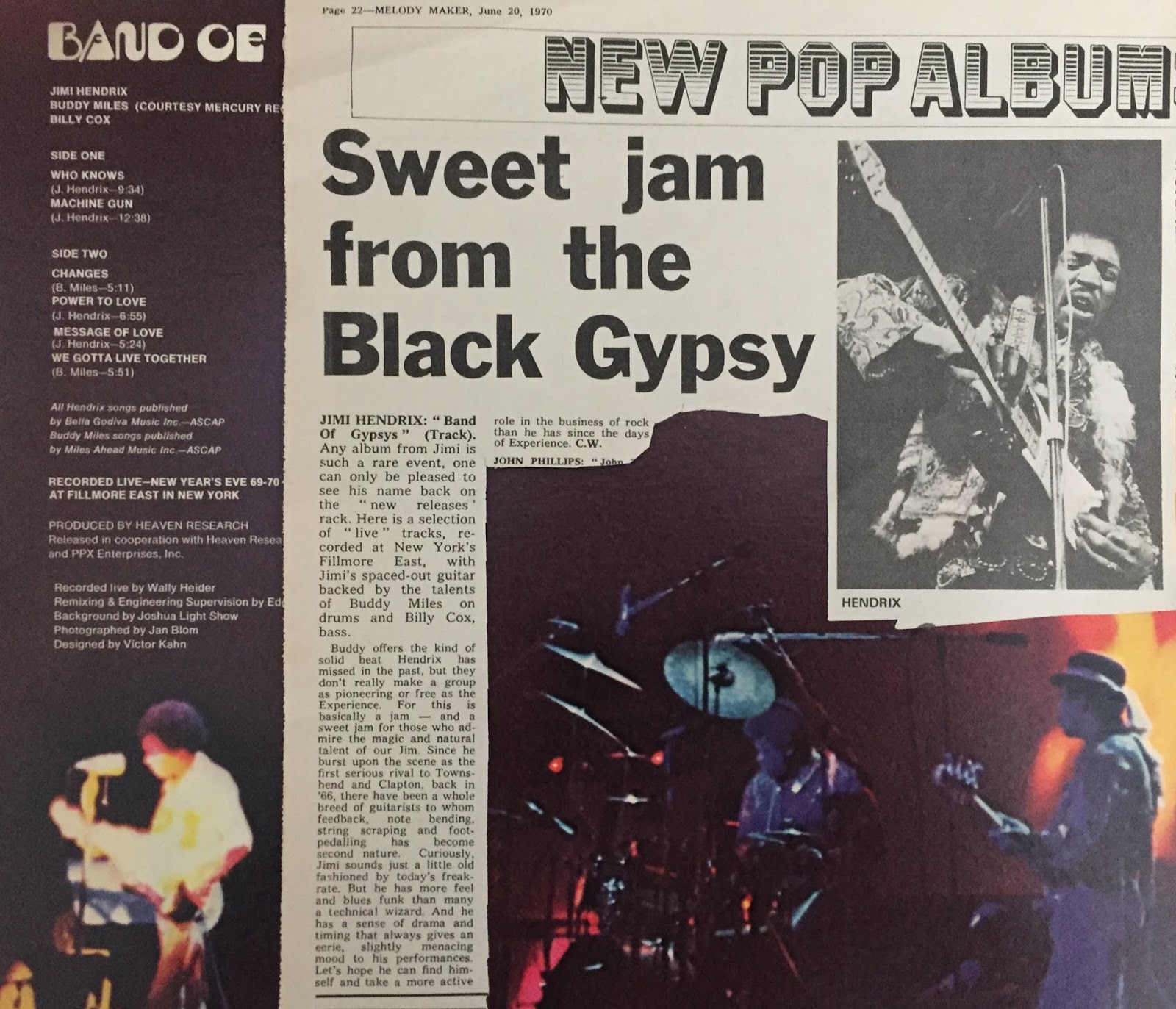
June 1970 - Hendrix's 'Band of Gypsys' album reviewed by Melody Maker

Rockin' The Fillmore
The final album released by Jimi Hendrix in his lifetime was the live record 'Band of Gypsys'. Recorded on New Year's Eve 1969/70 at the Fillmore East in New York, the record showcased new material reflecting a more mature and soulful Hendrix, backed by his old army friend Billy Cox on bass and Buddy Miles on drums and vocals.

Jimi had lost a bit of momentum after the release of his masterpiece album Electric Ladyland in 1968. With manager Chas Chandler and bassist Noel Redding both departing during the EL sessions, which they saw as indulgent and directionless, Hendrix put a random bunch of musicians together for his performance at Woodstock in August 1969. They were loosely billed as "Gypsy Sun and Rainbows" and Hendrix referred to them as “just a band of gypsies”.

Dec 1969 - click on the image to expand it
In this interview with Melody Maker in December 1969, Jimi talks about wanting to get the Experience back together and waiting on Noel and drummer Mitch Mitchell to agree.

In the meantime, he mentioned he was working on a recording for the Band of Gypsies project with Buddy Miles on drums and Billy Cox on bass.

Cox had played in a band with Jimi when they were both in the US army and he joined Hendrix for his performance at Woodstock in August 1969.

Buddy Miles had played on the Electric Ladyland two-part track Rainy Day, Dream Away and Still Raining, Still Dreaming and the Band of Gypsies material reflected this slightly more funky approach, though with less of the humour and lightness evident on EL. 
 
Hendrix’s business affairs were complicated by the fact he was contracted to provide an album to a former manager, Ed Chalpin and his company PPX Enterprises. With Cox and Miles now in tow, Hendrix was encouraged by his manager Mike Jeffrey to work on material that could be used to settle the contract with Chalpin. 

The Band of Gypsys - Hendrix, Miles and Cox

Bill Graham booked Hendrix to appear at the Fillmore over New Year’s and plans were made to record the shows. The recordings were not perfect. Hendrix had problems with mild feedback and he admitted he was out of tune on some numbers. Nonetheless, his playing is still remarkable and the album's standout track, Machine Gun, bears all the hallmarks of his iconic performance of the Star-Spangled Banner at Woodstock. 
Band of brothers

Hendrix dedicated Machine Gun "to all the soldiers that are fighting in Chicago and Milwaukee and New York, oh yes, and all the soldiers fighting in Vietnam". The combination of his wailing and swooping guitar and Miles' rat-a-tat-tat drums give the track a haunting power that few other rock artists could get close to at that time. 

But during the two-night run at the Fillmore Jimi couldn't resist showing off and Bill Graham had harsh worlds for him after the first set on the second night.
 
When Hendrix asked him during the intermission what he thought, Graham said, "You're Jimi Hendrix and anything you do is taken as gospel because of who you are. You humped the guitar, you played it with your teeth; you stuck it behind your back. You just forgot to play."

Stunned, Jimi went back on stage for the second show and really played. The incandescent version of Machine Gun on Band of Gypsys was recorded at that show. 

Hendrix went up to Graham when he came off stage and said, "Alright motherfucker? That good enough for you?" 

He wheeled around to the stage for the encore and did, in Graham's words, "fifteen minutes of the greatest shtick you'd ever want to see." grinding up against his Strat and all his old showboating tricks. 

"At one point he looked to the side of the stage and stuck his tongue out at me," said Graham. "It was very, very funny."

UK ad in June '70
The contractual obligation nature of Band of Gypsys cast an unhappy shade over the whole episode though, despite the album being well-received on release in March 1970 (in the US). It became his best-selling album since his debut ‘Are You Experienced’.

An ongoing dispute between Chalpin and Hendrix’s management meant that the album wasn’t released in the UK for another three months.

Plans were made to take it on the road, but it didn’t last long. A concert at Madison Square Garden on January 28 1970, ended prematurely after just two numbers. 

Just 'Hendrix' - contractual obligation honoured
Observers at the show, including other performers such as Johnny Winter, commented on how down and detached Hendrix appeared. There were a lot of rumours about the effect drugs were having on him.

There were also tensions between Hendrix and Buddy Miles, with the latter reluctant to play second fiddle. Whatever the truth, the band dissolved right then and Hendrix was encouraged to reconvene the Experience, with Cox on bass replacing Noel Redding. 

What we have left is a reminder that on his day, Jimi Hendrix was still way ahead of everyone else in terms of imagination on the guitar. That he couldn’t sustain the high quality he established from 1967 and '68 onwards is perhaps not surprising.


In his album review, Melody Maker's reviewer Chris Welch noted that Hendrix's playing is at times restrained and even "old-fashioned". But he still has "a sense of drama that gives an eerie slightly menacing mood to his performance".

Below is a clip containing interviews and footage of the band playing "Who Knows", the first track of the album. The music is quite different from the Experience and funkier, for sure. But I don't buy the narrative that the Band of Gypsys documentary is putting across, saying this was the real Jimi because he was playing with black guys. If the black community got off on it more than the Experience albums, that's understandable. Producer Eddie Kramer has it right though - the albums are just different and that reflects the breadth of Jimi's abilities and his musical vision. He could have gone anywhere musically, he was that talented.

Here's a non-album version of Power of Soul, from the first show at the Fillmore.
and this film has recently surfaced of the new year's celebration and extracts from the first show at the Fillmore.
The gatefold inside cover of the original north American release of Band of Gypsys

IF YOU LIKE MY BLOG, PLEASE HIT THE FOLLOW BUTTON ON THE SIDE PANEL THANKS

See also on this blog:

Jimi Hendrix wows Monterey 1967