I was in my office in Hong Kong on the day Bowie died,
surrounded by people mostly much younger than me, who didn't seem at all
interested when I blurted out 'Oh no, David Bowie died!'
The first tweets were coming through (news guy wept and told
us…) with the shocking truth. Faced with
a room full of 150 people who couldn’t give a toss, I had to take a walk outside.
Top Of The Pops, 1972
It can’t be wrong to feel so deeply the loss of someone you didn’t know personally, when that someone has been such a powerful figure in your life.
It’s a story well-told, that for anyone who grew up in the 1970s and 80s, Bowie played a pivotal, crucial role in our youthful fantasies.
Hard to imagine now but on the 6th of July 1972, when Bowie appeared on Top Of The Pops and sang, “I had to phone someone, so I picked on you…” and pointed straight at the camera, he sparked a cultural change for a whole generation.
Such was the power of television at that time. Everyone who saw it, remembers Bowie putting his arm around Mick Ronson as they sang the Starman chorus in harmony. Men didn't do that kind of thing, but these guys were clearly different. I mean, look at them! "Bunch of poofs", our Dads would have said.
Ciggie stardust
His carefully cultivated image of otherness - from Major Tom to Ziggy to the Thin White Duke and on, to the many and various characters he embodied - gave young people the licence to think outside of the norms of society, with no apologies.
His intellect and imagination was fed by a diet of the most diverse
writing he could find, some of which, like The Divided Self by R. D. Laing or The
Stranger by Albert Camus and The Outsider by Colin Wilson, inspired his music
directly.
At Live Aid in 1985, it was Bowie’s performance at Wembley, rather than Queen’s, that had people grabbing their phones to donate. His selfless decision to set aside time in his set to show the awful images of the Ethiopian famine, was a true measure of the man and his humanity, capturing the mood of that amazing day perfectly.
I could make the transformation as a rock and roll star
He was well ahead of the game in seeing the potential of the internet and his early bowienet platform allowed him to see at close quarters how online communities might develop.
We were all
richer for having David Bowie in our lives.
That evening in Hong Kong, I went back to my flat, opened
the windows wide and played 'Life On Mars' at full volume. It never sounded
better.
Something
happened on the day he died
IF YOU LIKE MY BLOG, PLEASE HIT THE FOLLOW BUTTON ON THE SIDE PANEL. THANKS
Here was an artist who had been a feature of my life since I first heard him on record in the early 1970s. On his passing this week, I felt a tinge of regret that I might have taken him for granted of late. Time for a reappraisal of his career.
On Sunday nights as mid-teenagers a bunch of us would gather at a girlfriend's house in Pinner. We'd sit in her bedroom and listen to records. Actually only two records, but they were both excellent - Steely Dan's Katy Lied and David Bowie's Young Americans.
The title track of the Bowie album had that instantly familiar intro sax line and solo by David Sanborn that everyone recognises, whether they know his name or not.
Sanborn at Woodstock
Sanborn's first major exposure (to a mere 400,000 people) had come, aged 24, as a member of the Paul Butterfield Blues Band. He appeared at the 1969 Woodstock festival with the Butterfield band, though not in the movie.
Then in 1972, he got his first big exposure on record, featuring on Stevie Wonder's classic album Talking Book, on the gorgeous track Tuesday Heartbreak.
It was a sound that became Sanborn's calling card, a signature style that would make him a first-call session player from then on.
When Bowie decided to record in the US in 1975, it was an inspired move to have Sanborn provide the saxophone riff that would usher in his new sound.
Young Americans was a bold change of style for Bowie, one that some found difficult to take. From Glam rocker to Soul crooner? Come off it mate! But our little gang loved the new album. Sanborn's sax was integral to the whole vibe, especially on tracks like Win and Fascination.
His solo career took off in the late 1970s and early 80s, with albums such as Hideaway, Voyeur and Change Of Heart. His collaboration with Bob James,
Double Vision won them both a Grammy. In all, Sanborn won six.
He kept the best company in his choice of backing musicians and collaborators, not the least of whom was bassist Marcus Miller, who was just 19 when they first worked together. Tracks like Chicago Song and Run For Cover demonstrate how important Miller was to Sanborn's sound in that classic 1980s period.
Sanborn capitalised on
his popularity as one of New York's finest, leading the house band on Saturday Night Live and featuring on David Letterman's late-night chat shows. There are some legendary performances
from those days on Youtube.
Here's the cream of New York's session players, including Marcus, guitarist Hiram Bullock and drummer Omar Hakim playing the Weather Report track Teen Town.
He also co-hosted Night Music, a late-night music
show on television with Jools Holland, and curated a syndicated radio program, The Jazz Show with David
Sanborn.
I first saw him live in London in the 1980s, as the support act for Al Jarreau. Sanborn's band included drummer Steve Gadd, so my mate Graham and I - both mad keen drummers - went along two nights running to check him out.
And from Night music, here's the band backing Miles Davis on Tutu, introduced by Dave Sanborn.
Of his more recent recordings, I picked up the album Time Again on a business trip in Singapore in about 2005. And I'm still playing it. Again, just the best musicians; Steve Gadd, Mike Mainieri, Randy Brecker, Christian McBride, playing a mix of old and new. Here's a live version of the first track on Time Again, Comin' Home Baby.
IF YOU LIKE MY BLOG, PLEASE HIT THE FOLLOW BUTTON ON THE SIDE PANEL THANKS
Probably the only CDs I have of any monetary value are the five David Bowie albums from the batch released in the mid 1980s, and then withdrawn by RCA after they lost the rights to the Bowie catalogue.
I haven't played them for years, since my born-again vinyl conversion. Well I've just played the Ziggy CD and blow me, it sounds great!
That got me thinking: I wonder if their stock has risen, or whether they are just worthless bits of plastic, like most CDs.
I searched online and discovered there is no end of discussion on the relative merits of the German and Japanese RCA Bowies (Nerd fact: mine are the German versions ). Also, it turns out the RCAs have stood the test of time in terms of being faithful to the original vinyl, because subsequent versions messed with the formula.
As one reviewer on Amazon commented, "the original RCA Bowie CDs from the 1980s were lambasted at the time as sub-par, but actually did a pretty good job of staying faithful to the sound of the original LPs.
Oh gawd !
They have held up very well in light of the reissues that followed: the anemic and overly bright Ryko reissues of the late 1980s and the bloated, heavily compressed Virgin/EMI remasters of the late `90s, which remain the standard versions available today.
"However, it was the 30th Anniversary edition of Ziggy Stardust that represented the nadir of all Bowie remasters: it sounded worse than even the '90s EMI remaster; worse yet, it actually removed portions of the music and reversed the stereo channels." Bowie himself said the CD remaster sounded 'weedy'. OK, so while that makes the case for the original vinyl even stronger, it should at least make these RCA CDs more collectible.
From a quick scan of various blogs and online resellers, it appears each of the CDs is worth at least $100 (US) and perhaps more given they are in good condition.
But hey, it's not about the money! What pleases me the most is they actually sound really good.
And then there's my vinyl copies of these two classic Bowie albums.
Early pressings are worth a fortune. These two are currently worth around $200 each. Crazy, considering what I paid for them.
IF YOU LIKE MY BLOG, PLEASE HIT THE FOLLOW BUTTON ON THE SIDE PANEL THANKS
It is a rare thing to find an individual musician who can move effortlessly from gentle acoustic playing to frenetic jazz freak-outs. Over his long career, jazz guitarist Pat Metheny has explored many different musical landscapes and he manages to find a purity of expression in each of them.
He is best known for his work with the Pat Metheny Group, which for many years included his closest musical partners, pianist Lyle Mays, who sadly died last month, and bassist Steve Rodby.
Outside of the group, he has collaborated with vibraphone legend Gary Burton, bassist Charlie Haden and with Chick Corea, among many others. Metheny began recording professionally in the 1970s alongside the legendary bassist Jaco Pastorius, another player who had that ability to shift from the tender to the jarring.
Metheny's recorded work is often melodic and played with a distinctive style that once heard is seldom forgotten. But he has also wandered off into darker areas, taking influences from free jazzers like Ornette Coleman. On many of his albums, over the last 20 years especially, there are moments that jolt the listener. He doesn't always play safe and has never been afraid to push the boundaries.
Now 65, he has reached a point where he feels able to revisit some of his most popular tunes, with the help of his three-piece band, consisting of Gwilym Simcock on piano, Linda May Han Oh on bass and Antonio Sanchez on drums.
For his current audience, many of whom are here for the nice tunes, the good news is that Metheny will be playing
reasonably familiar material. He told the audience he
started out with a short tour two years ago ‘playing the hits’, which he
admitted was unusual. It’s gone down so well with audiences he has just
kept going, extending the tour into places like NZ, where he has only been
once before in his almost 50 year career.
So the audience on Tuesday in Auckland were treated to a set full of familiar tunes, for those with the Pat Metheny Group albums
(songs like Phase Dance, Bright Size Life, Last Train Home, Have You Heard, Better Days Ahead) and the ‘As Falls Wichita, So Falls Wichita Falls’ album he made with Lyle Mays in 1981, a favourite of mine.
As the concert began, Metheny sat alone at the centre of the stage holding a very strange looking instrument - a many headed monster called a Manzer Pikasso. incorporating 6 and 12 string guitars and various other strings spanning across its body - 42 strings and he utilised them all, to great effect.
The set also featured material from his various collaborations, plus a piece from
the solo acoustic album ‘One Quiet Night’. And in the acoustic medley for the encore, there was even a snatch of his one genuine hit ‘This Is Not
America’, the song he recorded with David Bowie.
photo: Zed Pics
Metheny is still one of the most accomplished and versatile
guitarists I’ve ever seen. I once saw him and the group up-close at the Half Moon pub in
Putney (London) playing Ornette Coleman 'tunes' and jazz standards as a warm up for his UK tour. To this day, I don't think I've ever seen a virtuoso musician in that close proximity and it remains one of the most mind-blowing shows I've seen.
If you're in any doubt about his abilities, just check out this short clip promoting the 2020 tour.
His latest band, of quite a different generation to Metheny himself, are energetic and certainly accomplished in their own right, with Simcock proving to be a
powerful and nimble-fingered piano player. It was fitting to see his strong
performance in the week we lost the great McCoy Tyner.
I was also
especially struck with upright bassist Linda Oh, who showed once again
how women have come to the fore as bass players in recent years. I’m
thinking Esperanza Spalding, Tal Wilkenfeld and Rhonda Smith, in particular. Linda was a delightful presence on the stage and added a particular lyricism on the bass during the more reflective pieces.
photo: Zed Pics
Here, Metheny plays the song Slip Away, accompanied by Oh and Antonio Sanchez.
Sanchez
has a percussive approach to the drums; he's a kind of instinctual, reactive drummer in the
style of Brian Blade. Impressive. Anyone who has seen the movie Birdman may recall the soundtrack, which was composed and played by Sanchez.
Towards the end of the show, Metheny duetted with each member of the band in turn. He and Sanchez were the last of the duets and began by playing the Metheny tune Question and Answer. Butthe tune soon became less recognisable as they built up a dissonant crescendo of sound - Metheny playing his guitar synth in a frenzy and Sanchez at the end scraping the edge of his cymbals. It was exciting to watch, but would certainly have freaked out some of the more conservative members of the audience.
Listening to the set, I realised I have a lot more Pat Metheny on various media than I thought, including some on cassette that I haven't listened to for years. These include a wonderful album called 'Beyond The Missouri Sky' recorded in New York in 1996 with bassist Charlie Haden.
Metheny grew up in Missouri and his more reflective acoustic music, of which this is a perfect example, is inspired by the remote and often desolate landscapes of that part of America.
A selection of my music and video featuring Pat Metheny
I have several of Metheny's 1970s and 80s ECM albums on vinyl, which are played fairly regularly. My favourites are a couple of his albums with Gary Burton recorded before he formed the Pat Metheny Group, and a more recent Burton album, Like Minds, where Burton reunited with early collaborators including Pat Metheny and Chick Corea, who had never previously played together.
My other favourite of the ECM era is the Pat Metheny/Lyle Mays album As Falls Wichita, So Falls Wichita Falls. It features the song September 15th, which pays tribute to one of their heroes, Bill Evans. It's an almost meditative album, full of atmosphere and reflection, while also managing to be uplifting.
Other regulars from the CD era were Imaginary Day and the live album, The Road To You. The song 'Have You Heard' from that album drew one of the biggest cheers of the night from the Auckland audience. The DVD We Live Here mirrors the material on The Road To You and gives a good illustration of the Pat Metheny Group in the mid 1990s, when they were probably at the height of their popularity.
The other DVD in the collection pictured above is of Joni Mitchell's Shadows and Light tour in 1980, which featured Metheny and Mays alongside Jaco Pastorius, Don Alias on drums and Michael Brecker on saxophone. Metheny plays a fittingly ethereal solo on Joni's song Amelia.
Here's another live beauty - The Gathering Sky, which features a solo by drummer Antonio Sanchez.
HO HO HO!!! HERE'S MY GROOVY NEW LP, JUST IN TIME FOR CHRISTMAS.
Yes, it's December 1967 and Jimi's playing Santa Claus, bringing you seasonal joy with his new waxing Axis: Bold As Love.
The second of his three classic studio albums, 'Axis' combines some of Jimi's most psychedelic guitar experiments with his most sensitive songwriting. Tracks like Little Wing (truly one of his greatest songs) and Castles Made of Sand showed Jimi was so much more than the wild man of Borneo he was portrayed as by the media back then.
The recording was done mostly in London at Olympic Studios. Despite the ground-breaking guitar effects and stereo panning featured on tracks such as If 6 Was 9 and Bold As Love, the album could potentially have sounded even better if Jimi had not left a master tape of side one in a London taxi. The lost tape had to be remastered in one overnight session and Jimi always felt the rushed nature of it compromised the record. But to these ears it still sounds amazing, especially considering the limitations of using 4 track recorders.
Fast forward to December 1969 and Phillips/Fontana were trying to convince us to buy these goodies right away, because if we waited until Christmas eve they'd be sold out. Now let's be honest, Santa would not have been delivering many copies of any of these records. Scott 4 is beloved of wise-after-the-event hipsters, but it was his worst selling of the four 'Scott' albums.
The 'David Bowie' album, renamed Space Oddity in 1972 after his second coming with Ziggy Stardust, was another flop in 1969.
And Flaming Youth are only remembered now because their drummer was Phil Collins - that's him at the bottom of the diamond on the cover.
Of the four featured albums, Greek diva Nana Mouskouri was probably the best seller at the time; popular with the mums and dads, don't you know.
And of the others, well Blue Mink were having hits and Melting Pot is one of their best, so that would have probably been the best seller of the lot.
Elsewhere in this pre-Christmas 1969 edition of UK music paper Melody Maker, CBS would have had a bit more luck promoting the new album from Janis Joplin, I Got Dem Ol' Kozmic Blues Again Mama!
With a new more soulful sound, a shift away from the psychedelic rock of Big Brother & The Holding Company, Janis was ready to rip up the joint as she did at Woodstock that summer. The new album should have done better sales-wise but a lot of fans were put off by the change of direction. Judged on its own merits, the record has some strong songs, including Try (Just A Little Bit Harder) and To Love Somebody. Check out those links, seriously. It's probably my favourite of her albums.
Island Records were also advertising in this edition of Melody Maker in December 1969. One or two of these albums, notably Fairport's Liege & Leif, Jethro Tull's Stand Up and In The Court of the Crimson King, had already been on the charts. Others, such as Quintessence, Mott and poor old Nick Drake would see little Yuletide activity.
During the summer holidays in 1968, I would sit on the low front wall of the house across the road, with the neighbours’ kids, all of us around 10 years old, and we'd listen to the radio.
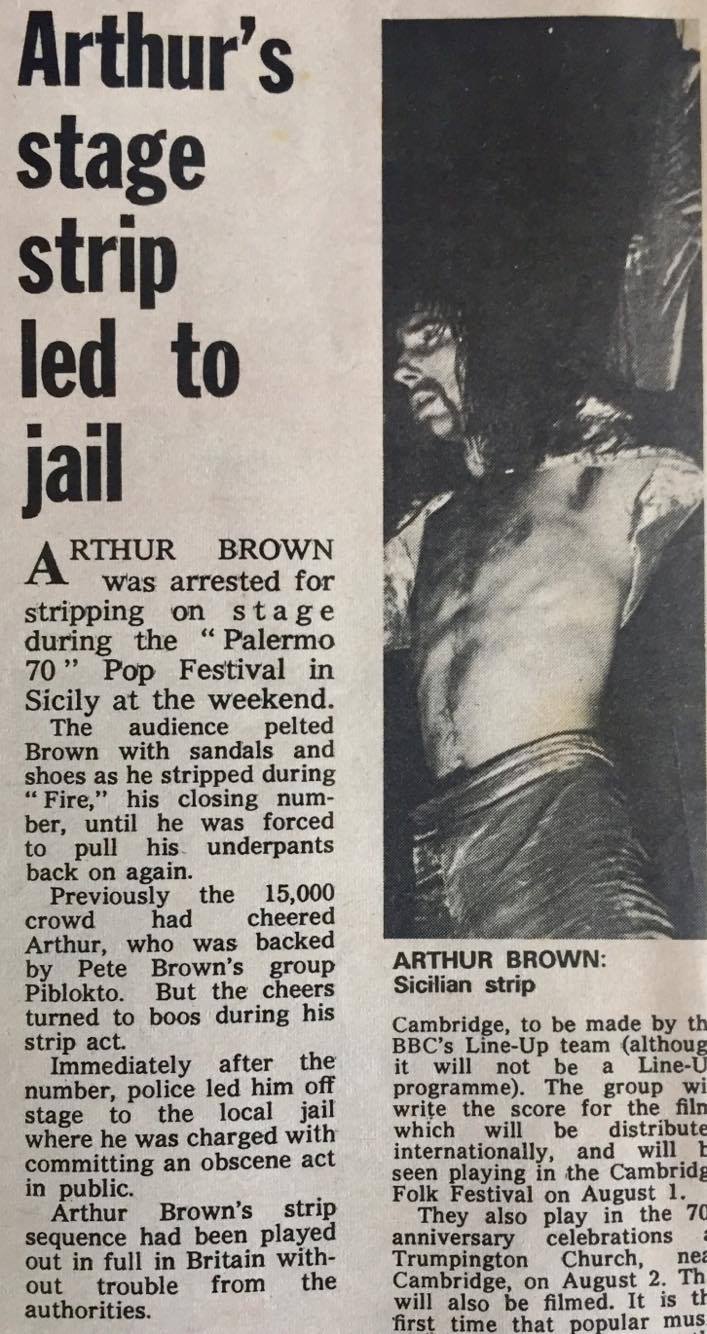
But our very favourite that psychedelic summer was 'Fire' by The Crazy World of Arthur Brown. A pretty freaky song for a 9 year old boy. It begins with Arthur bellowing "I am the God of Hell Fire!"
That was precisely why we all liked it, of course. It was slightly scary and it had this organ sound, like something out of a horror movie.
As 'Fire' entered the singles charts, The Crazy World... appeared on Top Of The Pops, so we could see that Arthur wore a crown of fire while singing and gyrating like some demented wizard.
Arthur Brown sings 'Fire' on Top Of The Pops
I hadn't started buying records at this point and in those days you couldn't just summon your favourite
song out of the ether. You had to wait for BBC Radio One to play
it. And if you missed it, you might have to wait several hours for them
to play it again.
Thankfully, 'Fire' got a fair bit of airplay that late summer, as it captured everyone's
attention when the Crazy World appeared on TOTP - Arthur with his crown of fire. The song jumped up the charts, hitting the number 1 spot
(pop-pickers!) in August 1968.
Down at the local park, we decided to form a club, The Fire Appreciation
Society, membership of which was confirmed by pledging allegiance to
Arthur Brown - The God of Hellfire! I felt like this was proper
rebellious behaviour for a young boy.
Arthur Brown in full voice was, and still is amazingly, a thing to behold. He had a terrific vocal range, with a natural deep speaking voice, but he was also capable of some blood-curdling screams. Deep Purple's singer Ian Gillan has said he was inspired by Arthur to incorporate screaming into his own style.
The Crazy World of Arthur Brown, with Vincent Crane on Hammer Horror Hammond organ (Crane later formed Atomic Rooster with Carl Palmer) - were a feature of London's psychedelic rock scene in 1967 and '68.
Review of Arthur at the Middle Earth club
They appeared with bands like The Soft Machine and The Pink Floyd at
psychedelic underground clubs like UFO and Middle Earth. The band were
signed to The Who's record label, Track, so would also have appeared at
shows with The Who and Jimi Hendrix in this period.
Interviewed by Record Collector magazine in 2013, Arthur said, "UFO was
quite short-lived. It was an old Irish club for most of the week. The
psychedelic light shows that began there were run by Mark Boyle, who was
an adventurer in all those oil wheel projections that you see in
photographs.
"Middle Earth was a scene where poets, dancers, political extremists, hippie radicals - like Yoko Ono and her 'Bag-In' - all did their thing. It was really everybody influencing everybody else. Out of all that came a lot of the experimentation we did."
After The Crazy World came to an end, Arthur fronted the band Kingdom Come. His performance at Glastonbury in 1971 - a highlight of the film 'Glastonbury Fayre' - shows how much he put into each performance. It really is a wonderful snapshot of the period, full of long-haired hippies stoned out of their minds.
Arthur recalled, "There were only 2,000 people there. The Maharishi spoke from the first pyramid stage and taught us his spiritual path. David Bowie appeared at dawn but strangely didn't appear in the film."
The cameraman was probably asleep. Bowie told how he had been up all
night smoking dope at the Worthy farmhouse in the company of Terry Reid and Linda Lewis.
So getting to the stage at 5am, he would not have been in the best
shape, but nonetheless he seems to have captivated those who were awake.
Audio of Bowie's Glastonbury appearance exists, in which he thanks the
audience for appreciating him, at a time when he was considering giving
up playing live altogether:
"I just want to say that you’ve given me more pleasure than I’ve had in a
good few months of working. I don’t do gigs any more because I got
so pissed off with working, and dying a death every time I worked, and
it’s really nice to have somebody appreciate me for a change.”
Black and Brown
Arthur moved to America for a few years in the 1970s and, among other
things, had a decorating business with Jimmy Carl Black, the drummer
from The Mothers of Invention.
He described Jimmy as "a fantastic character. His favourite line was 'God-dammit Arthur, why can't I make any money in music. I never got paid and I don't suppose I ever God-damned will!"
Frank Zappa meets Arthur Brown in London
He met Frank Zappa too and described him as "a visionary who worked harder than anybody I knew, in terms of recorded music and how to present it."
Through his connection with The Who, Arthur was invited by Ken Russell
to play the role of The Preacher in Russell's film of 'Tommy'.
Arthur claims that Pete Townshend actually wrote 'Tommy' with him in
mind to perform it, rather than Roger Daltrey, which would have been interesting. But in any case, The Who's co-manager
Kit Lambert persuaded Pete that he needed to let The Who perform it.
Arthur as The Preacher in Ken Russell's 'Tommy'
In
later years, Arthur would tell how he had burned himself so many times
wearing the crown of fire. You can see in the TOTP clip, how he removes
it in the middle of the song. That hasn't stopped him from wearing
variations of the crown of fire in performances down the years. Well he
is The God of Hellfire - his audience expects nothing less!
He says, "People still like to hear 'Fire'. We did it with a string section. We did it with a ska band, with Jerry Dammers, and with Johnny Clegg and 20 piece reggae orchestra at the 40th anniversary of Glastonbury."
In this clip, Arthur tells the story of how he wrote 'Fire' - drugs were not involved apparently - and he uncovers his old fire crowns in a shed. https://www.youtube.com/watch?v=VqeXoAk4PR4
Arthur's still doing his thing
And so, being a long-time member of the Fire Appreciation Society, I have
always had a soft spot for Arthur. He's an eccentric for sure, but quite sane for all that and
he has stayed true to his roots as a theatrical musical act. Except for him
it's more than an act. He has pursued a lifestyle that conforms to many
of the original hippy ideals of communal and sustainable living.
He's
also a
good storyteller and with a strong and
committed spiritual side.
I
met Arthur very briefly in Victoria Station about 20 years ago. He's
very tall and thin, with a deep voice. I didn't get the chance to tell
him about the Fire Appreciation Society, but maybe if he reads this...
Here are some examples of Arthur Brown playing live back in the day and right up to this year.
Michael Chapman's album Fully Qualified Survivor had just been released on Harvest. It featured some classic Mick Ronson guitar, instantly recognisable now as the sound Ronson would soon deliver on David Bowie's album The Man Who Sold The World. But in February 1970, it would be hard to say who was the more successful of the two, Bowie or Ronson.
Mick Ronson in 1970
David was at this point involved in his Arts Lab project and had formed an electric band, The Hype, a vehicle for the new songs he had written, some of which would be heard on his next album, The Man Who Sold The World.
The Hype was Bowie with Tony Visconti on bass, Mick Ronson on guitar and John Cambridge on drums. Cambridge had been replaced by Ronson's mate Woody Woodmansey by the time they came to record TMWSTW in the late summer of 1970.
Here's a short clip of them performing the Velvet Underground's 'I'm Waiting For The Man' at the 'Atomic Sunrise' festival in February 1970.
They also did a radio session for the BBC's Sounds Of The Seventies the following month.
Bowie was still a long way (another two years) from seeing any more commercial success, after his lone hit Space Oddity in 1969. Mick Ronson, on the other hand, was not only helping Bowie forge a new sound, but was being picked up by various other emerging artists, including Michael Chapman and Elton John.
Here is Ronson to the fore on this track from Fully Qualified Survivor, 'Stranger in the Room
The common denominator between Chapman and Elton was producer Gus Dudgeon. Gus was so impressed with Ronson's playing on Fully Qualified Survivor, he recommended Elton John check him out for his forthcoming album Madman Across The Water.
Ronson did record some guitar for Elton's record, but it didn't make the final mix of the original album release. In fact, it didn't see the light of day until much later, when a CD reissue of the album featured out-take tracks, including the version of Madman with Ronson's guitar part.
Meanwhile, as the above page from the Melody Maker of the time shows, on Tuesday this week, Ronson had started gigging with Bowie and The Hype, who were booked to play at the White Bear pub in Hounslow! In the advert, they were billed as 'David Bowie's new electric band'.
It's fair to say The Hype were not well received by the critics. Bowie's questing for the right sound to reboot his career would take a few more twists, before he finally hit the big time with Ziggy Stardust in 1972.
He was at a particularly low point when he appeared at Glastonbury in 1971, but took encouragement from the reception at the festival, even though he was playing at dawn.
Bowie told how he was up all night smoking dope with Terry Reid and Linda Lewis. He
took the stage at 5am, but
nonetheless he seems to have captivated those who were awake.
Bowie at Glastonbury in 1971
Audio
of his Glastonbury appearance exists, in which he thanks the
audience for appreciating him, at a time when he was considering giving
up playing live altogether:
"I just want to say that you’ve given me more pleasure than I’ve had in a
good few months of working. I don’t do gigs any more because I got
so pissed off with working, and dying a death every time I worked, and
it’s really nice to have somebody appreciate me for a change.”
The Supermen: Mick, David and Woody, 1971
Here's some rare footage of Michael Chapman, live in Paris in 1970, with Rick Kemp on bass and Richie Dharma on drums - both of whom are mentioned in the above news item about Chapman teaming up with Ronson in the MM cutting, under 'Folk News'.
IF YOU LIKE MY BLOG, PLEASE HIT THE FOLLOW BUTTON ON THE SIDE PANEL THANKS
Other-worldly. In the early 1970s,
David Bowie really was that rock hero from another planet, the starman waiting in the sky. His words and music sparked the imagination of a new
generation of pop fans. The images from the Ziggy Stardust period in 1972 and '73
show an artist taking the early stylings of Glam Rock established by T.
Rex and Slade to a whole different level. The front cover of the Ziggy
Stardust album plays up the other-worldliness perfectly, as if Bowie had just fallen to earth. And this advert for his 1973 single 'Drive-in Saturday' plays on the other-worldly persona; a cleverly cultivated image and a perfect complement to the music. Drive-in Saturday is one of the stand-out tracks on the 'Aladdin Sane' album and, for some fans it is one of Bowie's
greatest songs. Its setting is a futuristic world where people have
forgotten how to make love. When he played the song live soon after he
wrote it, Bowie said, "This is after a catastrophe of some kind, and
some people are living on the streets and some people are living in
domes, and they borrow from one another and try to learn how to pick up
the pieces."
This interview is featured in the anthology "Greatest Hits - The Best of the NME" published to hit the Christmas market in 1974. The book also features interviews with Mick Jagger, Slade, Ray Davies, Lou Reed, Sly Stone, Syd Barrett and the New York Dolls, among others. But since it is one year today since we lost David Bowie, I thought I would share the interview he did with Charles Shaar Murray. In it, Bowie reflects on his 'rock star experiment' with Ziggy and what drives him to keep the whole thing fresh and interesting.
Bowie was always open and honest with good interviewers and CSM gets him to open up on his feelings about stardom and success. He also reveals his feelings about certain bands and, in particular, remembers how The Who were not really Mods, in the sense that he was a Mod, right on top of the latest fashions, rather than five months behind like The Who.
So I hope you can read it. Click on each page to enlarge it. Enjoy. Love on ya!
IF YOU LIKE MY BLOG, PLEASE HIT THE FOLLOW BUTTON ON THE SIDE PANEL
The shock of the new - that's how it felt to behold the reformed King Crimson in 1981.
My ticket for the Discipline show and a recording of it
Six years previously, Robert Fripp had called a halt to the band, which by then was just a three piece, with John Wetton on bass and vocals and Bill Bruford on drums.
They had recorded the album Red, which had been one of their most commercially successful albums, and completed a US tour, when Fripp pulled the plug, to Wetton and Bruford's disappointment.
They were at the peak of their popularity, but that was part of the problem for Fripp. They had become like a conventional rock band and he didn't want that. The closer they got to the mainstream, the less comfortable he became.
In 1975, Fripp enrolled at the International Academy for Continuous Education at Sherborne House in Gloucestershire. Students at the IACE underwent an intensive training in the techniques that founder John Bennett had learned from G.I. Gurdjieff.
Gurdjieff taught that most humans do not possess a unified consciousness - and thus live their lives in a state of hypnotic "waking sleep" - but that it is possible to awaken to a higher state of consciousness and achieve full human potential. Gurdjieff's method for awakening one's consciousness unites the methods of the fakir, monk and yogi, and thus he referred to it as the "Fourth Way".
In this interview, Fripp talks about his search for meaning and direction, having ditched his music career. Notably, he refers to his approach of setting a goal for a specific period as "the drive to 1981", calling it his "personal discipline".
By the end of 1976, Fripp had 'recovered' (in his words) from the IACE experience and, once back into his stride musically, he wasn't idle. He continued his occasional collaborations with Brian Eno and became David Bowie's go-to guitarist for the albums from Heroes to Scary Monsters (1977-80).
In 1981, news came through that Fripp had a new band. Me and three bandmates, all big Crimson fans, bought tickets for the first gig in London,
May 1981 at Her Majesty's Theatre, Haymarket.
Tony Levin and Chapman Stick
They were called Discipline - no doubt inspired by the IACE experience. Only Bruford remained from previous configurations of KC. We had no idea what to expect, but we hoped they would play some old stuff. We certainly didn't expect it was going to be a life-changing
experience, in the sense that this new band was making music from the
future, such that their influence endures into KC’s music to this day.
So Discipline started off the concert playing a new track (called Discipline as it turned out) and the first thing
that struck me was the rhythm, a hypnotic pulse driven by Bruford's electronic drums, but
with a distinctive bass.
Belew and elephant noises
Those of us who had seen Peter Gabriel live around this time would have seen Tony Levin playing his Chapman Stick, an odd looking bass instrument. Levin is the acknowledged
master of the instrument.
Then all hell broke loose! The band launched into Thela Hun Ginjeet.
[check it out!] We were pinned back by the dual onslaught of Fripp and new lead
guitarist Adrian Belew producing all manner of sonic fireworks. Bruford attacking his kit with staccato rolls, Levin slapping at his bass.
Each new track had an distinct edge, from the "this is a dangerous place" storyline of Thela Hun Ginjeet to the sheer shimmering beauty of Matte Kudesai, or the interstellar soundscape of The Sheltering Sky. Belew was not only an amazing stunt guitar player - as he had proved with Frank Zappa and Talking Heads - he was an excellent vocalist too. Zappa's song City of Tiny Lights is a good example, and with Crimson he excelled on Matte Kudesai.
They played some old too. Red was tucked into the set early on and they played Larks Tongues In Aspic part 2 as an encore. The clip of Larks Tongues here gives you an idea of the energy they brought to the old material. But it was the new ones that really had us gripped. Like Elephant Talk, a bizarre but
compelling statement of the new Crimson.
Soon afterwards, an almost inevitable name-change, from Discipline back to King Crimson, took the band into a highly successful period, artistically and commercially, that has sustained right up to the latest line-up, which still owes much to the inventiveness of the 1980s version.
Everyone has their favourite period of Crimson and there have been so many different phases. But 40 years on from this particular gig, I can still remember how we were blown away
by this new music.
Due to a change of living arrangements (working in Hong Kong for an extended period) I am revisiting my CD collection. Have to say these old David Bowie CDs sound much better than I thought they would.
Probably the only CDs I have of any monetary value are the five Bowie albums from the batch released in the mid 1980s, and then withdrawn by RCA after they lost the rights to the Bowie catalogue. I haven't played them for years, preferring the vinyl experience. Well I've just played the Ziggy CD and blow me, it sounds great!
That got me thinking: I wonder if their stock has risen, or whether they are just worthless bits of plastic, like most CDs. So I searched online and discovered there is no end of discussion on the relative merits of the German and Japanese RCA Bowies (Nerd fact: mine are the German versions ). Also, it turns out the RCAs have stood the test of time because subsequent versions have messed with the formula.
As one reviewer on Amazon commented, "the original RCA Bowie CDs from the 1980s were lambasted at the time as subpar, but actually did a pretty good job of staying faithful to the sound of the original LPs. They have held up very well in light of the reissues that followed: the anemic and overly bright Ryko reissues of the late `80s and the bloated, heavily compressed Virgin/EMI remasters of the late `90s, which remain the standard versions available today.
Oh Gawd!
However, it was the 30th Anniversary edition of Ziggy Stardust that represented the nadir of all Bowie remasters: it sounded worse than even the '90s EMI remaster; worse yet, it actually removed portions of the music and reversed the stereo channels." Bowie himelf is on record as having said the recent CD remaster sounded 'weedy'.
OK, so while that makes the case for the original vinyl even stronger, it should at least make these RCA CDs more collectible. From a quick scan of various blogs and online resellers, it appears each of the CDs is worth at least $100 (US) and perhaps more given they are in good condition.
But hey, it's not about the money! What pleases me the most is they actually sound really good. So until I can get back to using my record deck, it's time to rediscover the joys of CD.
For a time in 1971 and 1972, before he was overshadowed by Bowie and the other Glam Rock bandwagon jumpers, Marc Bolan was unquestionably Britain's biggest pop star. In my archive I found these black and white photos which capture Bolan and his T. Rex band mates Mickey Finn, Steve Currie and Bill Legend as they are about to release the album Electric Warrior.
A version of this photo was given as a poster with copies of Electric Warrior
The photos were taken by Kieron 'Spud' Murphy, who was also responsible for the original photo used as the image for the cover of Electric Warrior.
That photo, taken at the Albert Hall, Nottingham on 14 May 1971, can be seen on the wall behind Mickey Finn in the lounge photo shown here.
These interior photos and the colour photo below were all taken at the flat in Clarendon Gardens, Maida Vale, London, where Marc lived with his wife June Child.
The band photo with Marc in the foreground was given away as a poster with early copies of the Electric Warrior vinyl LP.
Following on from the success of Hot Love, the Electric Warrior album contained the hits Get It On(Elton John plays piano on this clip from Top Of The Pops) andJeepster, which cemented Bolan's new rock style and created the greatest teen music craze since Beatlemania.
The album was produced by Tony Visconti and benefits from the background vocal talents of Howard Kaylan and Mark Volman, otherwise known as Flo & Eddie, fresh from their exploits with Frank Zappa. The template for the T. Rex sound, with the characteristic raw crunch of Bolan's guitar and the band's behind-the-beat groove, was set on this record.
My vintage copy of Electric Warrior
But not everyone was taken in by Bolan's new direction. DJ John Peel said his close friendship with Marc and June effectively ended because Peel was reluctant to play the new T. Rex single when it arrived at Radio One.
Marc and June Child
Peel didn't specify which single it was, but having been such a strong
supporter of the band in its previous form, Tyrannosaurus Rex, he had to
ask himself whether he would have played the record if he and Marc were
not friends. He concluded that he wouldn't have. Bolan froze him out
from then on.
Peel obviously felt that Bolan had sold his soul to the screaming teens. I'm sure a lot of other fans from the Tyrannosaurus Rex period felt the same.
Whatever the merits of Bolan's new direction, it was a hugely successful
one and in 1972 the run of hits continued with Telegram Sam, Metal Guru,
Children of the Revolution, Solid Gold Easy Action and 20th Century
Boy.
But as
the photographer in the colour shot here (not credited so I can't
name them) says, Marc was extremely vain and convinced of his own
genius.
As his fame increased, so did his cocaine usage. Tony Visconti is adamant that his music suffered as a result.
Clarendon Gardens, Maida Vale
Visconti noted that while Bolan was still able to write hit songs, he didn't have the musical vocabulary to break beyond the singles market and was incapable of taking direction from those around him. It was only a matter of time before his star burnt out.
As their careers progressed, Bolan was compared with David Bowie, who had his own ideas about how to carve out an identity with glam rock imagery.
By 1973, Bowie soon overtook Bolan, through the sheer breadth and brilliance of his music, whereas Marc wasn't able to maintain the quality and the momentum. His run of Top10 hits came to an end in 1974.
In that initial burst of Glam Rock in 1971 and 72, though, Bolan vied with Slade as the UK's most popular chart act. Electric Warrior stands as a still vibrant and vivid snapshot of the time.
Here is a live studio version of Jeepster which I think captures the spirit of the T. Rex sound. There's some contemporary footage included at the end of the video too.
And while we're celebrating this music, let's have some more. Probably my favourite of the 1972 singles. Children Of The Revolution. Mickey Finn is a riot on this.




He is best known for his work with the Pat Metheny Group, which for many years included his closest musical partners, pianist Lyle Mays, who sadly died last month, and bassist Steve Rodby.
Outside of the group, he has collaborated with vibraphone legend Gary Burton, bassist Charlie Haden and with Chick Corea, among many others. Metheny began recording professionally in the 1970s alongside the legendary bassist Jaco Pastorius, another player who had that ability to shift from the tender to the jarring.
Metheny's recorded work is often melodic and played with a distinctive style that once heard is seldom forgotten. But he has also wandered off into darker areas, taking influences from free jazzers like Ornette Coleman. On many of his albums, over the last 20 years especially, there are moments that jolt the listener. He doesn't always play safe and has never been afraid to push the boundaries.
Now 65, he has reached a point where he feels able to revisit some of his most popular tunes, with the help of his three-piece band, consisting of Gwilym Simcock on piano, Linda May Han Oh on bass and Antonio Sanchez on drums.
For his current audience, many of whom are here for the nice tunes, the good news is that Metheny will be playing reasonably familiar material. He told the audience he started out with a short tour two years ago ‘playing the hits’, which he admitted was unusual. It’s gone down so well with audiences he has just kept going, extending the tour into places like NZ, where he has only been once before in his almost 50 year career.
As the concert began, Metheny sat alone at the centre of the stage holding a very strange looking instrument - a many headed monster called a Manzer Pikasso. incorporating 6 and 12 string guitars and various other strings spanning across its body - 42 strings and he utilised them all, to great effect.
The set also featured material from his various collaborations, plus a piece from the solo acoustic album ‘One Quiet Night’. And in the acoustic medley for the encore, there was even a snatch of his one genuine hit ‘This Is Not America’, the song he recorded with David Bowie.
If you're in any doubt about his abilities, just check out this short clip promoting the 2020 tour.
His latest band, of quite a different generation to Metheny himself, are energetic and certainly accomplished in their own right, with Simcock proving to be a powerful and nimble-fingered piano player. It was fitting to see his strong performance in the week we lost the great McCoy Tyner.
I was also especially struck with upright bassist Linda Oh, who showed once again how women have come to the fore as bass players in recent years. I’m thinking Esperanza Spalding, Tal Wilkenfeld and Rhonda Smith, in particular. Linda was a delightful presence on the stage and added a particular lyricism on the bass during the more reflective pieces.
Sanchez has a percussive approach to the drums; he's a kind of instinctual, reactive drummer in the style of Brian Blade. Impressive. Anyone who has seen the movie Birdman may recall the soundtrack, which was composed and played by Sanchez.
Towards the end of the show, Metheny duetted with each member of the band in turn. He and Sanchez were the last of the duets and began by playing the Metheny tune Question and Answer. But the tune soon became less recognisable as they built up a dissonant crescendo of sound - Metheny playing his guitar synth in a frenzy and Sanchez at the end scraping the edge of his cymbals. It was exciting to watch, but would certainly have freaked out some of the more conservative members of the audience.
Listening to the set, I realised I have a lot more Pat Metheny on various media than I thought, including some on cassette that I haven't listened to for years. These include a wonderful album called 'Beyond The Missouri Sky' recorded in New York in 1996 with bassist Charlie Haden.
Metheny grew up in Missouri and his more reflective acoustic music, of which this is a perfect example, is inspired by the remote and often desolate landscapes of that part of America.
The album with Haden also includes the theme music from the movie Cinema Paradiso.
My other favourite of the ECM era is the Pat Metheny/Lyle Mays album As Falls Wichita, So Falls Wichita Falls. It features the song September 15th, which pays tribute to one of their heroes, Bill Evans. It's an almost meditative album, full of atmosphere and reflection, while also managing to be uplifting.
Other regulars from the CD era were Imaginary Day and the live album, The Road To You. The song 'Have You Heard' from that album drew one of the biggest cheers of the night from the Auckland audience. The DVD We Live Here mirrors the material on The Road To You and gives a good illustration of the Pat Metheny Group in the mid 1990s, when they were probably at the height of their popularity.
The other DVD in the collection pictured above is of Joni Mitchell's Shadows and Light tour in 1980, which featured Metheny and Mays alongside Jaco Pastorius, Don Alias on drums and Michael Brecker on saxophone. Metheny plays a fittingly ethereal solo on Joni's song Amelia.
Here's another live beauty - The Gathering Sky, which features a solo by drummer Antonio Sanchez.
In this interview, Metheny talks fondly of working with Bowie.