Showing posts with label the mothers. Show all posts

Saturday, 4 December 2021

Smoke On The Water - Montreux 50 years on

The Montreux Casino goes up in smoke, Dec 4 1971
50 years ago this evening, “some stupid with a flare-gun” caused the Montreux casino fire that was the inspiration for Deep Purple’s best-known song Smoke On The Water.

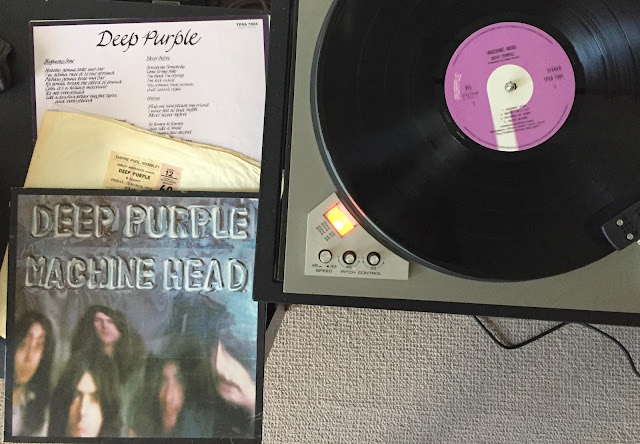
In December 1971, Deep Purple were in Switzerland to record what would become their classic album Machine Head. On December 4th they attended a show at the Montreux Casino, on the shore of Lake Geneva. During the show, by Frank Zappa’s band The Mothers Of Invention, a member of the audience fired a flare into the wooden rafters of the casino roof.

There is an audio recording of the concert where Zappa can be heard calmly telling the audience to head for the exits. The evacuation was completed safely and there was no loss of life. The casino building was totally ruined by the fire.

The Montreux Casino as it was

As the smoke drifted across the lake, Purple's bass guitarist Roger Glover thought of the title...

We all came out to Montreux
On the Lake Geneva shoreline
To make records with a mobile
We didn't have much time
Frank Zappa and the Mothers
Were at the best place around
But some stupid with a flare gun
Burned the place to the ground

Smoke on the water
Fire in the sky

FZ surveys the scene
Zappa’s band lost most of their gear in the fire. Deep Purple, who were scheduled to begin recording at the casino the next day, managed to avoid losing their equipment, but had lost their recording location.

With nowhere to make their album, Montreux’s music festival promoter Claude Nobs came to the band's rescue. Glover said, “He put all his problems aside. We had no place to record, so he arranged to have us move into a small theatre near the smouldering remains of the casino.”

The ruins of the Casino


They burned down the gambling house
It died with an awful sound
And Funky Claude was running in and out
Pulling kids out the ground

Whilst at the theatre, they started messing around with a new riff. "We were doing the first take of this new song – well, it wasn’t a song yet, it was just a jam with a kind of rough arrangement to it," said Glover.

What they didn’t know was that the police were outside banging on the door trying to get in and stop them playing. Apparently they were keeping the whole town awake. "Montreux was then a very sleepy town, populated mostly by old ladies,” quipped Glover.

Deep Purple recorded their classic album in a hotel corridor
It became clear the band were not welcome in the lakeside town, especially after the events of the fire. Rock bands meant trouble to the Swiss, but Nobs helped Purple find “a place to sweat”.

When it all was over
We had to find another place
But Swiss time was running out
It seemed that we would lose the race

Thanks to Funky Claude, they were able to secure a place where they could make some noise - The Grand Hotel.

Glover recalled, “It was closed for the winter. A cold sort of place, I mean it was freezing cold. We had a carpenter put a couple of walls up. We threw some mattresses against the windows, brought in a couple of industrial heaters. And we recorded there.”

 The Stones' mobile truck at the hotel
The Rolling Stones’ mobile recording truck was parked at the rear of the hotel. Engineer Martin Birch set up an intercom so he could communicate with the band in the hotel corridor. Here's Take 2 of Highway Star, the first track on the album.

"We were still short of a song, so it was suggested that we work up the song we had jammed at the theatre. It became a song about the adventure of coming to try and record, and the place burning down and ending up doing it in a hotel corridor."

We ended up at the Grand Hotel
It was empty, cold, and bare
But with the Rolling truck Stones thing just outside
Making our music there

Guitarist Ritchie Blackmore came up with the classic riff and in its simplicity, Blackmore has likened it to the famous introduction to Beethoven’s fifth symphony.

"What Beethoven does with just very few notes, that riff does too. But it’s got a hint of Eastern mysticism in it, just by the semitone lift. Instantly recognisable and yet like nothing else," said Glover.

The Grand Hotel, Montreux, November 2021
Blackmore also pointed out that everyone plays the famous riff wrong. Blackmore plays it in fourths, plucking two strings at a time, rather than block chording it.

Glover and singer Ian Gillan wrote the lyrics. "We never thought for a minute it was going to have the kind of future it has had,” said Glover. “We didn’t think that much of it. We put all our efforts into another song on the album, Never Before."

Purple"s run of hit singles in 1970 and '71 - Black Night, Fireball and Strange Kinda Woman - came to a halt with Never Before, one of the new tracks recorded in Montreux. For some reason it didn't sell. It probably didn't make the playlists on major radio stations, perhaps because it was a little different from what you'd expect of Purple; neither rock nor pop. 

The rebuilt Montreux Casino, November 2021
Nonetheless, the album sold well and Purple picked up further sales momentum when the live version of Smoke On The Water, from the album Made In Japan, was released in the US in 1973.

Given the limitations of space and comfort at the Grand Hotel, it is remarkable that Deep Purple were able to make such a great record as Machine Head. It showcases not only a consistently high quality of songwriting, but also a band that rocks (Highway StarSpace Truckin) and swings too (LazyMaybe I'm A Leo).  

And then there is Smoke On The Water - a riff they must be sick of playing after all these years. But for better or worse, it's what most people know them for. And it's got a great story behind it.

With a few red lights, a few old beds
We made a place to sweat
No matter what we get out of this
I know, I know we'll never forget Smoke on the water
Fire in the sky

The Lake Geneva shoreline, November 2021
Last month, my wife and I visited some friends in Vevey, the next big town along the lake from Montreux. 

We walked along the promenade, sampling the delights of the Christmas market in Montreux. We visited the rebuilt Casino, which houses the recording studio that was owned by Queen for many years. 

And there, on the water, was the same view of the Lake Geneva shoreline from the Machine Head album, minus the smoke.

IF YOU LIKE MY BLOG, PLEASE HIT THE FOLLOW BUTTON ON THE SIDE PANEL THANKS

See also on this blog:

1970 - Deep Purple Get Heavy with 'In Rock'

Most-viewed Youtube clips - Tommy Bolin live, 1976

There's a lot to like in the 'ZAPPA' movie

Electric Ladyland - The Genius of Jimi Hendrix

What Is Led Zeppelin's Best Acoustic Song?

The Who - Who's next - Lightning In A Bottle

Worth watching:
Rick Beato dissects Smoke On The Water


Sunday, 31 October 2021

The Velvet Underground movie shows why 'The VU & Nico' album is such a classic

I love a good music documentary and the latest film by Todd Haynes on the Velvet Underground definitely hits the spot. 

On the basis that a band's early evolution is usually more interesting than their later career (Zappa is a case in point), Haynes focuses at least half the movie on the formation of the band in the mid 1960s and the making of their classic first album - The Velvet Underground and Nico, produced by Andy Warhol.

The interviews with John Cale are the most revealing, on all manner of things to do with how the band evolved and the contribution of each member. Cale's story is also fascinating in the depiction of a poor Welsh upbringing that somehow led to his unlikely development as a conservatory-trained avant garde musician.

Lou Reed said his college band was so bad they had to change their name a lot, because no one would hire them twice. Cale, the musical prodigy from the valleys, pushed Reed to throw off his straight R&B chops and embrace the avant garde. The unconventional drumming of Maureen Tucker and the addition of Nico as chanteuse resulted in a unique and groundbreaking sound; at once jarring and beautiful. 

Original footage of the band's first shows and early versions of songs like Heroin and Venus In Furs give real insight into how the band evolved from those rudimentary demos to produce such a startling debut.

Through Andy Warhol’s connections with ‘straight’ society, the VU’s early appearances were at bizarre  functions such as the American Society of Clinical Psychiatrists’ annual ball.  

Lou admits that although Warhol wasn't a hands-on producer, the band wouldn't have got the freedom to make the music they wanted if he hadn't got behind them.

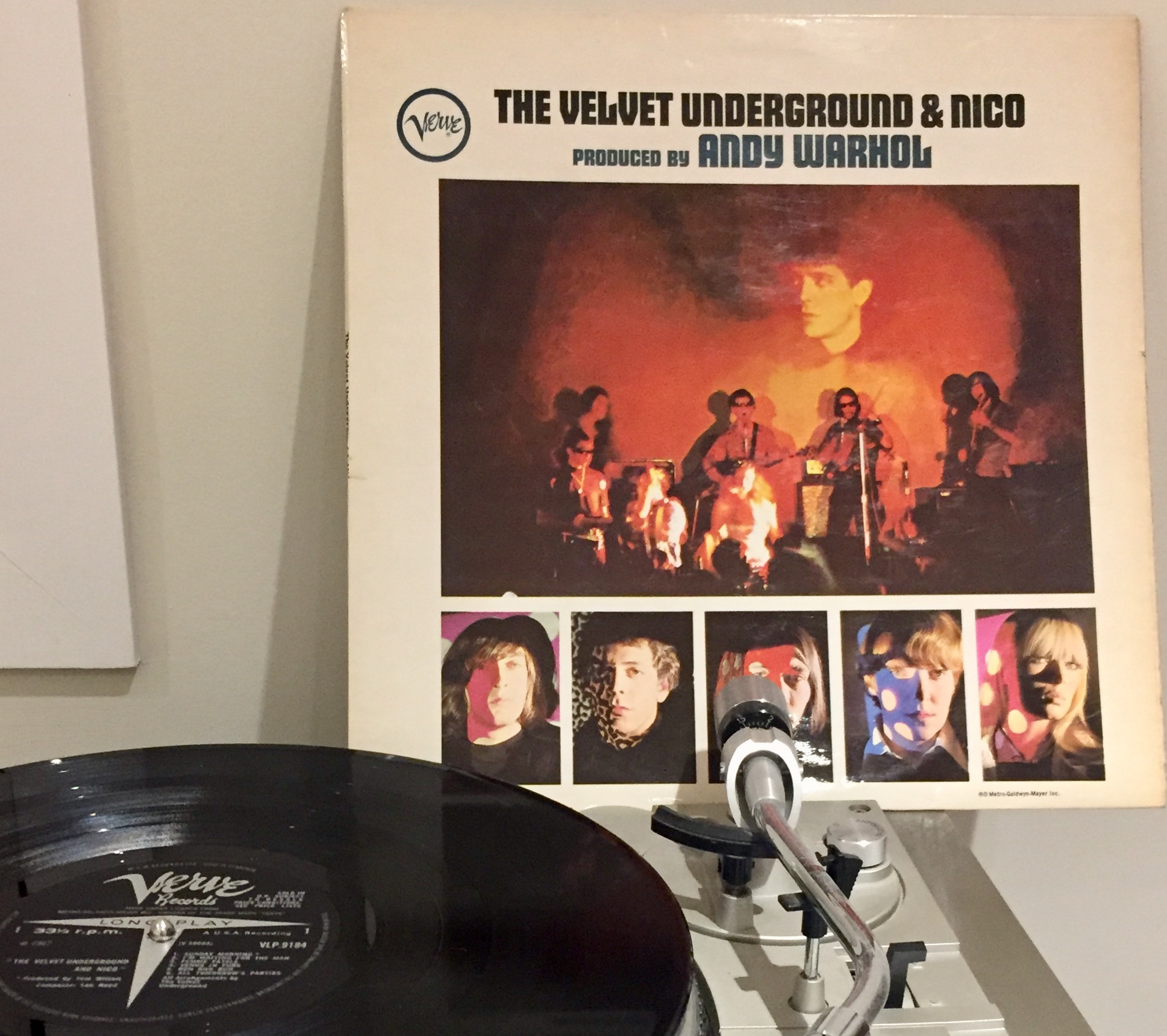
An original UK pressing of The VU and Nico.
The banana cover came later

What's also remarkable is that two of the most artistically out-there bands of the mid-sixties, The Velvets and The Mothers of Invention, were on the same MGM/Verve label. However there was no love lost between the two; east coast clashed with west. 

Lou complained that when the VU went to play some shows in Los Angeles, the record company added The Mothers to the bill, which Lou saw as an attempt to undermine them. "We hated the Mothers." said dancer Mary Woronov: "They were hippies".

Well, they were long-hairs, anyway. In reality, Zappa had no time for mush-brained hippiedom and took great pleasure in poking fun at it. Watch the 'Zappa' movie to understand more about what made The Mothers as outrageous and anti-hippie as The Velvets.

After 'The Velvet Underground and Nico' was released and was largely ignored by the wider public (Lou claimed to have made more money out of his earlier bands than he ever did out of the VU), the band continued to tour and evolve their sound. By the second album, White Light/White Heat, the pressure of touring and Lou's surly behaviour had already soured the relationship with Cale, who said there was nothing he could do: "If you tried to please him, he hated you more." 

Their influence over bands in later years is undeniable, though often overstated. Cale himself has said the idea that the VU were among the most influential bands of the 1960s is "fatuous". At the time, the Velvet Underground met with a lot of hostility. The engineer on White Light/White Heat would set up the mixing desk and leave the room while they were recording, saying "I don't have to listen to this shit". 

Sterling Morrison, Lou Reed, Nico, Moe Tucker and John Cale
Of Nico, Cale said she was always writing her own songs and was apt to move from one idea to the next, so she was never going to be around with the VU for very long. 

Cale himself was forced out by Lou after the second album and the band moved more towards mainstream rock on their subsequent albums.  

The movie reminds you just what a great album that first one was. A collection of songs so strong and engaging it's surprising they didn't reach a wider audience at the time. With The Velvet Underground and Nico they created a unique sound: a burst of creativity that sounds as vital today as it did back in the 60s. 

The Velvet Underground - A Todd Haynes Documentary, is available on Apple TV.

IF YOU LIKE MY BLOG, PLEASE HIT THE FOLLOW BUTTON ON THE SIDE PANEL THANKS

Also on this blog:

There's value in those old RCA David Bowie CDs

Marc Bolan and the Electric Warrior album, 1971 

Roxy Music - Ferry and Eno still competing with one another

There's a lot to like in the 'Zappa' movie

My Woodstock 50th Anniversary Diary

A Wizard, A True Star - my all-time favourite album

Blonde On Blonde - Bob Dylan's Artistic Peak in the 1960s

 Joni Mitchell - The Hissing of Summer Lawns


Saturday, 22 September 2012

It's Frank Zappa Day

September 19th is officially designated as Frank Zappa Day in Baltimore, the city where Frank grew up, before his family moved to the west coast of the US and he eventually settled in Los Angeles.  Two years ago, I happened to be in Baltimore on business and as usual I checked to see what was on while I was there. The announcement of a statue unveiling grabbed my attention straight away:

"FREE Outdoor Festival and Tribute Concert Featuring DWEEZIL ZAPPA AND ZAPPA PLAYS ZAPPA.
On September 19th, the city of Baltimore will dedicate a monument to the memory and cultural impact of the legendary Frank Zappa". 

To me, Frank Zappa is a complete one-off; a man whose unique musical vision was formed by early exposure to obscure and, to most ears, impenetrable sounds at the extremes of classical and jazz - with a garnish of doo-wop.  

I'm pretty sure that from an early age he would have been seen, and seen himself, as an outsider. His family lived in a series of small towns and this sense of cultural isolation contributed to his singular vision. He remained a maverick throughout his life, which is why I think he deserves greater recognition for the enormous catalogue of music he created, even if I don't care for all of it. 

He did what he did and some of it was successful, artistically and commercially. Some of it was only successful artistically and, yes, some of it was un-PC and of questionable taste. But musically, the proof of his worth as a composer and his skills as a band leader are the sheer number of virtuoso musicians who have come through his ranks. Only Miles Davis could beat him in that regard.

Percussionist Ruth Underwood
said of Frank, "there was always more music.." He never stopped working and writing out manuscripts for the band to work on. If you are a musician and you want a fuller appreciation of Frank's oeuvre, read 'The Real Frank Zappa Book', his autobiography. In it, he details the unusual inspiration he found in the music of modern classical composers such as Varese and Stravinsky and of the primitive early recordings he made with The Mothers.

Frank also writes about how the Mothers evolved their act, via a 6-month residency at the Garrick Club in New York's Greenwich Village. The book provides the context and a greater understanding of how Frank came to create those early Mothers records - the arrangements, the little filligree passages, the tape looping, the orchestral interludes. There is so much in there.

Here is Ruth explaining the richness of her relationship with Frank:

So anyway, on that sunny Sunday afternoon in Baltimore, I grabbed a cab out to the Highlandtown suburb. My driver was a lovely Nigerian guy who played Fela Kuti and explained the stories behind each of the songs.  


Highlandtown is an ordinary featureless suburb, but for this day at least it got a spruce-up. The sidewalk bushes had been fitted with larger than life dental floss containers. Pictures of FZ were hanging from all the lamp-posts, and best of all, the main street running through the town had been renamed 'Frank Zappa Way'. 

The official bit was mercifully short. Gail Zappa, Frank's wife, made a speech reminding everyone that Frank had stated ‘if you want to get laid, go to college, but if you want an education, go to the library’. So it was fitting that his bust would be unveiled outside the community library in the place of his birth.
Gail, Ahmet, Dweezil, Diva - and Frank

Baltimore's Mayor Stephanie Rawlings-Blake made the official proclamation, then invited Gail to unveil the statue topped by a bust of FZ. Curiously, the bronze bust was donated by artists from Vilnius, the capital of Lithuania, where apparently Zappa was a beacon of freedom of expression during the Soviet occupation.
Over by the denil floss bush

The other members of the Zappa clan included daughter Diva and son Ahmet. All were openly moved by the honour and respect being shown to Frank. Then Dweezil and the band paid their own respects with a two hour set of Frank's music that ran as follows:

Stinkfoot / Florentine Pogen / Broken Hearts Are For Assholes / Easy Meat / Keep It Greasy / City Of Tiny Lights / Echidna's Arf For You / Don't Eat The Yellow Snow / Blessed Relief / Big Swifty / Apostrophe / RDNZL / I'm The Slime / Dinah Moe Humm

You want some more? Well here's some more.....The following clip starts with the unveiling of the statue and continues with highlights from the set by Zappa Plays Zappa


Spooky - Frank's ghost appears front centre  


Thursday, 30 August 2012

Frank Zappa and Lowell George together

For a brief period in late 1968, early 1969, Lowell George was a member of The Mothers. He can be heard on the album 'Weasels Ripped My Flesh' and the first disc of 'You Can't Do That on Stage Anymore, Vol. 5', which included a version of "Here Lies Love" with Lowell as lead vocalist. 
Whether he jumped or was pushed, there's not a lot known about why he didn't last very long working alongside Frank Zappa. I imagine he was ambitious enough to think he might be able to get some of his tunes included in the set. 

Although Lowell acted as vocalist and played slide guitar for the Mothers’ shows in his brief tenure with the band, he was kind of peripheral and it’s not hard to see why he didn’t last long with Zappa. Frank saw that Lowell was ambitious as a writer.

But of course, this was Frank's band and Frank's music. George said he was fired from the Mothers because he "wrote a song about dope". Anyway, for whatever reason, Frank suggested Lowell should go and form his own band. So thanks to Frank, we got Little Feat.

There isn't much photographic evidence of Lowell with Frank, but a few have drifted out in recent years, including the one at the top of this page, released by a member of Lowell's family.

Lowell appears here, top left, in another photo backstage with fellow Mothers.

And here's another that's recently surfaced, from early 1969. From left to right: Jimmy Carl Black, Bunk Gardner, FZ and Lowell


Here's a Reprise Records promotional photo, probably the only to feature Lowell.

Also on this blog:

When Lowell George Was The Future of Rock 'n Roll 

Little Feat at the Warner Bros. Music Show, 1975

There's a lot to like in the ZAPPA movie

It's Frank Zappa Day in Baltimore