Showing posts with label mothers of invention. Show all posts

Friday, 26 March 2021

There's a lot to like in the 'ZAPPA' movie

The recently released movie about Frank Zappa was compiled using never-before-seen footage from his extensive music and video archive. It provides a level of detail that even uber-fans will find revealing. Those less familiar will also enjoy it, if they are open to learning about this unique composer.

Zappa remained a maverick throughout his life and wasn't afraid to confront the petty morals of those attempting to curtail his activities. Above all, he is deserving of greater recognition for the enormous catalogue of music he created - even if you or I don't care for some of it.
ZAPPA the movie, does him justice, highlighting his considerable talents not just as a rock musician, but as a composer of orchestral works.

Early in the film we see inside the massive Zappa tape archive which director Alex Winter had full access to in making ZAPPA. The project was crowd-funded (I contributed a modest amount), allowing the estate managers to back up and preserve all the old tapes.

FZ with his master tapes and other treasures
With unearthed home movies from the period we see how, from an early age, Frank saw himself as an outsider. After a childhood in Baltimore, his family lived in a series of small towns in California and this sense of cultural isolation contributed to his singular vision.

He was a contrarian from the outset, seeking out unusual and unpopular music - the uglier the better. He took inspiration from modern 20th century classical composers such as Varese and Stravinsky, particularly in the primitive early recordings he made with his group The Mothers Of Invention, and in his later orchestral pieces.

His earliest compositions were all classical in nature, he said, even if they didn't conform to most people's idea of classical music. As his percussionist Ruth Underwood says of the tune 'Oh No' in the movie: "This music could sit comfortably in a concert hall. It was a product of everything that was in him. But you couldn't really categorise it."

An early Mothers concert poster
This interpretation of 'Oh No' by Owen Adams is a great example of, as he says, the beauty and complexity of Zappa's music.

This wasn't rock and roll and it wasn't jazz. It was like psychedelic art with musical interludes, that could be anything from classical to avant-garde.

The early Mothers records, from 1966 to '68, such as Freak Out! and We're Only In It For the Money  were like musical collages, with tape looping and orchestral interludes laced into the more mainstream rock music of the period. 

If there was a lyrical thread running through his rock/jazz records, it was mostly to do with getting laid. This led naturally to many costly run-ins with the guardians of the public morals.

The movie includes film of the band's legendary residency at the Garrick Theatre in New York, where Frank would delight in toying with the audience.
On one occasion, Zappa brought a bunch of marines onto the stage and had them acting out a battle scene with plastic dolls.

"We were loud, we were coarse and we were strange," recalled Frank.


He
disbanded the original Mothers in the late 60s, saying that having a road band on a full-time basis was unsustainable. He concentrated for a while on solo albums, including many people's favourite, Hot Rats. He then regrouped the Mothers with different musicians and the singers Mark Volman and Howard Kaylan from the pop group The Turtles.

The cover of Overnite Sensation
In the mid 1970's, he produced probably his most consistent and enduring records for a wider audience, such as Overnite Sensation, Apostrophe and One Size Fits All. The smut quotient did not diminish.

By the late 70s, as one of the more astute musicians business-wise, it was only a matter of time before he fell out with his record company.

He and wife Gail set up one of the first truly independent record labels, Barking Pumpkin. His first album release under his own label, Sheikh Yerbouti, turned out to be one of his biggest sellers, allowing him to sustain his performing career and pursue his orchestral ambitions. 

The Mothers at The Whiskey in LA, 1967
My interest in this movie was in the treasures that lay in the vault. Overall, Winter and his editors did a good job of giving us (albeit short) glimpses of this material, including early home movies.

I appreciated the way they spent much of the first half of a two-hour movie on the earliest incarnations of the Mothers - from the 60s to the early 70s, which musically I think is far more interesting. 

The strange evolution of Zappa's music is brought to life with never-seen clips of his earliest musical exploits. Though I'd seen some of it before, it's fascinating, for example, to see extended footage of the Mothers evolving their bizarre act via a 5-month residency in 1967 at the Garrick Theatre in New York's Greenwich Village.

Ruth nails The Black Page
As the movie illustrates, Zappa was driven to write and compose. He toured regularly around the world until the late 1980s. The proof of his worth as a composer - and his skills as a band leader - are the sheer number of virtuoso musicians who came through his ranks. Only Miles Davis could beat him in that regard.

Ruth Underwood said of Frank, "there was always more music" He never stopped working and writing out manuscripts for the band to work on.  

There's a lovely moment in the movie where Underwood and drummer (and Zappa archivist) Joe Travers have a go at one of Frank's most difficult-to-play compositions, The Black Page. There's a look of surprise and joy on Ruth's face as she finishes playing and Travers exclaims "You fucking nailed it!". That's a measure of the challenge that Zappa set for his musicians.

Frank and Alice Cooper in 1969
Zappa nurtured other bands too, including his school friend Don Vliet, otherwise known as Captain Beefheart. He produced Beefheart's album Trout Mask Replica in 1969.

Frank was also the only one who would take a chance on the Alice Cooper group when they were starting out.

Alice said Zappa came to a show: "We scared the hell out of the audience - they were all on acid. We looked like we'd just come up out of the ground, and we didn't mind a little violence onstage. That audience couldn't get out of the room fast enough. It was like somebody yelled "FIRE!" There were three people left standing. Frank said, "Anybody that can clear a room that quick, I've got to sign."

Seeing the cover of We're Only In It For The Money  brought to life is another treat. Jimi Hendrix can be seen among the people appearing in the film of the cover shoot.

Jimi Hendrix at the cover shoot
The Beatles also feature in the movie, once when Frank complains how Paul McCartney was unwilling to help resolve any potential problems over the cover of We're Only In It For The Money - a pastiche of Sgt. Pepper. Frank was forced to reverse the cover when The Beatles failed to see the joke.

The Moptops appear again briefly in a clip of them arriving in the US on their first tour in 1964, which shows fans holding up signs saying 'Beatles Unfair to Bald Men' and 'Beatles are starving the barbers'. My, how times have changed.

Another highlight of the movie for me is seeing rare film of Frank going over a passage of written music with drummer Vinnie Colaiuta. It's unusual to see any drummer, let alone one of the greatest of all time, up close and in an informal setting working with Frank.

FZ conducting the Ensemble Modern
As the movie progresses, we learn more about Frank's clashes with the forces of political correctness. He was a lone voice in the fight against censorship of the record industry, on the basis that he was not beholden to anyone, unlike most artists.

We also get to understand more about his challenges in getting his classical compositions played live. Some orchestras proved incapable of playing his compositions to Frank's satisfaction. He said he'd rather not have them performed at all, than have them done badly.

Close to the end of his life, in 1992 we see him conducting a performance of the Yellow Shark by the Ensemble Modern, which Frank described as one of the most fulfilling projects of his career, and as the best representation of his orchestral works.

Zappa meets with Havel
Frank died of prostate cancer in 1993, working right to the end to complete written compositions. The movie does a good job of reflecting the frustrations of his final years, when he was embraced by political leaders in eastern Europe, while the US government tried to undermine his efforts. 

Zappa met with Czech leader Vaclav Havel, who led the country's Velvet Revolution and the collapse of the Soviet regime in 1989. The Bush administration's message to the Czechs was simple - you either deal with the US government, or you deal with Zappa.

The casual viewer of Zappa the movie will learn much about this unique character. I came away from it pleased that Alex Winter had done justice to the complex life and music of FZ.

If you want to see more from the early days, there is this Day In The Life clip available on YT.

https://twitter.com/zappamovie
https://www.instagram.com/zappamovie/

Steve Vai talks about the Zappa movie

Audio - The Mothers at The Garrick Theatre, New York, 1967

Mothers - Live at the Fillmore, San Francisco, 1970 

Frank Zappa & The Mothers - Montana, Live at the Roxy, LA, 1973

IF YOU LIKE MY BLOG, PLEASE HIT THE FOLLOW BUTTON ON THE SIDE PANEL THANKS

See also on this blog:
Zappa's album One Size Fits All reviewed in 1975

Unveiling a Frank Zappa statue in Baltimore - Dweezil plays live, 2010

Frank Zappa and Lowell George together, 1969


Friday, 20 September 2019

The Crazy World of Arthur Brown - The God of Hell Fire!

During the summer holidays in 1968, I would sit on the low front wall of the house across the road, with the neighbours’ kids, all of us around 10 years old, and we'd listen to the radio.

We would wait for our favourite songs to come on, like 'Itchycoo Park' by The Small Faces, 'Pictures of Matchstickmen' by The Status Quo, 'Green Tambourine' by The Lemon Pipers and 'Jesamine' by The Casuals.

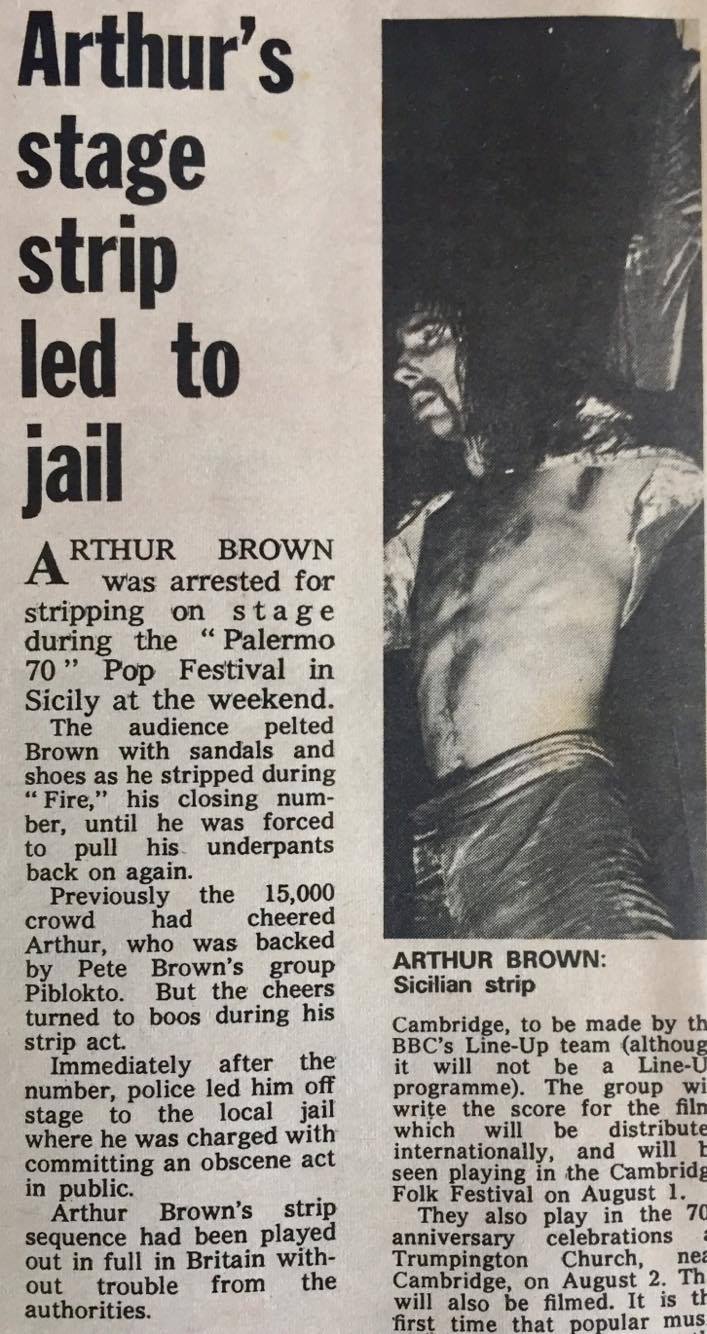
But our very favourite that psychedelic summer was 'Fire' by The Crazy World of Arthur Brown. A pretty freaky song for a 9 year old boy. It begins with Arthur bellowing "I am the God of Hell Fire!"

That was precisely why we all liked it, of course. It was slightly scary and it had this organ sound, like something out of a horror movie.

As 'Fire' entered the singles charts, The Crazy World... appeared on Top Of The Pops, so we could see that Arthur wore a crown of fire while singing and gyrating like some demented wizard.

Arthur Brown sings 'Fire' on Top Of The Pops

I hadn't started buying records at this point and in those days you couldn't just summon your favourite song out of the ether. You had to wait for BBC Radio One to play it. And if you missed it, you might have to wait several hours for them to play it again.

Thankfully, 'Fire' got a fair bit of airplay that late summer, as it captured everyone's attention when the Crazy World appeared on TOTP - Arthur with his crown of fire. The song jumped up the charts, hitting the number 1 spot (pop-pickers!) in August 1968.

Down at the local park, we decided to form a club, The Fire Appreciation Society, membership of which was confirmed by pledging allegiance to Arthur Brown - The God of Hellfire! I felt like this was proper rebellious behaviour for a young boy.

Arthur Brown in full voice was, and still is amazingly, a thing to behold. He had a terrific vocal range, with a natural deep speaking voice, but he was also capable of some blood-curdling screams. Deep Purple's singer Ian Gillan has said he was inspired by Arthur to incorporate screaming into his own style.

Here's a clip of Arthur performing the 'Fire Suite' song 'Nightmare' in a British film of 1968 called The Committee. https://www.youtube.com/watch?v=4KlQLJri-a4

And here's a live clip from the period, with a very rare sighting of original Crazy World drummer Carl Palmer, later of ELP.
https://www.youtube.com/watch?v=2bBpWW3eizY

The Crazy World of Arthur Brown, with Vincent Crane on Hammer Horror Hammond organ (Crane later formed Atomic Rooster with Carl Palmer)  - were a feature of London's psychedelic rock scene in 1967 and '68.
Review of Arthur at the Middle Earth club

They appeared with bands like The Soft Machine and The Pink Floyd at psychedelic underground clubs like UFO and Middle Earth. The band were signed to The Who's record label, Track, so would also have appeared at shows with The Who and Jimi Hendrix in this period.

Interviewed by Record Collector magazine in 2013, Arthur said, "UFO was quite short-lived. It was an old Irish club for most of the week. The psychedelic light shows that began there were run by Mark Boyle, who was an adventurer in all those oil wheel projections that you see in photographs.

"Middle Earth was a scene where poets, dancers, political extremists, hippie radicals - like Yoko Ono and her 'Bag-In' - all did their thing. It was really everybody influencing everybody else. Out of all that came a lot of the experimentation we did."

After The Crazy World came to an end, Arthur fronted the band Kingdom Come. His performance at Glastonbury in 1971 - a highlight of the film 'Glastonbury Fayre' - shows how much he put into each performance. It really is a wonderful snapshot of the period, full of long-haired hippies stoned out of their minds.

Arthur recalled, "There were only 2,000 people there. The Maharishi spoke from the first pyramid stage and taught us his spiritual path. David Bowie appeared at dawn but strangely didn't appear in the film."

The cameraman was probably asleep. Bowie told how he had been up all night smoking dope at the Worthy farmhouse in the company of Terry Reid and Linda Lewis. So getting to the stage at 5am, he would not have been in the best shape, but nonetheless he seems to have captivated those who were awake.

Audio of Bowie's Glastonbury appearance exists, in which he thanks the audience for appreciating him, at a time when he was considering giving up playing live altogether:

"I just want to say that you’ve given me more pleasure than I’ve had in a good few months of working. I don’t do gigs any more because I got so pissed off with working, and dying a death every time I worked, and it’s really nice to have somebody appreciate me for a change.”

Black and Brown


Arthur moved to America for a few years in the 1970s and, among other things, had a decorating business with Jimmy Carl Black, the drummer from The Mothers of Invention.

He described Jimmy as "a fantastic character. His favourite line was  'God-dammit Arthur, why can't I make any money in music. I never got paid and I don't suppose I ever God-damned will!"

Frank Zappa meets Arthur Brown in London
He met Frank Zappa too and described him as "a visionary who worked harder than anybody I knew, in terms of recorded music and how to present it."

Through his connection with The Who, Arthur was invited by Ken Russell to play the role of The Preacher in Russell's film of 'Tommy'.

Arthur claims that Pete Townshend actually wrote 'Tommy' with him in mind to perform it, rather than Roger Daltrey, which would have been interesting. But in any case, The Who's co-manager Kit Lambert persuaded Pete that he needed to let The Who perform it.

Arthur as The Preacher in Ken Russell's 'Tommy'
In later years, Arthur would tell how he had burned himself so many times wearing the crown of fire. You can see in the TOTP clip, how he removes it in the middle of the song. That hasn't stopped him from wearing variations of the crown of fire in performances down the years. Well he is The God of Hellfire - his audience expects nothing less!

He says, "People still like to hear 'Fire'. We did it with a string section. We did it with a ska band, with Jerry Dammers, and with Johnny Clegg and 20 piece reggae orchestra at the 40th anniversary of Glastonbury."

In this clip, Arthur tells the story of how he wrote 'Fire' - drugs were not involved apparently - and he uncovers his old fire crowns in a shed.
https://www.youtube.com/watch?v=VqeXoAk4PR4

Arthur's still doing his thing
And so, being a long-time member of the Fire Appreciation Society, I have always had a soft spot for Arthur. He's an eccentric for sure, but quite sane for all that and he has stayed true to his roots as a theatrical musical act. Except for him it's more than an act. He has pursued a lifestyle that conforms to many of the original hippy ideals of communal and sustainable living.

He's also a good storyteller and with a strong and committed spiritual side.

I met Arthur very briefly in Victoria Station about 20 years ago. He's very tall and thin, with a deep voice. I didn't get the chance to tell him about the Fire Appreciation Society, but maybe if he reads this...

Here are some examples of Arthur Brown playing live back in the day and right up to this year.

Arthur Brown's Kingdom Come - live at Glastonbury, 1971
https://www.youtube.com/watch?v=xUjo7iZPkMA

Arthur talks about the Glastonbury Festival in 1971
https://www.youtube.com/watch?v=XAbZhmSqlDg

I Put A Spell On You - Live 2009
https://www.youtube.com/watch?v=vjw_ZLF8lhg

Fire Poem, Glastonbury, 2011
https://www.youtube.com/watch?v=TSSWiMyxJps 

Arthur interviewed by Steve Jones, 2017
https://www.youtube.com/watch?v=75DT21Kb0w0

The Crazy World of Arthur Brown - live in 2019
https://www.youtube.com/watch?v=BcMb363Rp-I
The Fire suite starts about 33 minutes into the set.

Sunday, 24 July 2016

Zappa/Mothers - One Size Fits All, reviewed in Sounds 1975

Fans of Frank Zappa's early and mid 1970s albums rate 'One Size Fits All' as one of several career high points. Featuring some of the band's stage favourites from the period, including Inca Roads, Florentine Pogen and Andy, it is a consistently excellent record musically, with outstanding contributions from his core group members at the time - George Duke, Ruth Underwood, Chester Thompson and Napoleon Murphy Brock.

Here is Pete Makowski's review from the weekly UK music paper Sounds from June 1975, when the album was released. Not particularly detailed or illuminating, but it does reflect the widespread acceptance of the album, one of his most enduring recordings.

Some Zappa purists dismiss the mid-70s material (the trilogy of Overnite Sensation, Apostrophe and One Size Fits All) because it marks the closest Zappa ever came to the mainstream. But their accessibility is entirely due to the quality of the songwriting and the playing on these records.

The basic track for the opener, Inca Roads, was taken from the recording of a 'TV special' in Los Angeles, the video of which reveals just how tight and well-rehearsed the band were, as all Zappa's bands were!

The solo on the album is lifted from a show in Helsinki during the 1974 tour of Europe. This was typical of Zappa, who recorded pretty much everything and rarely let a good performance go to waste.

There's one story told by drummer John Guerin (who appears on the Hot Rats album track 'It Must be A Camel', and also on the Apostrophe' album).

Guerin didn't recall playing on the Apostrophe sessions - that's cos he didn't. Zappa had liked the drums at another recording session and simply isolated them to create a new song, which turned out to be ExcentrifugalForz.

The 74/75 band featured on One Size Fits All
Having at least two gifted vocalists in the band, Brock and Duke, allowed FZ to craft songs that were not only technically challenging for the musicians, but were also exceptionally tuneful.

The quality of the material on One Size Fits All is such that several of the tunes were a staple part of the Zappa stage show for many years. Even now, Dweezil and his band Zappa Plays Zappa, will feature songs like Florentine Pogen in their set.

Guerin told Modern Drummer magazine: "Frank was a genius in the editing room. For instance, on the Hot Rats album, we let the tape run most of the time. There was no music, he just directed different feelings, or we’d establish a groove and he’d cut it off. Then, a few months later, an album with actual songs would come out. That was the beauty of his editing.”

On One Size Fits All, the track Sofa #2 features a lyric in German, the translation for which is typically bizarre:

I am the heaven
I am the water
Ich bin der Dreck unter deinen Walzen  (I am the dirt beneath your rollers)
(Oh no, whip it on me, honey!)
Ich bin dein geheimer Schmutz (I am your secret smut)
Und verlorenes Metallgeld (And lost metal money)
(Metallgeld)
Ich bin deine Ritze (I am your cracks)
Ich bin deine Ritze und Schlitze  (I am your cracks & crannies)

I am the clouds
I am embroidered
Ich bin der Autor aller Felgen  (I am the author of all tucks)
Und Damast Paspeln  (And damask piping)
Ich bin der Chrome Dinette  (I am The Chrome Dinette)
Ich bin der Chrome Dinette  (I am The Chrome Dinette)
Ich bin Eier aller Arten  (I am eggs of all persuasions)

Ich bin alle Tage und Nachte  (I am all days and nights)

Ich bin hier  (I am here)
Und du bist mein Sofa  (And you are my sofa)
Ich bin hier  (I am here)
Und du bist mein Sofa  (And you are my sofa)
Ich bin hier  (I am here)
Und du bist mein Sofa (And you are my sofa)

Yeah, my Sofa
Yeah-ha-hey
In the absence of the complete 1974 Roxy shows on Youtube, you should seek out the DVD entitled 'A Token of His Extreme' which contains the whole show. For fans of this period Zappa it is well worthwhile.

And if you haven't seen the 'classic albums' series edition about the Overnite Sensation and Apostrophe sessions, you should definitely check that out too. Here, Dweezil shows how FZ used subtle percussion effects to provide the magic 'eyebrows'.

IF YOU LIKE MY BLOG, PLEASE HIT THE FOLLOW BUTTON ON THE SIDE PANEL
THANKS

Saturday, 22 September 2012

It's Frank Zappa Day

September 19th is officially designated as Frank Zappa Day in Baltimore, the city where Frank grew up, before his family moved to the west coast of the US and he eventually settled in Los Angeles.  Two years ago, I happened to be in Baltimore on business and as usual I checked to see what was on while I was there. The announcement of a statue unveiling grabbed my attention straight away:

"FREE Outdoor Festival and Tribute Concert Featuring DWEEZIL ZAPPA AND ZAPPA PLAYS ZAPPA.
On September 19th, the city of Baltimore will dedicate a monument to the memory and cultural impact of the legendary Frank Zappa". 

To me, Frank Zappa is a complete one-off; a man whose unique musical vision was formed by early exposure to obscure and, to most ears, impenetrable sounds at the extremes of classical and jazz - with a garnish of doo-wop.  

I'm pretty sure that from an early age he would have been seen, and seen himself, as an outsider. His family lived in a series of small towns and this sense of cultural isolation contributed to his singular vision. He remained a maverick throughout his life, which is why I think he deserves greater recognition for the enormous catalogue of music he created, even if I don't care for all of it. 

He did what he did and some of it was successful, artistically and commercially. Some of it was only successful artistically and, yes, some of it was un-PC and of questionable taste. But musically, the proof of his worth as a composer and his skills as a band leader are the sheer number of virtuoso musicians who have come through his ranks. Only Miles Davis could beat him in that regard.

Percussionist Ruth Underwood
said of Frank, "there was always more music.." He never stopped working and writing out manuscripts for the band to work on. If you are a musician and you want a fuller appreciation of Frank's oeuvre, read 'The Real Frank Zappa Book', his autobiography. In it, he details the unusual inspiration he found in the music of modern classical composers such as Varese and Stravinsky and of the primitive early recordings he made with The Mothers.

Frank also writes about how the Mothers evolved their act, via a 6-month residency at the Garrick Club in New York's Greenwich Village. The book provides the context and a greater understanding of how Frank came to create those early Mothers records - the arrangements, the little filligree passages, the tape looping, the orchestral interludes. There is so much in there.

Here is Ruth explaining the richness of her relationship with Frank:

So anyway, on that sunny Sunday afternoon in Baltimore, I grabbed a cab out to the Highlandtown suburb. My driver was a lovely Nigerian guy who played Fela Kuti and explained the stories behind each of the songs.  


Highlandtown is an ordinary featureless suburb, but for this day at least it got a spruce-up. The sidewalk bushes had been fitted with larger than life dental floss containers. Pictures of FZ were hanging from all the lamp-posts, and best of all, the main street running through the town had been renamed 'Frank Zappa Way'. 

The official bit was mercifully short. Gail Zappa, Frank's wife, made a speech reminding everyone that Frank had stated ‘if you want to get laid, go to college, but if you want an education, go to the library’. So it was fitting that his bust would be unveiled outside the community library in the place of his birth.
Gail, Ahmet, Dweezil, Diva - and Frank

Baltimore's Mayor Stephanie Rawlings-Blake made the official proclamation, then invited Gail to unveil the statue topped by a bust of FZ. Curiously, the bronze bust was donated by artists from Vilnius, the capital of Lithuania, where apparently Zappa was a beacon of freedom of expression during the Soviet occupation.
Over by the denil floss bush

The other members of the Zappa clan included daughter Diva and son Ahmet. All were openly moved by the honour and respect being shown to Frank. Then Dweezil and the band paid their own respects with a two hour set of Frank's music that ran as follows:

Stinkfoot / Florentine Pogen / Broken Hearts Are For Assholes / Easy Meat / Keep It Greasy / City Of Tiny Lights / Echidna's Arf For You / Don't Eat The Yellow Snow / Blessed Relief / Big Swifty / Apostrophe / RDNZL / I'm The Slime / Dinah Moe Humm

You want some more? Well here's some more.....The following clip starts with the unveiling of the statue and continues with highlights from the set by Zappa Plays Zappa


Spooky - Frank's ghost appears front centre