Showing posts with label melody maker. Show all posts

Tuesday, 28 January 2020

1970 - Deep Purple get heavy with 'In Rock'

This one's for my mate Clem. When we were teenagers we'd go round to his house after school, dim the lights and put on Deep Purple In Rock at full volume.

This was my education in rock drumming. While Clem flailed away at a tennis racquet, I used a pair of Clem's mother's knitting needles and beat the hell out of her sofa cushions. She still reminds me about the state I left them in.

'In Rock' was the first album proper by the second incarnation of Deep Purple. They'd had a hit single in 1968 - 'Hush'  - but no follow-up success and by 1969 Deep Purple were treading water.

Guitarist Ritchie Blackmore wanted to move more into heavy rock, which was now popular on the back of Cream's success and Led Zeppelin's early concerts. Black Sabbath were also coming through at this time and American groups like Vanilla Fudge, Iron Butterfly and Mountain were creating their own heavy rock sounds.
Getting to know you: Purple's first photo together

Blackmore and Lord, as the accepted leaders of the band, made a decision to replace original singer Rod Evans and bassist Nick Simper and bring in some new blood. When they approached singer Ian Gillan from the band Episode Six and his bandmate Roger Glover, Deep Purple Mark II was born.

But then far from releasing a heavy rock album, they came out with a live orchestral recording. It could easily have backfired on them, but in some weird way it actually raised their profile again.

Jon Lord had composed the Concerto for Group and Orchestra and the band's management probably thought this would be a good publicity stunt. A performance with the Royal Philharmonic Orchestra was arranged for 24 September 1969 at the Royal Albert Hall in London.
Two worlds collide
The rest of the band were not at all keen on the idea of playing with an orchestra. Ian Gillan said he only wrote the lyrics on the day of the concert.

For their part, the orchestra considered playing with a rock band was beneath them and put little effort into the rehearsals.

The conductor, Malcolm Arnold, scolded them for their snobbish behaviour. He is reported to have said, "You're supposed to be the finest orchestra in Britain, and you're playing like a bunch of cunts!"

Despite these problems, a recording of the show was released in December 1969 and did gain the group a higher profile, but as a classical rock group. 

Deep Purple In Rock was the perfect antidote to that. 

Blackmore was adamant that Purple needed to shake off the orchestral tag and the best way to do that was to play as loud as possible. He is said to have told the band, "If it's not dramatic or exciting, it has no place on this album".

Roger Glover remembers, "We were playing our instruments as hard as possible. Amps and speakers were being driven hard. If I had to pick one image that sums up Deep Purple In Rock, it would be the VU meters always in the red."
 
 Speed King, the first track on 'In Rock'

Everything louder than everything else


The album kicks off with Speed King and just about the heaviest opening imaginable; everyone playing as loud and as fast as they can for a minute, until the music tumbles down to just the sound of Lord's church-like organ. As that initial furious burst of energy dissipates, you can hear Blackmore's amps crackling. As a statement of intent, it couldn't have been clearer.

The centrepiece of In Rock was the track Child In Time, a climactic song featuring Lord, Ian Gillan's incredible screamed vocal and a ferocious solo from Blackmore. It became a staple of their live act. The live version on Made In Japan from 1972 shows the group absolutely on fire.
Child In Time, recorded for Granada TV in the UK

Halfway through the sessions for In Rock, Martin Birch took over as the recording engineer. "The chemistry between the band and Martin was instant," recalled Glover.

Ian Gillan also recognised Birch's affinity for the music: "Martin was the only engineer who bothered to go out into the room to hear what the band sounded like. When we called him a 'catalyst' on the record sleeve, I think that was very true." Birch became the band's mainstay producer after that.

The review of In Rock in Melody Maker, by Roy Carr, called it "magnificent" and "a stunningly good album".

Carr highlighted the band's ability as players and Gillan's powerful singing, also praising Blackmore's "masterly guitar work, which is completely in context. His sympathy with the mood of each work throughout the album is quite remarkable".

Jon Lord's "exciting work at the organ" was another highlight for Carr. In summary he said that In Rock was "a magnificent album which no enthusiast of today's music dare miss."

In the Melody Maker interview piece from August 1970 (reproduced below) Ian Gillan explained how Deep Purple rose above the other heavy groups by working on the varied dynamics.
Blackmore killed off any idea that Purple were a classical group: "It was one album, which gave us a lot of publicity....the classical thing is dead and buried as far as we are concerned." I have discovered that this interview is also the inspiration for the quote in Cameron Crowe's movie Almost Famous where the lead singer character played by Jason Lee says to a the Rolling Stone reporter "and the chicks are great".


Years later, DJ Alan 'Fluff' Freeman was deputising for Simon Bates on his BBC Radio One morning radio show. Bates had a regular daily section where you had to guess the year all the records were made. Freeman had 1970 on this day and was scheduled to play Deep Purple's hit Black Night. But instead (by mistake? I think not) he played the B-side, Speed King.

Knowing Fluff's admiration for all things heavy, I'm convinced he did it deliberately.

Meanwhile, the housewives of England will have got the shock of their lives. He didn't take it off either - played the whole thing - Not 'arf!

"Guitar-smashing Ritchie Blackmore" and the story of a
cancelled French gig, that would be echoed later in Montreux.
At this time, Blackmore was still alternating between the
 Gibson 335 and his newly acquired Fender Stratocaster.

IF YOU LIKE MY BLOG, PLEASE HIT THE FOLLOW BUTTON ON THE SIDE PANEL THANKS

ALSO ON THIS BLOG: Smoke On The Water - Montreux 50 years on

Saturday, 28 December 2019

December 1969, Led Zeppelin promise not to go soft

As 1969 came to a close, Led Zeppelin were, after the success of their second album, the band everyone expected to become massive in the new decade. However, guitarist Jimmy Page caused concern amongst the group's fans by suggesting the band would be expanding their musical horizons on future albums.

In the article featured here, Melody Maker's Chris Welch said fans should have no fear - Zeppelin will not be going soft. Little did he know.

The interview is an interesting snap-shot of the time, with Zeppelin having sold over five million albums in 1969 and being considered for a Queen's Award for their export achievements.

In the interview with Welch at the Savoy Hotel in London, John Bonham talks about buying his three year-old son Jason a miniature drumkit and why the single version of Whole Lotta Love was withdrawn in the UK.
 
Jimmy Page assured Welch that although Zeppelin were exploring more acoustic songs, "we're still a heavy group" saying it would be wrong for them to change their sound completely.

Click on the image to enlarge it
Of course, the next album, 1970's Led Zeppelin III was indeed a departure from the heavy sound of the first two albums. The angry reaction of some fans was hard for the band to take.

The faintly exotic and more reflective material on Led Zeppelin III has stood the test of time very well. It was the jumping off point for the various musical explorations that peaked with Physical Graffiti.

Tracks from LZ III like 'Friends' and 'Gallows Pole' formed the core of the Page and Plant Unplugged release in the 1990s and those same tracks are still featured in Robert Plant’s solo concerts.

But many fans wanted another Led Zep II and by 1971 and the imminent release of Led Zeppelin IV, it was clear that the new folky direction had not gone down well with some of their fans.

At the time, many fans felt let down that Led Zep III didn’t contain another Whole Lotta Love or Heartbreaker. The new material to be released on Led Zeppelin IV, and being aired on BBC sessions in April 1971, suggested there would definitely be no return to the lemon-squeezing days of yore. A letter to the Melody Maker (below) in May 1971, under the headline ‘Don’t go soft Zeppelin!’ sums up the mood:

“Zep sound great on Whole Lotta Love and their many earlier songs, but please leave the gentle songs to people like The Strawbs, who have grown up with their music and can do it justice. It’s obvious from Zeppelin’s performance on the radio last week, that they just don’t make it without the volume.”

The BBC session to which J. Miller from Chester was referring contains this lovely coupling of Going To Cailfornia and That's The Way. Judge for yourself whether Led Zeppelin were out of their depth.

Other letters in MM’s May 1971mail bag included a fan of King Crimson suggesting since their reformation (after the break up of the Court of the Crimson King band)  “there seems to be no hope for any other group”.  No other musicians could compare, apparently. Robert Fripp would probably have agreed. 

And Roger B Bartley of London E12 describes Stevie Wonder as an “abominable popcorn merchant”. Wow, so he’s just produced Music of My Mind and was about to release Talking Book,  Innervisions and Fullfillingness’ First Finale. Mr Bartley, you jest.
 
IF YOU LIKE MY BLOG, PLEASE HIT THE FOLLOW BUTTON ON THE SIDE PANEL THANKS

Tuesday, 17 December 2019

Jimi Hendrix and some Christmas gift suggestions

HO HO HO!!! HERE'S MY GROOVY NEW LP, JUST IN TIME FOR CHRISTMAS.

Yes, it's December 1967 and Jimi's playing Santa Claus, bringing you seasonal joy with his new waxing Axis: Bold As Love.

The second of his three classic studio albums, 'Axis' combines some of Jimi's most psychedelic guitar experiments with his most sensitive songwriting. Tracks like Little Wing (truly one of his greatest songs) and Castles Made of Sand showed Jimi was so much more than the wild man of Borneo he was portrayed as by the media back then.

The recording was done mostly in London at Olympic Studios. Despite the ground-breaking guitar effects and stereo panning featured on tracks such as If 6 Was 9 and Bold As Love, the album could potentially have sounded even better if Jimi had not left a master tape of side one in a London taxi. The lost tape had to be remastered in one overnight session and Jimi always felt the rushed nature of it compromised the record. But to these ears it still sounds amazing, especially considering the limitations of using 4 track recorders.
Fast forward to December 1969 and Phillips/Fontana were trying to convince us to buy these goodies right away, because if we waited until Christmas eve they'd be sold out. Now let's be honest, Santa would not have been delivering many copies of any of these records. Scott 4 is beloved of wise-after-the-event hipsters, but it was his worst selling of the four 'Scott' albums.

The 'David Bowie' album, renamed Space Oddity in 1972 after his second coming with Ziggy Stardust, was another flop in 1969.

And Flaming Youth are only remembered now because their drummer was Phil Collins - that's him at the bottom of the diamond on the cover.
Of the four featured albums, Greek diva Nana Mouskouri was probably the best seller at the time; popular with the mums and dads, don't you know.

And of the others, well Blue Mink were having hits and Melting Pot is one of their best, so that would have probably been the best seller of the lot.

Elsewhere in this pre-Christmas 1969 edition of UK music paper Melody Maker, CBS would have had a bit more luck promoting the new album from Janis Joplin, I Got Dem Ol' Kozmic Blues Again Mama!

With a new more soulful sound, a shift away from the psychedelic rock of Big Brother & The Holding Company, Janis was ready to rip up the joint as she did at Woodstock that summer. The new album should have done better sales-wise but a lot of fans were put off by the change of direction. Judged on its own merits, the record has some strong songs, including Try (Just A Little Bit Harder) and To Love Somebody. Check out those links, seriously. It's probably my favourite of her albums.

Island Records were also advertising in this edition of Melody Maker in December 1969. One or two of these albums, notably Fairport's Liege & Leif, Jethro Tull's Stand Up and In The Court of the Crimson King, had already been on the charts. Others, such as Quintessence, Mott and poor old Nick Drake would see little Yuletide activity.


Sunday, 17 February 2019

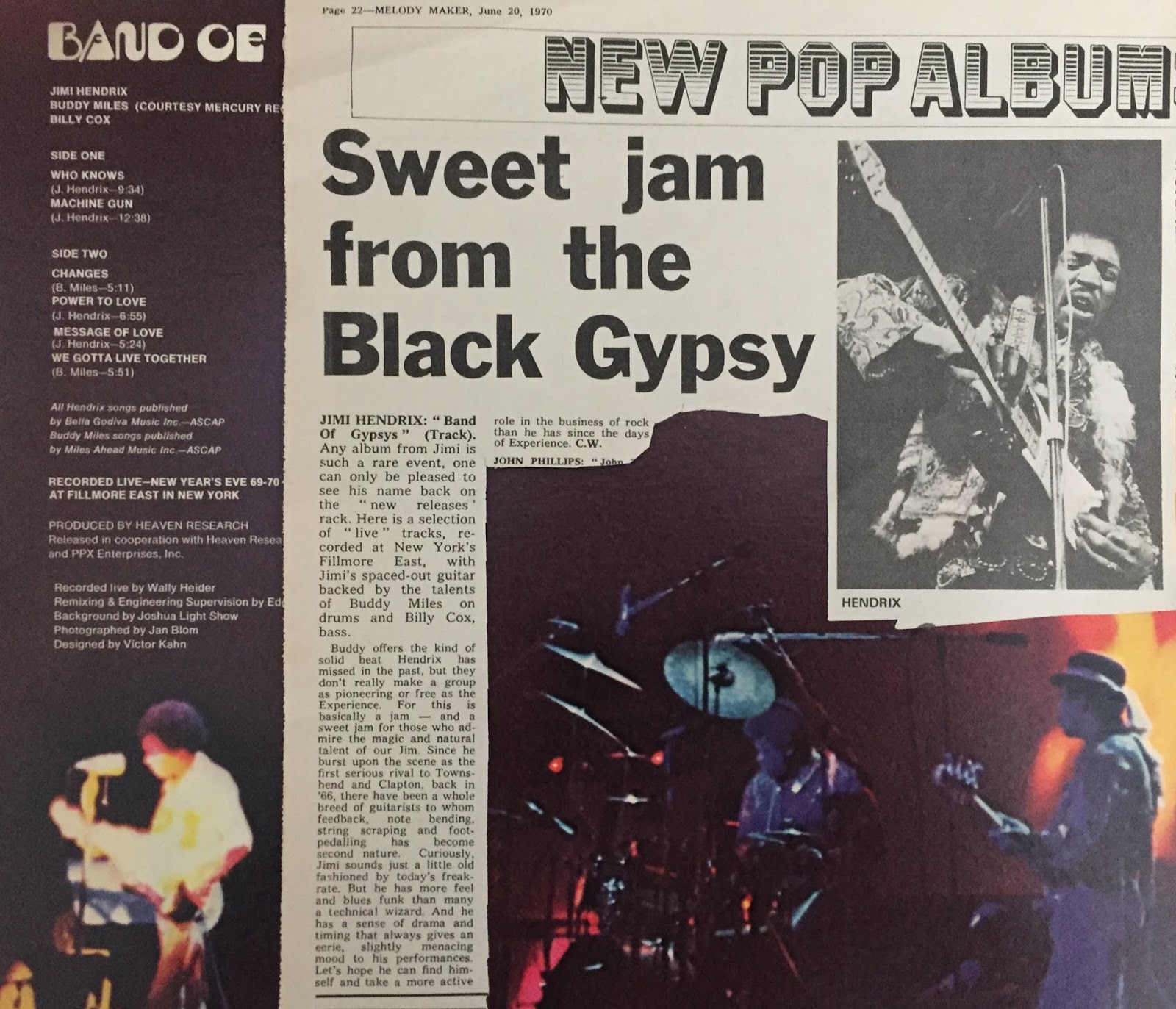
June 1970 - Hendrix's 'Band of Gypsys' album reviewed by Melody Maker

Rockin' The Fillmore
The final album released by Jimi Hendrix in his lifetime was the live record 'Band of Gypsys'. Recorded on New Year's Eve 1969/70 at the Fillmore East in New York, the record showcased new material reflecting a more mature and soulful Hendrix, backed by his old army friend Billy Cox on bass and Buddy Miles on drums and vocals.

Jimi had lost a bit of momentum after the release of his masterpiece album Electric Ladyland in 1968. With manager Chas Chandler and bassist Noel Redding both departing during the EL sessions, which they saw as indulgent and directionless, Hendrix put a random bunch of musicians together for his performance at Woodstock in August 1969. They were loosely billed as "Gypsy Sun and Rainbows" and Hendrix referred to them as “just a band of gypsies”.

Dec 1969 - click on the image to expand it
In this interview with Melody Maker in December 1969, Jimi talks about wanting to get the Experience back together and waiting on Noel and drummer Mitch Mitchell to agree.

In the meantime, he mentioned he was working on a recording for the Band of Gypsies project with Buddy Miles on drums and Billy Cox on bass.

Cox had played in a band with Jimi when they were both in the US army and he joined Hendrix for his performance at Woodstock in August 1969.

Buddy Miles had played on the Electric Ladyland two-part track Rainy Day, Dream Away and Still Raining, Still Dreaming and the Band of Gypsies material reflected this slightly more funky approach, though with less of the humour and lightness evident on EL. 
 
Hendrix’s business affairs were complicated by the fact he was contracted to provide an album to a former manager, Ed Chalpin and his company PPX Enterprises. With Cox and Miles now in tow, Hendrix was encouraged by his manager Mike Jeffrey to work on material that could be used to settle the contract with Chalpin. 

The Band of Gypsys - Hendrix, Miles and Cox

Bill Graham booked Hendrix to appear at the Fillmore over New Year’s and plans were made to record the shows. The recordings were not perfect. Hendrix had problems with mild feedback and he admitted he was out of tune on some numbers. Nonetheless, his playing is still remarkable and the album's standout track, Machine Gun, bears all the hallmarks of his iconic performance of the Star-Spangled Banner at Woodstock. 
Band of brothers

Hendrix dedicated Machine Gun "to all the soldiers that are fighting in Chicago and Milwaukee and New York, oh yes, and all the soldiers fighting in Vietnam". The combination of his wailing and swooping guitar and Miles' rat-a-tat-tat drums give the track a haunting power that few other rock artists could get close to at that time. 

But during the two-night run at the Fillmore Jimi couldn't resist showing off and Bill Graham had harsh worlds for him after the first set on the second night.
 
When Hendrix asked him during the intermission what he thought, Graham said, "You're Jimi Hendrix and anything you do is taken as gospel because of who you are. You humped the guitar, you played it with your teeth; you stuck it behind your back. You just forgot to play."

Stunned, Jimi went back on stage for the second show and really played. The incandescent version of Machine Gun on Band of Gypsys was recorded at that show. 

Hendrix went up to Graham when he came off stage and said, "Alright motherfucker? That good enough for you?" 

He wheeled around to the stage for the encore and did, in Graham's words, "fifteen minutes of the greatest shtick you'd ever want to see." grinding up against his Strat and all his old showboating tricks. 

"At one point he looked to the side of the stage and stuck his tongue out at me," said Graham. "It was very, very funny."

UK ad in June '70
The contractual obligation nature of Band of Gypsys cast an unhappy shade over the whole episode though, despite the album being well-received on release in March 1970 (in the US). It became his best-selling album since his debut ‘Are You Experienced’.

An ongoing dispute between Chalpin and Hendrix’s management meant that the album wasn’t released in the UK for another three months.

Plans were made to take it on the road, but it didn’t last long. A concert at Madison Square Garden on January 28 1970, ended prematurely after just two numbers. 

Just 'Hendrix' - contractual obligation honoured
Observers at the show, including other performers such as Johnny Winter, commented on how down and detached Hendrix appeared. There were a lot of rumours about the effect drugs were having on him.

There were also tensions between Hendrix and Buddy Miles, with the latter reluctant to play second fiddle. Whatever the truth, the band dissolved right then and Hendrix was encouraged to reconvene the Experience, with Cox on bass replacing Noel Redding. 

What we have left is a reminder that on his day, Jimi Hendrix was still way ahead of everyone else in terms of imagination on the guitar. That he couldn’t sustain the high quality he established from 1967 and '68 onwards is perhaps not surprising.


In his album review, Melody Maker's reviewer Chris Welch noted that Hendrix's playing is at times restrained and even "old-fashioned". But he still has "a sense of drama that gives an eerie slightly menacing mood to his performance".

Below is a clip containing interviews and footage of the band playing "Who Knows", the first track of the album. The music is quite different from the Experience and funkier, for sure. But I don't buy the narrative that the Band of Gypsys documentary is putting across, saying this was the real Jimi because he was playing with black guys. If the black community got off on it more than the Experience albums, that's understandable. Producer Eddie Kramer has it right though - the albums are just different and that reflects the breadth of Jimi's abilities and his musical vision. He could have gone anywhere musically, he was that talented.

Here's a non-album version of Power of Soul, from the first show at the Fillmore.
and this film has recently surfaced of the new year's celebration and extracts from the first show at the Fillmore.
The gatefold inside cover of the original north American release of Band of Gypsys

IF YOU LIKE MY BLOG, PLEASE HIT THE FOLLOW BUTTON ON THE SIDE PANEL THANKS

See also on this blog:

Jimi Hendrix wows Monterey 1967