Showing posts with label sgt pepper. Show all posts

Monday, 18 January 2021

LIFE reports on 'The New Far-out Beatles' - July 1967

I recently acquired a stack of LIFE magazines from the 1960s. They are a fascinating window on the world as seen by reporters and photo journalists of the time. 

The stories range from graphic coverage of the Vietnam war to sumptuous colour spreads of Sophia Loren and husband Carlo Ponti at their palatial home in Italy. There are special reports on The Warren Commission's findings on the assassination of President Kennedy and a study of the reasons for Marilyn Monroe's suicide. 

Amongst the stories about life in Britain in the 1960s is a piece from July 1967 about The Beatles' new psychedelic look and sound. The cover announces 'The New Far-out Beatles' and the introduction says, "They're grown men now and creating extraordinary musical sounds."

Click to enlarge
The writer, Thomas Thompson, notes that the group has moved such a long way from the music that made them popular, they risk alienating their fans: "They are stepping far ahead of their audience,' but the possibility of losing support "does not bother them in the least."

One evening, at EMI studios on Abbey Road in London's St. John's Wood, Paul and John are explaining a new song to producer George Martin. They have written it that day and want to get it down on tape. The melody is to be called 'Lucy In The Sky With Diamonds'.

"They go through it half a dozen times while Martin nods, quickly familiarising himself with the composition and making notes. I begin to understand the remarkable process of the Beatle music. It begins absolutely from scratch. The Beatles, who can neither write nor read music, are composing even as they record."

The writer profiles the four Beatles with descriptions that fit the popular characterisations. George, while not actually called The Quiet One, is described as the least social of the four, with a particular interest in Eastern spiritualism. Ringo is seen as the "least complex" member and the one with the least musical input.

"Of the four, 26 year old John's life is probably the most complicated. An awesome world of literature, art, philosophy and thought has opened up to him. He reads copiously - everything from Bertrand Russell to Paul Tillich to Allen Ginsberg, and he writes poetry that only he can understand." 

John was fond of creating poems inspired by the nonsense verse of Edward Lear. My brother and I received a Beatles Fan Club flexi-disc for Christmas in 1968. It contains examples of Lennon's nonsense verse. I can still recite them today.

"Paul, 24, the unmarried Beatle, is also the only one who lives in London. He is swept up in London's so-called swinging world, goes to dinner parties and discotheques, and talks about art and football. He is very much aware of the world's troubles and has his own ideas of what it will take to straighten everything out.

"If the politicians would take LSD, there wouldn't be any more war, or poverty or famine."

The album that resulted from these recording sessions, Sgt. Pepper's Lonely Hearts Club Band, had been released the previous month, June 1967 and was immediately hailed as a new creative peak, not just for The Beatles, but pop music in general.

Its influence on the generation of musicians that came through in the 60s was immeasurable. That is why many people still consider it to be their best album. Not only for the songs themselves, but for the unique and groundbreaking way they were recorded.

Pink Floyd's Roger Waters said, "Sgt. Pepper freed a whole generation of young English men and women, given permission to write songs about real things, and having the courage to accept your feelings."

George Martin's view of their creative genius was that "they're always coming up with something new they've just learned; something I wouldn't dream of. They never cease to amaze me."

IF YOU LIKE MY BLOG, PLEASE HIT THE FOLLOW BUTTON ON THE SIDE PANEL THANKS

Elsewhere on this blog:

My Visit To Abbey Road Studios

The Beatles Escape The Madness to Create Revolver

Sgt. Pepper Is The Beatles - Who Knew?

At Home With the Lennons, 1967

A Night With John Lennon - The Fab Faux at Radio City Music Hall

2-Tone and possibly my best gig ever

Queen's 1976 Free Concert in Hyde Park

Memories of the Reading Festival, 1975

Five Days of High Drama at the Isle of Wight, 1970

From Pinner to LA - Elton's Big Breakthrough, 1970

My Woodstock 50th Anniversary Diary

A Wizard, A True Star - my all-time favourite album

Blonde On Blonde - Bob Dylan's Artistic Peak in the 1960s

 Joni Mitchell - The Hissing of Summer Lawns


Saturday, 9 November 2019

March 1978 - The Rutles Are Coming!

A postcard dropped on the doormat in March 1978, sent from the press office at Warner Brothers (WEA actually) where a mate of mine worked.

The postcard was heralding the television premiere on Easter Monday of All You Need Is Cash, the story of legendary British beat group The Rutles.
The Prefab Four
Note the postmark advert for Elvis Costello's second album
The Prefab Four, as they were known, were the brainchild of Monty Python's Eric Idle, with songs (not entirely) originally composed by Neil Innes of the Bonzo Dog Doo-Dah Band, who had collaborated on music for the Monty Python movies. His contribution to Holy Grail, for example, included the famous Tale of Sir Robin.

The Rutles' career arc was oddly familiar - from early days in Northwest England, to worldwide fame - Rutlemania! - the expansion of their musical horizon after consumption of exotic teas - and the embracing of eastern religion.

The TV special, shown at Easter time on BBC2 and on American TV the same week, included 
appearances by George Harrison, Mick and Bianca Jagger, Paul Simon, Dan Aykroyd, John Belushi, Bill Murray and Gilda Radner. The Saturday Night Live actors had become fans of the Rutles when Idle and Innes appeared on SNL in 1977.

For All You Need Is Cash, The Rutles characters, apart from Idle, were played by real-life musicians. 

Innes played singer and guitarist Ron Nasty, Idle was singer and bass player Dirk McQuickly.  

Ricky Fataar (a drummer in real life with the Beach Boys) played guitarist Stig O'Hara. 

John Halsey (drummer in the band Patto, whose sessions include Lou Reed's Transformer album) played drummer Barrington Womble, otherwise known as Barry Wom.

Guitarist Ollie Halsall, also from the band Patto, who was one of the studio musicians on the Rutles recording sessions, appears in the Rutles film as Leppo, the fifth Rutle "a friend of Nasty's from art college, who mainly used to stand at the back".

The Prefab Four became the most popular group in the whole world, loved for their cheeky banter as much as for their music.
 Here's the original trailer for The Rutles: All You Need Is Cash

Of course, The Rutles were a very closely observed pastiche of The Beatles. All You Need Is Cash is narrated by an earnest Alan Whicker-type documentary presenter and highlights the key moments of their career in the 1960s, familiar to anyone with a reasonable knowledge of The Fabs and with helpful commentary from Jagger and others:


Jagger
: Why did the Rutles break up? Women. Just women. Getting in the way. Cherchez la femme, you know.

Narrator: Do you think they'll ever get back together again?
Jagger: I hope not.

The show features some wicked caricatures of Rutle associates, such as Gwen Taylor in a Nazi costume playing the Yoko-like Chastity.

While the Rutles film now looks rather quaint and of its time, the music composed by Neil Innes still has universal appeal, because it is so fiendishly close to the source material. 

The Rutles - Ouch!
The Rutles - With A Girl Like You
The Rutles - Get Up And Go

Too close for some: While George Harrison was happy to provide some funding for the project and to appear in the film, Paul and John didn't see the funny side of having their music pastiched in this way.

The initial reaction to All You Need Is Cash from UK audiences was appreciative without being ecstatic. The Prefab Four's legend grew, though, with repeat TV showings. Perhaps it was a case, as had happened with The Beatles, that people needed to be told that this was actually a spoof.

And so, in May 1978, I received another postcard from WEA. The BBC were giving The Rutles another go, with a showing on BBC 1 at 10:15pm on May 27th.

The postcard featured the covers of various Rutles albums, With The Rutles, Tragical History Tour, Sgt. Rutters Only Darts Club Band and Let It Rot.

On the back of the postcard was a sample of "genuine Rutle trouser fabric", authenticated by the former Rutles manager, Leggy Mountbatten, now living in Australia.
Genuine Rutle trouser fabric

Archie Macaw, Record Producer: Well, one day this rather odd chap hopped into the office. He'd been to see virtually everyone in the business and been shown the door. He asked to see MY door, but I wouldn't show it to him. Instead, he showed me the photographs and tapes of the Rutles. They were pretty rough, but they had something.

Narrator: What was it?

Macaw: I think it was the trousers.
 
Following the release of The Rutles album in the 1978, ATV Music, the then-owner of the Beatles publishing rights, sued Innes for copyright infringement. Innes was always on a sticky wicket legally because The Rutles were unmistakeably a Beatles rip-off, however affectionate.

Lennon and McCartney both felt that, at least with some of the songs such as Get Up And Go, that Innes had sailed too close to the originals. He was forced to settle out of court for 50% of the royalties on the 14 songs included on the Rutles album.

In 2019 Neil Innes was still playing The Rutles' music live, but he died suddenly on 30th December. He is fondly remembered on social media for his work with The Bonzos on TV shows like Do Not Adjust Your Set and Rutland Weekend Television - even The Old Grey Whistle Test.  
Proof that his legend will live long after other living legends have died.

Neil Innes talks about Rutland Weekend Television and the genesis of The Rutles
https://www.youtube.com/watch?v=hxxyG9jJhm0

Ron Nasty and Barry Wom with The Rutles live in London, 2013
https://www.youtube.com/watch?v=EoOwx3j4b_I

IF YOU LIKE MY BLOG, PLEASE HIT THE FOLLOW BUTTON ON THE SIDE PANEL THANKS

See also on this site:

My Visit To Abbey Road Studios

The Beatles escape the madness of the road to create Revolver

Sgt. Pepper Is The Beatles - Who Knew?

At Home With The Lennons, 1967

A Night With John Lennon - The Fab Faux at Radio City Music Hall

Thursday, 25 May 2017

Sgt. Pepper is The Beatles... who knew?

50 years ago, in June 1967, the Beatles released a 'concept album' - before that term was ever used - but that's what it was.  

Sgt. Pepper's Lonely Hearts Club Band was a way of distancing themselves from Beatlemania. This advert, on the front page of the NME, suggests EMI were worried they might have gone too far.

As history shows, Sgt. Pepper was Paul McCartney's idea that the Beatles present themselves as some kind of vaudeville act, as a means of releasing new material that would reflect a broader range of their songwriting skills.

The first release of this new era was the double A-side single of Strawberry Fields Forever and Penny Lane, which was previewed on TV's Juke Box Jury in February 1967.

I can remember seeing the show and, on first listen, being rather baffled by Strawberry Fields Forever. I was only a youngster and, like many people I'm sure, assumed The Beatles would carry on making records we could all hum the tune to.

Strawberry Fields
really was unlike anything they - or anyone - had done before, inspired, fairly obviously, by their discovery of LSD. Fans of the Beatles' simple pop tunes would have been writing letters to the editor that very evening - "Beatles go mad!"; "Less of this druggy nonsense lads!"

The Beatles at the Sgt. Pepper launch party

I remember they showed the Penny Lane promo film but I have no recollection of the one for Strawberry Fields. Maybe they didn't show it or maybe it was just too much for a young boy to process. 

The surreal promo The Beatles made to accompany it (see below) shows them all clearly off their heads. It's fair to say that people sitting in their living rooms at tea-time on a Saturday evening were not ready for this.

Penny Lane would have been voted a HIT by the jury, and though I don't remember, it's hard to imagine Strawberry Fields Forever getting the thumbs-up. 

The Beatles had anticipated a hostile reception from many of their fans. While Sgt. Pepper turned out to be massively influential to other musicians and artists, as an extension of the art revolution of the 1960s, traditionalists hated it. 

If you'd idolised the Beatles for She Loves You or Yesterday, this new direction would have been too much. Think of the initial negative reaction some Radiohead fans had to Kid A, or how difficult it was to appreciate the avant garde sounds of Scott Walker, compared to his baroque pop classics of the late 60s. Too much for some. 

As time went on and people came to realise the Beatles had made a radical and historically influential musical shift, the initial 'shock of the new' created by Strawberry Fields Forever wore off. Nowadays, it is hard for people to appreciate just how pivotal a cultural event this moment was.

Penny Lane was a different matter of course, being a much more traditional song with a strong melody and a jaunty piano-led rhythm. Classic Paul.

Recording sessions for the album concluded in April 1967 and release was planned for June. Anticipation was intense for any new Beatles album, particularly since they had stopped playing live in 1966. Sgt. Pepper's Lonely Hearts Club Band was unveiled at a media launch hosted by their manager Brian Epstein at his London flat. It hit record stores on 1 June. 

It was the Summer of Love, peace, hippies and LSD - so not surprisingly, when the band were attending the cover shoot for the album, two of them, John and George, were literally flying.

Don't be fooled, it's really them

Was anybody really fooled by this masquerade of The Beatles pretending to be someone else?

Well, to judge from EMI's advertising, they must have been worried that people were confused about the band's identity. Otherwise they wouldn't have felt the need to remind people who was behind the album.

"Remember - Sgt. Pepper's Lonely Hearts Club Band is The Beatles"

Oh thanks, I was wondering who it was...

The initial shock, when the most famous band in the world transformed from lovable moptops to psychedelic freaks, has been lost sight of over the intervening years.

That's why, I think, Sgt. Pepper is no longer considered by some as The Beatles' masterpiece. People have forgotten what a dramatic effect it had on popular culture, not just music. 

Pink Floyd's Roger Waters said, "Sgt. Pepper freed a whole generation of young English men and women to write songs about real things."

My vintage 1967 mono copy of Sgt. Pepper, with insert cut-outs and inner sleeve

And consider this: When Sgt Pepper was released on 1st June 1967 (their 8th album) Paul McCartney and George Harrison were still only 24 years old.

For the back story to the making of Sgt Pepper, you could do worse than visit this page:
http://www.thebeatles.com/album/sgt-peppers-lonely-hearts-club-band

And of course, this week sees release of the 50th anniversary edition of Sgt. Pepper's Lonely Hearts Club Band. We hope you will enjoy the show...

Elsewhere on this blog:

My Visit To Abbey Road Studios

How Sgt Pepper disappeared from those lists of classic albums

LIFE magazine reports on 'The New Far-out Beatles', 1967

The Beatles escape the madness of the road to create Revolver

At Home With the Lennons, 1967

A Night With John Lennon - The Fab Faux at Radio City Music Hall

Sunday, 31 August 2014

At home with the Lennons, 1967


Another picture of domesticity, but one that was to come to an end soon afterwards. It is the Spring of 1967 and John Lennon is putting his feet up at the family home he shared with first wife Cynthia and their son Julian in Weybridge, Surrey.  

Surrounded by the traditional framed pictures and ornaments are the tell-tale signs of someone who has turned on to a new way of life, but has not quite let go of the old one. He's reading a copy of the counter-culture newspaper International Times and the cabinets are festooned with promotional stickers for Captain Beefheart's new album.

John's mind was clearly miles away from here. But while Paul McCartney was living in the heart of London, close to Abbey Road studios, John was cut off from all that and was going through what Cynthia described as his 'neurotic phase'. 

She said, "He didn't know where his life was going and he was fed up with being a Beatle. He'd spend a lot of his time in bed with a notepad. When he woke up he'd write a few words down and then maybe go over to the piano. He was basically dropping out. Everything he was doing outside the home was pretty high-powered."

As Derek Taylor attested, John also seemed to spend a lot of time taking acid, even once remarking one morning, as he was driving Taylor in his psychedelic Rolls Royce, that he had it for breakfast. 

1967 marked a real turning point for The Beatles. Having unveiled their crowning achievement as a band, Sgt Pepper, in June, they had shed the final layers of their moptop image and were in full experimental mode musically. 

Though they were forced to keep the whole Beatle gravy train on the rails, they had become disillusioned with it all. They had stopped touring, so it was only in the studio where they were still in any sense a band. 

As it was, they "battled on against overwhelming oddities" through 1967 and 68 with Magical Mystery Tour and the White Album. John's pursuit of something to make sense of his life brought about his fateful meeting with Yoko, the encounter that would lead him to, as he said, "break up a happily married state of boredom".

with son Julian, 1967

As Philip Norman writes in his biography of Lennon: "All four Beatles, kaftaned and beaded, sat at the yogi's feet to listen to his Buddhist wisdom. This was mysticism in an easily digested, tabloid form, instantly appealing to young earthly gods for whom real self-denial was unthinkable. 

"His route to spiritual regeneration involved no special training, no memorising of complex prayers or incantations, and next to no personal inconvenience. It was bliss without the effort. "

John wanted to take Yoko, but since the pilgrimage included wives, he had no choice but to take Cynthia. They stayed in a village on the banks of the River Ganges (Rishikesh) looking towards the snow-flecked Himalayas, though their living conditions were far from spartan. Their bungalows had hot water and western plumbing, and a handful of two-rupee notes bought extra home comforts, from chocolate bars to booze and hash. 

For all the Beatles, it was an enforced slowdown from the lunatic pace that had not let up for seven years, since they left Liverpool for Hamburg and their careers suddenly took off. Day after day, there was nothing to do but sit and think.

"John seemed happy, strumming guitars with Paul and George in the balmy sunshine and even holding hands with Cynthia. She was convinced their difficult marriage was entering a new phase of companionship and mutual tolerance. What she didn't know was that John was all the time receiving postcards from Yoko, which his minders had strict orders to forward to him in plain brown envelopes so she would suspect nothing. Often they consisted of a single thought, in Yoko's tiny, arty script: 'Watch for me - I'm a cloud in the sky."

IF YOU LIKE MY BLOG, PLEASE HIT THE FOLLOW BUTTON ON THE SIDE PANEL
THANKS

Also on the blog:

The Beatles retreat from the madness of the road to create Revolver

My Visit To Abbey Road Studios

Thursday, 14 June 2012

Jimi Hendrix - Sunday Night at the Saville, 1967

Brian Epstein outside The Saville
‘Sunday Night at the Saville’ was a popular date on the rock calendar in 1967. Brian Epstein, The Beatles manager, had leased the Saville Theatre on Shaftesbury Avenue in London’s West End, to put on plays and pop concerts. 
 
It was at these Sunday Night shows that Jimi Hendrix first came to the attention of a wider audience. His first single, Hey Joe  was in the charts and the band were playing at various club venues in the south of England.

The Saville Theatre's classical three-tiered design and 1500 seat capacity offered a unique showcase for rock acts in such a central location. The Jimi Hendrix Experience played at the Saville a number of times in 1967.

A while back, a friend of mine casually mentioned he had seen The Who and Jimi Hendrix on the same bill in 1967, and that he still had the programme for 'Sunday at the Saville' on January 29th 1967. This was the debut appearance by the Jimi Hendrix Experience. It's a fascinating document of the time.
Front and back cover of the Saville Theatre programme for January 29th, 1967
The cover was designed by the Dutch artists Simon Posthuma and Marijke Koger and their collective known as ‘The Fool’ – famous for painting the Beatles Apple store on Baker Street and for the inner record sleeve  design of Sgt. Pepper.
Inside, the psychedelic design reads, “Brian Epstein Presents This Sunday At The Saville…” The opening act was The Koobas, then the Jimi Hendrix Experience followed by an intermission and then The Who.

A few months later, at Monterey, Pete Townshend would win a famous argument about not wanting to follow Jimi on stage because his act was so explosive. But at this stage in January ’67, four months before the release of Are You Experienced, Hendrix was still developing his act. 
 
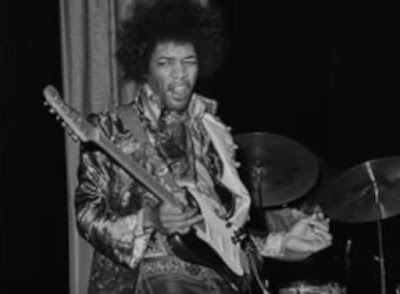
The flamboyant stage costumes were not apparent at this point but Jimi was already showboating and playing the guitar with his teeth.

The Saville Theatre program says of the Experience: “A couple of months ago the name of Jimmy Hendrix was unknown, and now his first release ‘Hey Joe’ has made the Jimi Hendrix Experience a household word. 
 
The JHE "rejected coloured group smoothness"
"Hendrix, with bass guitarist Noel Redding and drummer Mitch Mitchell, have rejected the traditional coloured group smoothness and plumped for an incredible gyrating dynamism that is both exciting and extraordinary. With fine lyrics, talented and professional musicians, a fresh original approach, and with you the audience, one lives the Jimi Hendrix Experience.”  
 
The language certainly belongs to another age (oddly referring to the JHE as a 'coloured group').  The "incredible gyrating dynamism" is fairly appropriate though.

The Beatles themselves attended various 'Sunday Night at the Saville' concerts, including this first performance by the JHE. 

Two days later, Jimi and the band returned to the Saville to record a promo video for Hey Joe (see the clip below). They played another Sunday night show at the Saville on 4th February and did two shows there on the 7th May.

Hendrix at the Saville, June 1967
Then on 4th June 1967, The Experience played their last show at the Saville - supported by The Move and Procol Harum - before Jimi’s triumphant return to the US for the Monterey Pop Festival.

At that Saville show in June, Jimi began the set with a performance of Sgt. Pepper’s Lonely Hearts Club Band. The Beatles album had only just been released a few days earlier, which shows what a huge influence the Beatles were on other musicians at the time. 
 
1967 was an amazing year for music - a unique moment, never to be repeated, with such a concentration of talent and ground-breaking records being released almost every week. Hard to imagine now, but for all four Beatles to show up to see you play, you just know that Hendrix was the guy everyone on 'the scene' wanted to see at that point. 
Jimi Hendrix with The Who backstage at 'Sunday Night At The Saville' in January 1967. Jimi is holding Pete Townshend's Rickenbacker guitar.
Here's Jimi, returning in triumph to America in June 1967
 
IF YOU LIKE MY BLOG, PLEASE HIT THE FOLLOW BUTTON ON THE SIDE PANEL
THANKS

Sunday, 27 May 2012

Sgt. Pepper is The Beatles - who knew?


50 years ago, in June 1967, the Beatles released a concept album, before that term was ever used, of course, but that's what it was. Sgt. Pepper's Lonely Hearts Club Band was their way of distancing themselves from Beatlemania.

As history shows, it was Paul McCartney's idea that the Beatles present themselves as some kind of vaudeville act, as a means of releasing new material that was, clearly, very different from what fans had come to expect.

But was anybody really fooled by this masquerade?  Well, to judge from EMI's advertising, they must have been worried that people were confused about the band's identity. Otherwise they wouldn't have felt the need to remind people who was behind Sgt. Pepper.

"Remember - SPLHCB is The Beatles"

oh thanks, I was wondering who it was...

And consider this: When Sgt Pepper was released on 1st June 1967 (their 8th album) Paul McCartney and George Harrison were still only 24 years old.

Also on this blog:

My Visit To Abbey Road Studios

The Beatles retreat from the madness of the road to create Revolver

How Sgt Pepper disappeared from those lists of classic albums