Showing posts with label joni mitchell. Show all posts

Thursday, 9 February 2023

Joni Mitchell's Dog Eat Dog and a chance meeting with Thomas Dolby

In August 1985, I had a chance meeting in Greece with electronic music pioneer Thomas Dolby. This was just after he'd co-produced Joni Mitchell's album Dog Eat Dog. The album hadn't yet been released and I got a preview of it while we both waited for a flight out of Athens airport.  

I've recently reacquainted with the album - much played by me back in the 1980s, but largely ignored since. I think there are two reasons for our estrangement.

Like many records produced in that decade, its use of electronic drums and all manner of digital keyboards gives it a shiny but rather impersonal feel.  

Also, because of Joni's preoccupations of the time, the album carries with it an unwelcome air of despondency. Which is a shame, because behind all that is some great music and writing. 

Dog Eat Dog marked a change of direction for Joni Mitchell in that, for the first time, she worked with a producer. Previously her engineer Henry Lewy served as producer in all but name; there to make it as easy as possible for Joni to get her musical ideas across. It was a partnership that yielded her entire catalogue of classics in the 1970s. 

Thomas Dolby at the controls
By the mid-1980s, with electronic instruments dominating the sonic landscape, Joni and husband/bassist Larry Klein were keen to explore new sounds. Klein in particular was keen to understand the possibilities of the Fairlight CMI digital synthesiser, which by the mid-1980s had become fairly commonplace on albums from ABC to Yes.

British musician Thomas Dolby, considered one of the key exponents of electronic music at the time, was brought in to work as a co-producer. Apart from his own solo work, his most recent success was as producer of Prefab Sprout's debut album, Steve McQueen, of which Dolby was particularly proud, he told me when we met.

Our encounter began at the Greek shipping port of Piraeus. We were both waiting around for the bus to Athens airport. We got talking and since I knew that he had recently played as part of David Bowie's band at Live Aid, we chatted about that.

Dolby and Bowie during Live Aid

Bowie had promised Bob Geldof he would play at Live Aid, but he hadn't toured for a while and didn't have a band. Dolby was asked to gather a bunch of musicians who could rehearse at short notice. He drafted in guitarist Kevin Armstrong and drummer Neil Conti, Matthew Seligman on bass, Pedro Ortiz on percussion, Clare Hurst on saxophone, with Tessa Niles and Helena Springs on backing vocals.

As Dolby said, the fact that Bowie was willing to take a chance with a young band with very little rehearsal was a ballsy move on his part. And he rose to the occasion brilliantly, leading the line and catching the mood of that amazing day perfectly.

We arrived at Athens airport and were sitting on the floor leaning against a wall. Lengthy delays for flights out of Greece were par for the course in those days and the airport was packed. Dolby told me he had just produced an album with Joni Mitchell - and would I like to hear it? So I slipped the tape into my Walkman and gave him a tape of mine - Miles's Kind Of Blue and Sketches of Spain

Joni's record was instantly recognisable as Dolby's sound and far removed from her previous albums. The first track Good Friends was straightforward enough, probably designed as a single, with backing vocals from Michael McDonald. It was on the second track, Fiction, where things got real. 

Joni had never shied away from straight talking in her music, especially about relationships, but by this time she had become downright angry at the world. Suddenly she was railing against rampant consumerism - Fiction of the "buy me", "Watch me", "Listen to me". 

There followed some sharp-tongued critiques of neo-liberal idealogues, TV evangelists and the shallowness and dumbing-down of society at large, while children starved to death in parts of Africa. 

As such, lyrically the album remains one of her most compelling, addressing cultural and political topics that are just as resonant today. No better example of this is the track ‘The Three Great Stimulants’. It's another shiny and synth-draped Dolby production, but with a message that’s as up to date as you could get.

No tanks have ever rumbled through these streets
And the drone of planes at night has never frightened me
I keep the hours and the company that I please
And we call for the three great stimulants
Of the exhausted ones
Artifice, brutality and innocence

The track Tax Free is particularly bleak in outlook. An American preacher shouting "There's evil in this land! Cast down these dope fiends and their noisy bands! Damn their souls!"

Dolby told me they had a genuine recording of a fire and brimstone preacher from the southern states, but they couldn’t get his permission to use it on the record. So they hired the actor Rod Steiger to act it out for the album.

In those times when the African famine had inspired Live Aid, it was entirely appropriate that Joni would record a song like Ethiopia, where the repetitive piano motif and the Fairlight sound effects combine to startling effect. That must have been an intense session to be involved in.

Yours truly on a Greek island, 1985
Indeed, that was the feeling Dolby took from the whole experience of producing Joni. He revealed to me that the sessions for Dog Eat Dog were tense and that Joni spent long periods in isolation working on her music - his meticulous working methods at odds with her less structured way of composing. 

It wasn’t that Joni was resisting the new technology. She based Dog Eat Dog’s awful filler track Smokin' (Empty, Try Another) around the sound of the cigarette machine in the parking lot of A&M studios. One reviewer at the time said, "Why would anyone want to listen to a cigarette machine churn away for 15 seconds?”

As she had in the 1970s with her increasingly jazzy records, Joni took a lot of flak for daring to change. The same reviewer concluded that "Dog Eat Dog may not be the biggest bow-wow that Mitchell has taken for a walk in her 14-album discography, but it's certainly in the prize-winning category."

Rolling Stone magazine called it "an unpleasant listen - the music simulates the soullessness of our 'culture in decline' without revealing anything new about it. While Joni’s venom is an encouraging sign, its clumsy expression is unnerving."

Did the technology smother the music? Arguably yes, the rhythms on Dog Eat Dog are programmed and metronomic (surely a waste of Vinnie Colaiuta's talents); there’s no acoustic-ness, very little of Joni's trademark guitar. The uptempo track Fiction, though it's highly listenable, suffers from the stiffness of the rhythm programming and the tendency to saturate the mix with superfluous details, like the roboticised voices of Dolby and Klein. 

Dolby said his guidance was often disregarded and Joni herself is on record as saying the sessions were one long fight to get her way, with not just Dolby but Klein as well. The final insult was that Dolby, hired for his expertise and credited as a co-producer on the original album, was demoted to "sound file assistance" on the version of Dog Eat Dog released as part of 2003's The Complete Geffen Recordings.

That was more than a little ungracious of Joni and tells of perhaps a quite serious falling out. Whatever happened, it was clearly not a great match-up on a personal level, and Dolby made no secret of it when we met. 

More recently, in an interview with the Washington Independent, he said it was still a huge honour to be asked to work with her. "It ended up not being that great an experience. I was probably a bit of a brat at the time and things didn't work out too well. The album was quite electronic and I think that her fans didn't receive it well and they wanted someone to pin the blame on, and that was me. I'm still glad to have done it. To be touched by that much grace and genius was very fortunate." 

For her part, Joni moved on and her next albums were less experimental, with her anger more contained. "I was out of sync with the ’80s," she said. "Thank God! To be in sync with those times, in my opinion, was to be degenerating both morally and artistically. Materialism became a virtue; greed was hip." 

Joni Mitchell - 'Shiny Toys', from Dog Eat Dog (1985)
 
IF YOU LIKE MY BLOG, PLEASE HIT THE FOLLOW BUTTON ON THE SIDE PANEL THANKS

Tuesday, 1 September 2020

Five days of high drama at the Isle of Wight, 1970

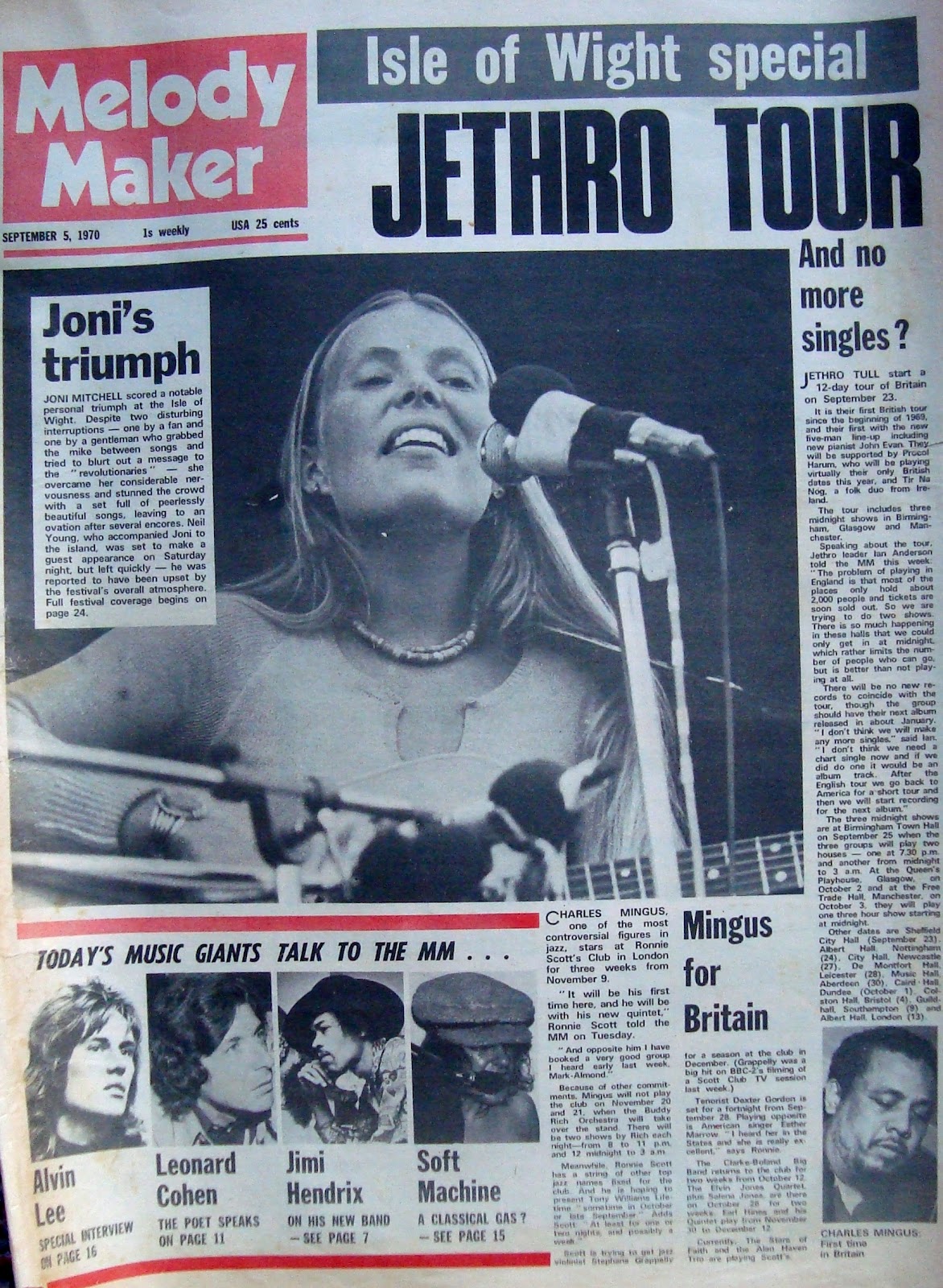
Melody Maker's extensive coverage of the festival
There are many stories and legends that grew out of the aftermath of the 1970 Isle of Wight music festival. 

There was the invasion by French anarchists; the stage meltdown by promoter Rikki Farr ("you go to hell!"); the way Joni Mitchell won over a restless crowd; the remarkable performance of Miles Davis, Jimi Hendrix's last UK show, The Who playing on until dawn, ELP's breakthrough and many others. 

It was five days of high drama. The festival was undoubtedly a triumph musically, but the bad vibes on the fringes were such that they curtailed the development of commercial festivals for several years afterwards. The free festival agitators were a powerful lobby and at the IOW they made life hell for the promoters even before the event began.

MM's verdict
In the UK music paper Melody Maker, the week after the IOW, the central editorial reflection (seen here >, click to read it) was that the festival "may well be the last occasion for a long time on which more than a quarter of a million kids come together to hear some rock and roll."

"There can be little doubt that the events of last weekend will have a chastening effect on any other promoter considering putting on a similar event.

"What kind of lunatic will want to risk having to deal with the French, Algerian and American revolutionaries who raised such hell?"

And yet even with all of that to contend with, the festival was a musical triumph, attended by many of the top performers from Europe and America at the time. Clicking on the links below will take you to clips of some of them.


Saturday's highlights included a more than two-hour set by John Sebastian, joined by his Lovin' Spoonful colleague Zal Yanofsky. Once again it seemed, as at Woodstock, Sebastian was on stage because no one else was ready to go on. 

"With that unique mixture of whimsy and open-hearted fun, John first shouted, "Just holler 'em up and I'll play whatever you want to hear!" 

Shawn Phillips followed on before Rikki Farr announced "a lovely surprise" and the arrival of Joni Mitchell.
the acts reviewed - click to view
An audience member was having a bad acid trip near the stage. Someone yelled, "Help!... we need a doctor" and as the MM noted, "suddenly, with terrifying swiftness, the good vibes turned right around."

Joni dealt with this and an attempted stage invasion with admirable poise. She brought the audience back onside by the sheer beauty of her songs - not to mention the genuine frustration she expressed at the bad vibes. You can read more about this in a separate piece I wrote.


A particular treat for the audience was the appearance of jazz giant Miles Davis, with a new electric band that included Chick Corea, Keith Jarrett, Dave Holland and Jack DeJohnette.


"Miles took the stage in a red leather jacket and silver-studded jeans and boots - at 44 years old as hip as anyone there."


The response to this new style of jazz must have been very encouraging for Miles, who took a lot of criticism from traditional jazz fans back in America for his radical change of style. Makes you wonder what music would have resulted if Miles and Jimi Hendrix had got together, as it was suggested they might. 


"The group's use of rock rhythms was far more evident than before, but they proved beyond any doubt that they are capable of making it as subtle, as complex and as rewarding as any conventional jazz rhythm," said the reviewer. The word fusion had yet to be coined in the context of rock and jazz, but you only have to listen to Dave Holland's bass playing during the 36 minute set by Miles to know that he had an intimate knowledge of rock and soul bass lines. 

Another of the artists destined to divide opinion was keyboard wizard Keith Emerson, with his new band Emerson Lake & Palmer, who made their debut at the IOW festival.


The MM said, "It's quite likely there are some of the rock fraternity who don't approve of Keith adapting classical themes, his displays of virtuosity and touches of showbiz. 


"ELP let off two cannons in the penultimate number. The arrangements were long and adventurous. There were no long blues guitar solos. In fact, they were wide open to criticism.

"But they didn't half play good," said the reviewer.

"The applause was almost as deafening as the cannonade which blew the spectacles off a man sitting in the firing line."

The stage lights dimmed just after midnight on Saturday and The Doors wandered on and proceeded to play a rather more muted set than the previous band. The reviewer noted, though, that they sounded better than when they played London's Roundhouse in 1968. 

"We want the world and we want it now! screamed Jim Morrison at one point, but it was not evident what he would do if circumstances arose which would make this possible," said the MM.
The Who played all night

"And now, a nice rock band from Shepherds Bush - the 'OO," announced DJ Jeff Dexter. 

Pete Townshend cheered up the English contingent, saying "We come home and find ourselves playing to a load of bloody foreigners causing trouble."


The Who played on well after 4am and as they reached the climax of Tommy, they turned huge spotlights on the crowd. It was a euphoric moment, to judge from the film.
The Raver gloating about his luxurious experience...
Keith Moon had arrived at the IOW with Viv Stanshall the night before the Who's appearance, to apparently "dig the acts and drop egg yolks into reporters' hard won cups of tea."

Peter Frampton was also backstage with his girlfriend Mary, as were George and Patti Harrison. 

'The Raver' columnist in Melody Maker had a rather more comfortable festival experience than his colleague Michael Watts (see article below) who drew the short straw and was given the assignment of spending the weekend on 'Desolation Hill' with the great unwashed.
..while Mike Watts was slumming it
on Desolation Hill
The Raver meanwhile, was roughing it at the former home of Alfred Lord Tennyson, now a three star hotel at Freshwater. 

Ian Anderson is said to have given one of the finest individual performances of the entire five days at the festival. "Jethro Tull emerged triumphant as one of the most entertaining of all the bands," said MM.

"Cocking his knee, grimacing, leaping, screaming, muttering, gibbering, sneezing, he looked like a brilliant but demented 18th century German music master.
Ian Anderson: brilliant but demented

"When Ian wasn't amazing us all with his flute, which leapt from the explosive to the beautiful, there was also the fine guitar of Martin Barre and some brilliant drumming by Clive Bunker to enjoy. One of the greatest assets of Tull proved to be the gifted piano playing of John Evan."

"Yes - it has been a long time, hasn't it?" said a cool, casual, but seemingly happy Jimi Hendrix. He was probably referring to the last time we saw him play in Britain, rather than the one-hour plus delay while one drum kit, a guitar and bass were set in working order.

"But it was nice to see him again, even if the sound was terrible - somehow there is always something wrong with the machinery of rock when Hendrix plugs in. Noel Redding's replacement, Billy Cox, proved a good bassman, but Mitch Mitchell, long a favourite drummer, was disappointing. He was hampered by a distorted PA and his playing seemed somewhat stiff."
One last look at the genius of Jimi Hendrix
The audience response was muted, probably because many were asleep, but slowly things started to improve. Jimi's guitar picked up. 

"They may be having an off-night but he is still incredibly good," said Peter Frampton, one of the crush in the VIP and press enclosure.

"Okay, we'll start all over again," said Jimi. "Hello England."

"Suddenly there was life on stage and Jimi showed why he is one of the all-time greats by some superb blues playing and singing on Red House."

As it turned out, this was Jimi's last show in the UK. A friend of mine attended the festival specifically to see Hendrix, but was asleep when he came on. Sadly, there would be no next time. September 18th 2020 will be the 50th anniversary of Jimi Hendrix's death, at just 27 years of age. 

Rory Gallagher and Taste
Earlier in the weekend, there were two stand-out performances, from Taste and Chicago. Taste were already popular, and starting with What's Going On they ran through their repertoire "with undiminished adulation from the crowd".  

Rory Gallagher, it was noted, "is technically excellent with the ability to play long passages at high speed." They were called back for four encores.

Chicago's set began at dusk on Friday. Guitarist Terry Kath made a big impression. "His guitar was fast and fluent. He looked like the kind of guy who would go down among the audience and personally sort out anyone who messed with his music. A girl actually screamed during one electrifying high speed guitar solo."

No such thing as a Free lunch
Free's set mid-afternoon on Sunday was well received: "Paul Rodger's tough, hairy voice and the obvious sensuality of Paul Kossoff's guitar were the outstanding points." 

But the reviewer said the time of day wasn't ideal for them: "It was a little too close to lunchtime to feel that funky."

"Their number one hit All Right Now really got the crowd moving, although the few who stood up to dance were soon on the ground again after a volley of Coke cans."

For a run-down of all the others artists appearing at the festival, check out the cuttings accompanying this piece. 


IF YOU LIKE MY BLOG, PLEASE HIT THE FOLLOW BUTTON ON THE SIDE PANEL THANKS


Thursday, 6 August 2020

Joni Mitchell tames the tiger at the Isle of Wight 1970


Persuaded to go on earlier than planned, when no one else would, Joni Mitchell got a lot of credit for hanging in there at the Isle of Wight festival, 50 years ago in August 1970.

In an impressive display of composure, Joni survived an initially restless crowd and a stage invasion early in her set. By the end she was given a standing ovation by the estimated 600,000 crowd and was called back for an encore.

The tension in the crowd was caused by an us-and-them anti-establishment vibe from the thousands of non-ticket holders camped on the hillside overlooking the festival. The free festival anarchists among them did their best to undermine the good vibes, bringing down fences and clashing with police. 
The massive crowd at the IOW festival

In the midst of this, and clearly nervous at the prospect, Joni took the stage.

Her IOW show is remarkable because it demonstrates not only Joni's qualities as an exceptional songwriter and performer, but her determination to win over a hostile crowd.

Joni was visibly upset by the bad vibes from a section of the crowd, some of whom just wanted to hear the rock bands. Then there were the freeloaders, who thought it was all too corporate and should be put on for nothing.

She admits, in the interview accompanying the film of her IOW show, Both Sides Now, that she wanted to run, but didn't feel like she could.
An unwelcome interruption

To her great credit, she toughed it out, enduring a stage invasion by one of the disgruntled hippies and telling the audience at one point that they were behaving like unruly tourists.

Joni scolds the audience
As one of the people who commented on my Facebook link to this blog noted, "She gets passionate!" 

"Will ya listen a minute!!," she yells at the crowd. 

"A lot of people get up here and it's fun, you know? But you've got your life wrapped up in it. It's very difficult to come out here and lay something down....Give us some respect!".

After that, she noted that the crowd settled down, as if a different mood had passed back through the crowd from the front rows. She had won them over with her "peerlessly beautiful songs" - as the Melody Maker report put it - even getting called back for an encore.

Neil Young had also planned to appear, but he didn't like the festival vibe and retreated. Other performers, notably Kris Kristofferson, survived a hostile reception and he even returned for a second show later in the weekend.

The trouble at the festival shouldn't detract from the fact that this was one of the great musical gatherings of the time - certainly one the biggest, larger than Woodstock it is claimed.

The festival featured landmark performances by some of the top bands of the time, including The Who, Jimi Hendrix and Free, and several of the acts that had been highlights of the Woodstock festival the previous year, including Sly & The Family Stone, Ten Years After, Joan Baez and Richie Havens. Emerson, Lake & Palmer made their debut there and Miles Davis's 38 minute set is held up as a prime example of his new electric jazz direction. All in all, as fine a collection of performances as you will find at any of the late 60s/early 70s festivals. 

IF YOU LIKE MY BLOG, PLEASE HIT THE FOLLOW BUTTON ON THE SIDE PANEL THANKS


Further reading on this blogsite:
Dylan, Joan and Joni on The Rolling Thunder Tour
https://bangnzdrum.blogspot.com/2019/07/five-reasons-why-you-should-watch-bob.html


Court and Spark - Joni Mitchell interview from 1974
https://bangnzdrum.blogspot.com/2019/01/court-and-spark-joni-mitchell-interview.html  


Joni Mitchell - The Hissing of Summer Lawns

Joni Mitchell - Hejira
http://bangnzdrum.blogspot.co.nz/2012/06/joni-mitchell-in-1970s-3-hejira.html


Joni Mitchell - Don Juan's Reckless Daughter
https://bangnzdrum.blogspot.com/2012/08/joni-mitchell-in-1970s-4-don-juans.html


Thursday, 12 March 2020

Pat Metheny - Live in 2020 and way back in time

It is a rare thing to find an individual musician who can move effortlessly from gentle acoustic playing to frenetic jazz freak-outs. Over his long career, jazz guitarist Pat Metheny has explored many different musical landscapes and he manages to find a purity of expression in each of them.

He is best known for his work with the Pat Metheny Group, which for many years included his closest musical partners, pianist Lyle Mays, who sadly died last month, and bassist Steve Rodby.

Outside of the group, he has collaborated with vibraphone legend Gary Burton, bassist Charlie Haden and with Chick Corea, among many others. Metheny began recording professionally in the 1970s alongside the legendary bassist Jaco Pastorius, another player who had that ability to shift from the tender to the jarring.

Metheny's recorded work is often melodic and played with a distinctive style that once heard is seldom forgotten. But he has also wandered off into darker areas, taking influences from free jazzers like Ornette Coleman. On many of his albums, over the last 20 years especially, there are moments that jolt the listener. He doesn't always play safe and has never been afraid to push the boundaries.

Now 65, he has reached a point where he feels able to revisit some of his most popular tunes, with the help of his three-piece band, consisting of Gwilym Simcock on piano, Linda May Han Oh on bass and Antonio Sanchez on drums.

For his current audience, many of whom are here for the nice tunes, the good news is that Metheny will be playing reasonably familiar material. He told the audience he started out with a short tour two years ago ‘playing the hits’, which he admitted was unusual. It’s gone down so well with audiences he has just kept going, extending the tour into places like NZ, where he has only been once before in his almost 50 year career.

So the audience on Tuesday in Auckland were treated to a set full of familiar tunes, for those with the Pat Metheny Group albums (songs like Phase Dance, Bright Size Life, Last Train Home, Have You Heard, Better Days Ahead) and the ‘As Falls Wichita, So Falls Wichita Falls’ album he made with Lyle Mays in 1981, a favourite of mine.

As the concert began, Metheny sat alone at the centre of the stage holding a very strange looking instrument - a many headed monster called a Manzer Pikasso. incorporating 6 and 12 string guitars and various other strings spanning across its body - 42 strings and he utilised them all, to great effect.

The set also featured material from his various collaborations, plus a piece from the solo acoustic album ‘One Quiet Night’. And in the acoustic medley for the encore, there was even a snatch of his one genuine hit ‘This Is Not America’, the song he recorded with David Bowie.
photo: Zed Pics
Metheny is still one of the most accomplished and versatile guitarists I’ve ever seen. I once saw him and the group up-close at the Half Moon pub in Putney (London) playing Ornette Coleman 'tunes' and jazz standards as a warm up for his UK tour. To this day, I don't think I've ever seen a virtuoso musician in that close proximity and it remains one of the most mind-blowing shows I've seen.

If you're in any doubt about his abilities, just check out this short clip promoting the 2020 tour.

His latest band, of quite a different generation to Metheny himself, are energetic and certainly accomplished in their own right, with Simcock proving to be a powerful and nimble-fingered piano player. It was fitting to see his strong performance in the week we lost the great McCoy Tyner.

I was also especially struck with upright bassist Linda Oh, who showed once again how women have come to the fore as bass players in recent years. I’m thinking Esperanza Spalding, Tal Wilkenfeld and Rhonda Smith, in particular. Linda was a delightful presence on the stage and added a particular lyricism on the bass during the more reflective pieces.

photo: Zed Pics
Here, Metheny plays the song Slip Away, accompanied by Oh and Antonio Sanchez.

Sanchez has a percussive approach to the drums; he's a kind of instinctual, reactive drummer in the style of Brian Blade. Impressive. Anyone who has seen the movie Birdman may recall the soundtrack, which was composed and played by Sanchez.

Towards the end of the show, Metheny duetted with each member of the band in turn. He and Sanchez were the last of the duets and began by playing the Metheny tune Question and Answer. But the tune soon became less recognisable as they built up a dissonant crescendo of sound - Metheny playing his guitar synth in a frenzy and Sanchez at the end scraping the edge of his cymbals. It was exciting to watch, but would certainly have freaked out some of the more conservative members of the audience.

Listening to the set, I realised I have a lot more Pat Metheny on various media than I thought, including some on cassette that I haven't listened to for years. These include a wonderful album called 'Beyond The Missouri Sky' recorded in New York in 1996 with bassist Charlie Haden.

Metheny grew up in Missouri and his more reflective acoustic music, of which this is a perfect example, is inspired by the remote and often desolate landscapes of that part of America.

The album with Haden also includes the theme music from the movie Cinema Paradiso.
A selection of my music and video featuring Pat Metheny
I have several of Metheny's 1970s and 80s ECM albums on vinyl, which are played fairly regularly. My favourites are a couple of his albums with Gary Burton recorded before he formed the Pat Metheny Group, and a more recent Burton album, Like Minds, where Burton reunited with early collaborators including Pat Metheny and Chick Corea, who had never previously played together.

My other favourite of the ECM era is the Pat Metheny/Lyle Mays album As Falls Wichita, So Falls Wichita Falls. It features the song September 15th, which pays tribute to one of their heroes, Bill Evans. It's an almost meditative album, full of atmosphere and reflection, while also managing to be uplifting. 

Other regulars from the CD era were Imaginary Day and the live album, The Road To You. The song 'Have You Heard' from that album drew one of the biggest cheers of the night from the Auckland audience. The DVD We Live Here mirrors the material on The Road To You and gives a good illustration of the Pat Metheny Group in the mid 1990s, when they were probably at the height of their popularity.

The other DVD in the collection pictured above is of Joni Mitchell's Shadows and Light tour in 1980, which featured Metheny and Mays alongside Jaco Pastorius, Don Alias on drums and Michael Brecker on saxophone. Metheny plays a fittingly ethereal solo on Joni's song Amelia.

Here's another live beauty - The Gathering Sky, which features a solo by drummer Antonio Sanchez.

In this interview, Metheny talks fondly of working with Bowie.
 
And finally, an update to this blog, the great interview that Rick Beato did with Pat in 2021. 

Wednesday, 31 July 2019

Bob and Joan and Scarlett and Joni... Bob Dylan's Rolling Thunder Revue

Jack Elliott, Joan Baez, Dylan, Mick Ronson, Ronee Blakley, David Mansfield
Martin Scorsese's Rolling Thunder Revue movie is a magical snapshot of a musical legend. How can something so special have been kept under wraps for so long?

The film footage of Bob Dylan's 1975/76 Rolling Thunder Revue tour has been available in unofficial rough-looking clips in the Youtube era. Some of it was even included in Dylan's obscure and quite awful 1978 film 'Renaldo and Clara'.

But it's taken over 40 years for the full treatment to be given to this unique gathering. Thankfully, Scorsese was at hand to work his magic on it. It's not perfect, and on second viewing I skipped over the fake narrative bits. But the concert footage is just so vivid it's almost breathtaking.

Just as he did with 'No Direction Home', his documentary on Dylan's early career, Scorsese has collated this amazingly vibrant footage to showcase Dylan's remarkable artistry and charisma.

Rolling Thunder Revue contains some of the most thrilling performances of Dylan's long career. If you liked the 'Desire' album, it's a kick seeing many of those songs performed by the same band, with the same intensity and warmth. On stage, Dylan is more animated than he's ever been.

It's a lot of fun to watch. The up-to-date Dylan is as enigmatic as ever and there's a lot of his customary misdirection in the narrative. But the real riches lie in the onstage and backstage interactions. You get a strong sense of the collective spirit among the musicians involved.

Joan Baez has a strong supporting role, as do several other women on the tour, such as violinist Scarlett Rivera, singer Ronee Blakley and the amazing Joni Mitchell.

Bob and Joan in the early 1960s
The relationship between Bob and Joan Baez has an enduring fascination. It is one of the great examples of unrequited love in the history of art. 

Bob used Joan as his jumping off platform early in his career - she invited him to share her stage and became his muse and his musical sidekick.

But, as we saw in the movie Don't Look Back ten years earlier, Joan’s love for Bob goes way beyond the music and it's really not clear how far Bob's love for Joan extends. 

The interaction in Rolling Thunder Revue, where they discuss how their lives diverged in the mid-60s, is poignant because it's clear even then that Joan still holds a candle for him.

"You went and got married without telling me"
Dylan acknowledged the debt he owed to Baez, but he did a poor job of repaying it in 1965, when Joan accompanied him to the UK. It was fairly obvious he didn't want her there. The circus that surrounded him just made her feel even more marginalised.

Bob would later say he was just trying to deal with the craziness of his life at that point; and it was crazy. Joan should never have gone with him to the UK. 

She described it as hell (everyone else was on drugs - she was straight). And Bob didn't - as she had expected - reciprocate Joan's generosity by inviting her onstage to perform with him.

For more insight into their complex relationship, I'd recommend David Hadju's excellent book 'Positively 4th Street'. It interweaves Bob and Joan's lives and their relationship, with Joan's sister Mimi and her partner Richard Fariña.For her part, Joan was guilty only of blind devotion. 

As Hadju's book notes: "This gorgeous woman, who is an icon in her own right, latches onto you and says, 'I'll be your everything, including being your lover'. She adopted him. She found this guy who gave voice to all that powerful stuff, and she nurtured him in that role. He made out on every level."

Hadju's book also gives a glimpse of their happier side, noting how they had a similar sense of the absurd and at times it appeared as if they were having a private joke against the world. "A lovely thing was happening and I didn't want it to end," she said later.

Joni not easily intimidated
The most noteworthy cameo in Scorsese's Rolling Thunder Revue comes from Joni Mitchell. We see her playing an early version of Coyote - which appeared on her next album Hejira - in an upstairs room at Gordon Lightfoot's house in Toronto. 

She had just written the song and the words are ever so slightly different, on the section "he's got a woman at home...". It's astonishing that all these years later we get to see it like this. Joni handles the situation with such assurance. How many other artists could have done that - come into Dylan's world and match him stride for stride?
Joni said, "I joined Rolling Thunder as a spectator. I would have been content to follow it for three cities just as an observer, but since I was there I was asked to participate. Then, for mystical reasons of my own, I made a pact with myself that I would stay on until it was over. 

"It was a trial of sorts for me. I went out in a foot soldier position. I made up songs onstage. I sang in French, badly. I did a lot of things to prevent myself from getting in the way. What was in it for me hadn’t anything to do with applause or the performing aspect. It was simply to be allowed to remain an observer and a witness to an incredible spectacle."

Sensibly, she requested that any footage of her not be used in Renaldo & Clara. "I preferred to be invisible. I’ve got my own reasons why."

Although Joni obviously enjoyed the experience, it took a toll on her health and caused her to cancel some of her own shows soon after. She said, "Rolling Thunder was mad. Heavy drama, no sleep – a circus. (Afterwards) I had bronchitis. A bone in my spine was out of place and was pinching like crazy. So I was in physical pain."
Dylan and Scarlett Rivera
The other key female interaction among the musicians on the tour was the mysterious violinist Scarlett Rivera. She provides wonderful accompaniment to Dylan on stage, showing a fine sense of taste in her playing on several of the featured performances.

She describes their meeting in the movie as an audition followed by a surreal evening jamming with Muddy Waters at the Bottom Line club in New York.

Dylan had such faith in Rivera's ability that she became the foil for all his recording and live dates during this highly productive time, including a memorable performance of Simple Twist of Fate, Hurricane and Oh Sister at a tribute TV show for legendary CBS executive, John Hammond, the man who signed Dylan.

The recording of the album Desire involved the other core musicians on the Rolling Thunder Tour, bassist Rob Stoner, drummer Howie Wyeth and guitarist singer Bob Neuwirth. But it was Rivera who captivated everyone, by virtue of the amazing musical understanding she had with Dylan. 

The song 'One More Cup of Coffee', for example, was recorded in one take. Emmylou Harris was caught off-guard by this and had wanted another run-through to get her vocal right. But that was it. Bob was happy with the first one. Onto the next song. 

The insight and magic shown in the Rolling Thunder Revue movie is quite unbelievable for those of us who have lived with the music and legend for over 40 years. I still have my copy of Sam Shepherd's Rolling Thunder Logbook and the movie fills in a lot of the gaps in Shepherd's sketches of the tour, like Dylan and Allen Ginsberg visiting Jack Kerouac's grave.

As a follow-on from Scorsese's No Direction Home, which finished after Bob's 1966 tour of the UK - and his withdrawal from music - the Rolling Thunder Revue is a perfect complement.

A bonus item this, from Acoustic Guitar magazine (see my recommended blogs at the side here) is a clip of Bob and Joan in 1976 on the second leg of the Rolling Thunder Revue, duetting on Blowin' In The Wind.

Joan Baez talks about Dylan and her activist life on Desert Island Discs.

For more on life on the road with the Rolling Thunder Revue, check out this interview with tour manager Chris O'Dell.  

IF YOU LIKE MY BLOG, PLEASE HIT THE FOLLOW BUTTON ON THE SIDE PANEL THANKS

ALSO ON THIS BLOG:
Blonde On Blonde - Bob Dylan's artistic peak in the 1960s 

Bob Dylan and Eric Clapton at Blackbushe, UK 1978

A Complete Unknown - The Life and Times of Bob and Joan

Idiot Wind marks Dylan's re-emergence in 1975

Wednesday, 23 January 2019

Court and Spark - Joni Mitchell interview from 1974

Joni Mitchell's sixth album, Court and Spark was released 45 years ago. I recently unearthed this interview from the US pop magazine 'Raves', which appeared in June 1974. In it, Joni talks about the evolution of her songwriting craft and her ongoing sense of loneliness.

The interviewer paints Joni as a tragic Garbo-like figure who had retreated from the LA music scene for some time, only recently re-emerging with her new album and a tour that took in a series of dates in London.

Joni had changed and indicated she had undergone "a painful transition" - "I was too close to my own work," she said. She took to the psychiatrist's couch - "I was practically catatonic," but that provided no solution.

She found some answers in the writing of German novelist Hermann Hesse. As she skimmed the book Narcissus and Goldmund she ran across a passage in which Narcissus the priest does not reproach Goldmund for his lack of insight into himself. Instead, he advises him to 'get his life in focus'.


Travel also broadened her mind and ultimately she "gained a perspective and distance on most of my songs."

She emerges, said the reviewer, "as a talented entertainer, rather than the emotional registrar of experiences."

Court and Spark marked the beginning of the most musically fulfilling period of her career. The confidence shines through in the performances from the London shows.

Joni embraced the opportunity of working with talented jazz players like Tom Scott, John Guerin and Robben Ford.

The results, in her next album, would blow away any notion that she was just a confessional singer/songwriter.


But that's another story, told here:
https://bangnzdrum.blogspot.com/2012/06/joni-in-70s-2-hissing-of-summer-lawns.html


Here's an excerpt from the 1974 London concert with Tom Scott and the LA Express:

IF YOU LIKE MY BLOG, PLEASE HIT THE FOLLOW BUTTON ON THE SIDE PANEL THANKS

Also on this blog:
Joni Mitchell in the 70s - Court and Spark 
http://bangnzdrum.blogspot.co.nz/2012_05_01_archive.html

Joni Mitchell in the 70s - The Hissing of Summer Lawns
http://bangnzdrum.blogspot.co.nz/2012/06/joni-in-70s-2-hissing-of-summer-lawns.html


Joni Mitchell in the 70s - Don Juan's Reckless Daughter

Joni Mitchell tames the tiger at the Isle of Wight 1970
https://bangnzdrum.blogspot.com/2020/08/joni-mitchell-tames-tiger-at-isle-of.html

Joni Mitchell's Dog Eat Dog and a chance meeting with Thomas Dolby
https://bangnzdrum.blogspot.com/2023/02/joni-mitchells-dog-eat-dog-and-chance.html