Showing posts with label the who. Show all posts

Friday, 23 February 2024

Who's next - lightning in a bottle

Photo by Ethan Russell

In their heyday The Who were a truly exciting live band; there can be little argument about that. But it wasn't until the release of their 1971 album 'Who's next', that they managed to capture the explosive nature of their live shows on a studio album. 

From their earliest shows, The Who created mild outrage with their stage antics, especially the smashing of guitars and drums at the climax of their set. 

Their December 1968 stint on 'The Rolling Stones Rock and Roll Circus' showed that even without the pyrotechnics they were a match for anyone playing live. 

That confident, cheeky performance of  'A Quick One, While He's Away' was perfectly pitched for the circus tent, and so much more polished and powerful than the Stones' lacklustre act. 

Indeed, it was this upstaging of the Stones, as much as the sorry state of Brian Jones, that convinced Jagger & Co to shelve the Rock and Roll Circus film. It didn't see a full official release for almost 30 years.

From the late '60s on, with the 'Tommy' album as the core of their act, The Who built a reputation as a heavy rock band, culminating in their triumphant early morning stint at Woodstock in August 1969. 

The 1970 'Live At Leeds' album was an all-guns-blazing set, with Pete Townshend and Keith Moon driving each other to new extremes. Check out this clip of them playing the original vinyl album's opener 'Young Man Blues' at the Isle of Wight festival that same year.

As the Village Voice music critic Robert Christgau wrote in 1971, The Who's studio recordings thus far were marred by a thin sound. Their 1971 masterpiece 'Who’s next' changed all that. With the help of master engineer Glyn Johns, they managed to transfer the power and majesty of a Who live show onto a studio record for the first time. Christgau said the group "now achieves the same resonant immediacy in the studio that it does live".

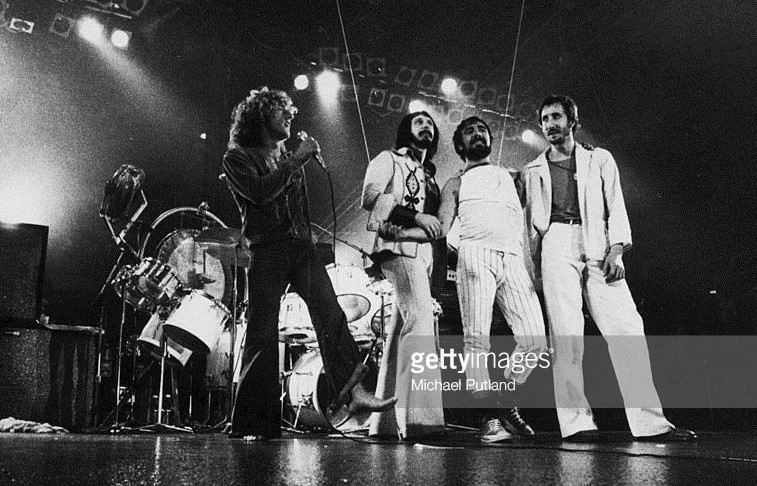
The Who in 1971 around the time of Who's next
It was a volatile chemistry that made them such an exciting and often unpredictable live act. John Entwistle played lead lines on the bass, allowing Townshend the freedom to jump around, imitate a windmill and bang out his wild riffs.

Moon was the whirlwind, totally unconventional as a drummer, but at his best, as on 'Who's next', he brought exceptional musicality to the drums. 

By '71 and tired of playing 'Tommy' and their 60s hits to the same audiences, Townshend conceived a new album concept as their next big project. He built himself a studio and began creating a new musical landscape. 

In the new Apple TV series 1971, Townshend says, “I’d heard about synthesisers and music computers and I could see this new revolution coming.

NME review, click to enlarge
"Lifehouse was going to be a movie based on a dystopian idea about the way media, electronics and technology would change society. I imagined this world in which there was incredible pollution, incredible difficulty with living in the outside world and so what the government did is it stuck us in our houses and fed us entertainment to keep us happy while they cleaned up the air.

“I called it The Grid, this global communication system where everybody would be fed similar stuff. It would be surreptitiously policed and censored. 

"Once they’d got us in and they were feeding us the programmes, we would imagine we had access to everything, because of its richness, its persuasiveness and its beauty. It was an anticipation of the idea that everything would go wrong, but that music would prevail."

Unfortunately, Pete couldn’t sell his vision to the band. They thought he'd gone mad. But producer Glyn Johns was sufficiently interested in the musical ideas to help Pete condense them into conventional backing tracks that The Who could then play along to. 

Rolling Stone
magazine’s 1971 review noted that “Townshend wrings more than his money’s worth out of his £14,000-worth of synthesizers, making, I daresay, shrewder at once more adventurous and better-integrated — use of them than any rock experimenter before him."

In 'Baba O’Riley', for instance, he sets the stage for the band’s dramatic entrance with a pre-recorded VCS3 part he obtained by programming certain of his vital statistics into a computer hooked up to the synthesizer, then treats the part as a drone while the song’s two major chords are transposed over it.
All in the best possible taste

The looped and synthesised intro to 'Baba O’Riley' and the trippy electronics of  'Won’t Get Fooled Again' were inspired by minimalist composer Terry Riley’s 1967 album 'A Rainbow in Curved Air'. 

Rolling Stone
noted the quality of the musicianship on this album, “with Moon thrashing and bashing more precisely than ever before on record, Entwistle dreaming up all manner of scrumptious melodic and rhythmic flourishes (listen especially to what he plays beneath the chorus of 'Won’t Get Fooled Again').

"And Townshend, with chunky acoustic rhythm, resounding monster chords of the classic sort, and cogent and lyrical solos, playing with exemplary efficiency and taste.” 

Singer Roger Daltrey also rose to the occasion with some of his most assured vocals, including the legendary scream at the climax of Won't Get Fooled Again. 

Re-reviewing 'Who’s next' in the mid 1970s, the NME’s Steve Clarke noted that Keith Moon’s unique style of playing – often without a hi-hat, hence the wash of cymbal sounds on many recordings – meant he lacked “the bombastic precision of many of Britain’s rock drummers. Instead. Moon sounds spontaneously manic, and nowhere has he sounded better than here.”

back cover photo
While the dramatic opening and closing tracks of 'Who's next' are the ones most people remember, there’s a satisfying variety in the moods in the remaining songs, with particularly melodic passages in 'Love Ain’t For Keeping', 'Song Is Over' and the utterly brilliant 'Behind Blue Eyes'. The acoustic-to-electric transition on the latter exemplifies the tension and release dynamics of The Who at their best – and with lyrics to match.

When my fist clenches crack it open, before use it and lose my cool. If I smile, tell me some bad news, before I laugh and act like a fool.

RS described ‘Song Is Over’ as “an unutterably beautiful song in which Townshend sings exquisitely over a gentle piano background with Daltrey charging in exhilaratingly, with breathtaking chord changes in the manner of the “Listening to you I hear the music . . .” refrain from Tommy.”

Photo by Ethan Russell

Pete may have failed to get the broader Lifehouse project off the ground, but 'Who's next' nonetheless carries a strong sense of what Clarke observed as “We’re all part of something bigger and somehow one day we’ll all join together as one.” 

The cover shot of the monolith, apparently taken in a Sheffield slag heap they passed in the tour bus (Or was it? see below) is odd but effective, although as Townshend pointed out, it bears no relation to the narrative of the record.

Indeed, photographer Ethan Russell said he thought after they had done it there was no chance it would be used.

Quite how it was selected, then, will remain a mystery. But in a recent twist to the tale, someone in Derbyshire has identified where the monolith actually was - since neither Russell or the band could recall exactly where they were when it was taken. 

The concrete pillar was actually a drain built into a spoil heap from a Derbyshire colliery to help prevent landslips.

John Hirst, who worked for Chesterfield Borough Council in the 1970s, photographed it a number of times before it all but disappeared. 

Today only the very top of it is visible at ground level, in what is now a farmer’s field.

Here's the full story from the Derbyshire Times: https://www.derbyshiretimes.co.uk/news/people/i-sat-on-this-for-years-film-crew-visits-derbyshire-field-to-unearth-truth-of-classic-who-album-cover-4677778

Townsend added, "Of course I don’t like it. It’s got no artistic consequence whatsoever. No link to the music. It’s meaningless. It’s four guys stopping in a car and pissing up against a chunk of concrete. Anyway, can we move on?"


IF YOU LIKE MY BLOG, PLEASE HIT THE FOLLOW BUTTON ON THE SIDE PANEL THANKS

Also On This Blog:

Five Days of Drama at The Isle of Wight, 1970

The Who 'Put The Boot In' at Charlton FC, 1976

Sunday Night at The Saville, 1967
 
2-Tone and possibly my best gig ever

Queen's 1976 Free Concert in Hyde Park

Memories of the Reading Festival, 1975

Five Days of High Drama at the Isle of Wight, 1970

From Pinner to LA - Elton's Big Breakthrough, 1970

My Woodstock 50th Anniversary Diary

A Wizard, A True Star - my all-time favourite album

Blonde On Blonde - Bob Dylan's Artistic Peak in the 1960s

 Joni Mitchell - The Hissing of Summer Lawns

Tuesday, 1 September 2020

Five days of high drama at the Isle of Wight, 1970

Melody Maker's extensive coverage of the festival
There are many stories and legends that grew out of the aftermath of the 1970 Isle of Wight music festival. 

There was the invasion by French anarchists; the stage meltdown by promoter Rikki Farr ("you go to hell!"); the way Joni Mitchell won over a restless crowd; the remarkable performance of Miles Davis, Jimi Hendrix's last UK show, The Who playing on until dawn, ELP's breakthrough and many others. 

It was five days of high drama. The festival was undoubtedly a triumph musically, but the bad vibes on the fringes were such that they curtailed the development of commercial festivals for several years afterwards. The free festival agitators were a powerful lobby and at the IOW they made life hell for the promoters even before the event began.

MM's verdict
In the UK music paper Melody Maker, the week after the IOW, the central editorial reflection (seen here >, click to read it) was that the festival "may well be the last occasion for a long time on which more than a quarter of a million kids come together to hear some rock and roll."

"There can be little doubt that the events of last weekend will have a chastening effect on any other promoter considering putting on a similar event.

"What kind of lunatic will want to risk having to deal with the French, Algerian and American revolutionaries who raised such hell?"

And yet even with all of that to contend with, the festival was a musical triumph, attended by many of the top performers from Europe and America at the time. Clicking on the links below will take you to clips of some of them.


Saturday's highlights included a more than two-hour set by John Sebastian, joined by his Lovin' Spoonful colleague Zal Yanofsky. Once again it seemed, as at Woodstock, Sebastian was on stage because no one else was ready to go on. 

"With that unique mixture of whimsy and open-hearted fun, John first shouted, "Just holler 'em up and I'll play whatever you want to hear!" 

Shawn Phillips followed on before Rikki Farr announced "a lovely surprise" and the arrival of Joni Mitchell.
the acts reviewed - click to view
An audience member was having a bad acid trip near the stage. Someone yelled, "Help!... we need a doctor" and as the MM noted, "suddenly, with terrifying swiftness, the good vibes turned right around."

Joni dealt with this and an attempted stage invasion with admirable poise. She brought the audience back onside by the sheer beauty of her songs - not to mention the genuine frustration she expressed at the bad vibes. You can read more about this in a separate piece I wrote.


A particular treat for the audience was the appearance of jazz giant Miles Davis, with a new electric band that included Chick Corea, Keith Jarrett, Dave Holland and Jack DeJohnette.


"Miles took the stage in a red leather jacket and silver-studded jeans and boots - at 44 years old as hip as anyone there."


The response to this new style of jazz must have been very encouraging for Miles, who took a lot of criticism from traditional jazz fans back in America for his radical change of style. Makes you wonder what music would have resulted if Miles and Jimi Hendrix had got together, as it was suggested they might. 


"The group's use of rock rhythms was far more evident than before, but they proved beyond any doubt that they are capable of making it as subtle, as complex and as rewarding as any conventional jazz rhythm," said the reviewer. The word fusion had yet to be coined in the context of rock and jazz, but you only have to listen to Dave Holland's bass playing during the 36 minute set by Miles to know that he had an intimate knowledge of rock and soul bass lines. 

Another of the artists destined to divide opinion was keyboard wizard Keith Emerson, with his new band Emerson Lake & Palmer, who made their debut at the IOW festival.


The MM said, "It's quite likely there are some of the rock fraternity who don't approve of Keith adapting classical themes, his displays of virtuosity and touches of showbiz. 


"ELP let off two cannons in the penultimate number. The arrangements were long and adventurous. There were no long blues guitar solos. In fact, they were wide open to criticism.

"But they didn't half play good," said the reviewer.

"The applause was almost as deafening as the cannonade which blew the spectacles off a man sitting in the firing line."

The stage lights dimmed just after midnight on Saturday and The Doors wandered on and proceeded to play a rather more muted set than the previous band. The reviewer noted, though, that they sounded better than when they played London's Roundhouse in 1968. 

"We want the world and we want it now! screamed Jim Morrison at one point, but it was not evident what he would do if circumstances arose which would make this possible," said the MM.
The Who played all night

"And now, a nice rock band from Shepherds Bush - the 'OO," announced DJ Jeff Dexter. 

Pete Townshend cheered up the English contingent, saying "We come home and find ourselves playing to a load of bloody foreigners causing trouble."


The Who played on well after 4am and as they reached the climax of Tommy, they turned huge spotlights on the crowd. It was a euphoric moment, to judge from the film.
The Raver gloating about his luxurious experience...
Keith Moon had arrived at the IOW with Viv Stanshall the night before the Who's appearance, to apparently "dig the acts and drop egg yolks into reporters' hard won cups of tea."

Peter Frampton was also backstage with his girlfriend Mary, as were George and Patti Harrison. 

'The Raver' columnist in Melody Maker had a rather more comfortable festival experience than his colleague Michael Watts (see article below) who drew the short straw and was given the assignment of spending the weekend on 'Desolation Hill' with the great unwashed.
..while Mike Watts was slumming it
on Desolation Hill
The Raver meanwhile, was roughing it at the former home of Alfred Lord Tennyson, now a three star hotel at Freshwater. 

Ian Anderson is said to have given one of the finest individual performances of the entire five days at the festival. "Jethro Tull emerged triumphant as one of the most entertaining of all the bands," said MM.

"Cocking his knee, grimacing, leaping, screaming, muttering, gibbering, sneezing, he looked like a brilliant but demented 18th century German music master.
Ian Anderson: brilliant but demented

"When Ian wasn't amazing us all with his flute, which leapt from the explosive to the beautiful, there was also the fine guitar of Martin Barre and some brilliant drumming by Clive Bunker to enjoy. One of the greatest assets of Tull proved to be the gifted piano playing of John Evan."

"Yes - it has been a long time, hasn't it?" said a cool, casual, but seemingly happy Jimi Hendrix. He was probably referring to the last time we saw him play in Britain, rather than the one-hour plus delay while one drum kit, a guitar and bass were set in working order.

"But it was nice to see him again, even if the sound was terrible - somehow there is always something wrong with the machinery of rock when Hendrix plugs in. Noel Redding's replacement, Billy Cox, proved a good bassman, but Mitch Mitchell, long a favourite drummer, was disappointing. He was hampered by a distorted PA and his playing seemed somewhat stiff."
One last look at the genius of Jimi Hendrix
The audience response was muted, probably because many were asleep, but slowly things started to improve. Jimi's guitar picked up. 

"They may be having an off-night but he is still incredibly good," said Peter Frampton, one of the crush in the VIP and press enclosure.

"Okay, we'll start all over again," said Jimi. "Hello England."

"Suddenly there was life on stage and Jimi showed why he is one of the all-time greats by some superb blues playing and singing on Red House."

As it turned out, this was Jimi's last show in the UK. A friend of mine attended the festival specifically to see Hendrix, but was asleep when he came on. Sadly, there would be no next time. September 18th 2020 will be the 50th anniversary of Jimi Hendrix's death, at just 27 years of age. 

Rory Gallagher and Taste
Earlier in the weekend, there were two stand-out performances, from Taste and Chicago. Taste were already popular, and starting with What's Going On they ran through their repertoire "with undiminished adulation from the crowd".  

Rory Gallagher, it was noted, "is technically excellent with the ability to play long passages at high speed." They were called back for four encores.

Chicago's set began at dusk on Friday. Guitarist Terry Kath made a big impression. "His guitar was fast and fluent. He looked like the kind of guy who would go down among the audience and personally sort out anyone who messed with his music. A girl actually screamed during one electrifying high speed guitar solo."

No such thing as a Free lunch
Free's set mid-afternoon on Sunday was well received: "Paul Rodger's tough, hairy voice and the obvious sensuality of Paul Kossoff's guitar were the outstanding points." 

But the reviewer said the time of day wasn't ideal for them: "It was a little too close to lunchtime to feel that funky."

"Their number one hit All Right Now really got the crowd moving, although the few who stood up to dance were soon on the ground again after a volley of Coke cans."

For a run-down of all the others artists appearing at the festival, check out the cuttings accompanying this piece. 


IF YOU LIKE MY BLOG, PLEASE HIT THE FOLLOW BUTTON ON THE SIDE PANEL THANKS


Friday, 20 September 2019

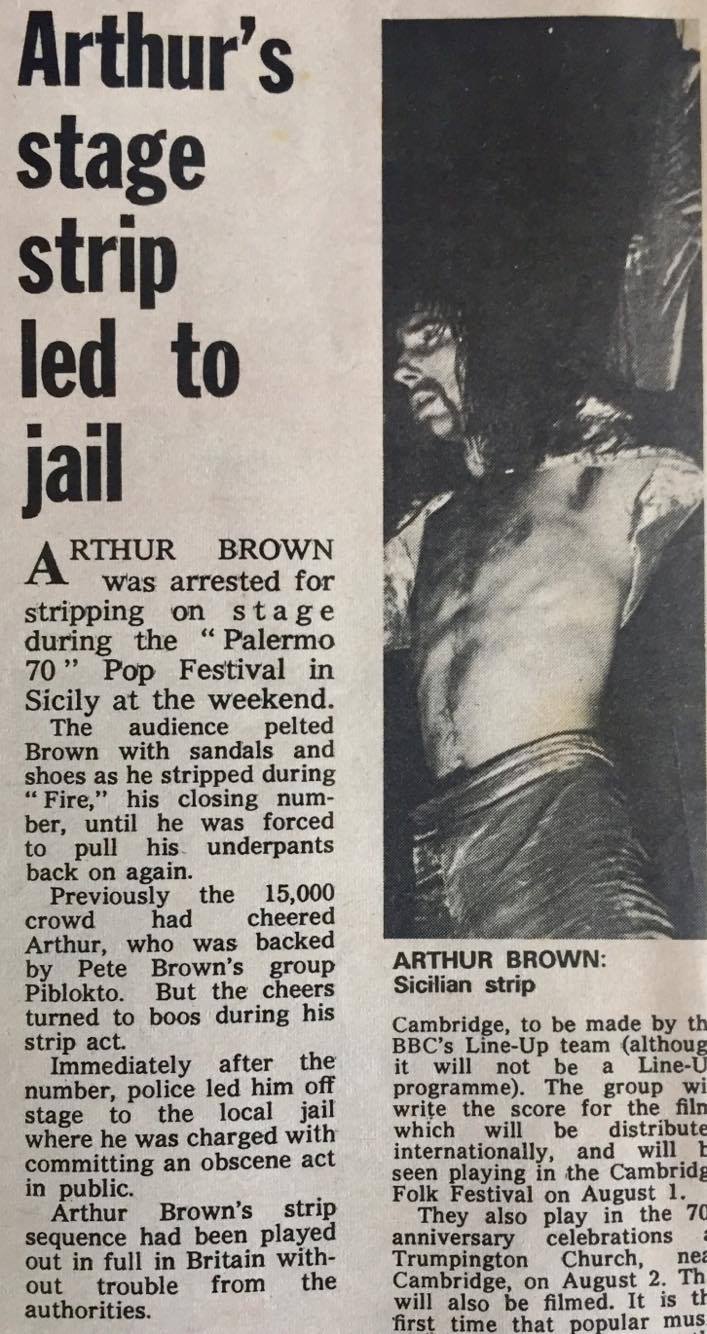
The Crazy World of Arthur Brown - The God of Hell Fire!

During the summer holidays in 1968, I would sit on the low front wall of the house across the road, with the neighbours’ kids, all of us around 10 years old, and we'd listen to the radio.

We would wait for our favourite songs to come on, like 'Itchycoo Park' by The Small Faces, 'Pictures of Matchstickmen' by The Status Quo, 'Green Tambourine' by The Lemon Pipers and 'Jesamine' by The Casuals.

But our very favourite that psychedelic summer was 'Fire' by The Crazy World of Arthur Brown. A pretty freaky song for a 9 year old boy. It begins with Arthur bellowing "I am the God of Hell Fire!"

That was precisely why we all liked it, of course. It was slightly scary and it had this organ sound, like something out of a horror movie.

As 'Fire' entered the singles charts, The Crazy World... appeared on Top Of The Pops, so we could see that Arthur wore a crown of fire while singing and gyrating like some demented wizard.

Arthur Brown sings 'Fire' on Top Of The Pops

I hadn't started buying records at this point and in those days you couldn't just summon your favourite song out of the ether. You had to wait for BBC Radio One to play it. And if you missed it, you might have to wait several hours for them to play it again.

Thankfully, 'Fire' got a fair bit of airplay that late summer, as it captured everyone's attention when the Crazy World appeared on TOTP - Arthur with his crown of fire. The song jumped up the charts, hitting the number 1 spot (pop-pickers!) in August 1968.

Down at the local park, we decided to form a club, The Fire Appreciation Society, membership of which was confirmed by pledging allegiance to Arthur Brown - The God of Hellfire! I felt like this was proper rebellious behaviour for a young boy.

Arthur Brown in full voice was, and still is amazingly, a thing to behold. He had a terrific vocal range, with a natural deep speaking voice, but he was also capable of some blood-curdling screams. Deep Purple's singer Ian Gillan has said he was inspired by Arthur to incorporate screaming into his own style.

Here's a clip of Arthur performing the 'Fire Suite' song 'Nightmare' in a British film of 1968 called The Committee. https://www.youtube.com/watch?v=4KlQLJri-a4

And here's a live clip from the period, with a very rare sighting of original Crazy World drummer Carl Palmer, later of ELP.
https://www.youtube.com/watch?v=2bBpWW3eizY

The Crazy World of Arthur Brown, with Vincent Crane on Hammer Horror Hammond organ (Crane later formed Atomic Rooster with Carl Palmer)  - were a feature of London's psychedelic rock scene in 1967 and '68.
Review of Arthur at the Middle Earth club

They appeared with bands like The Soft Machine and The Pink Floyd at psychedelic underground clubs like UFO and Middle Earth. The band were signed to The Who's record label, Track, so would also have appeared at shows with The Who and Jimi Hendrix in this period.

Interviewed by Record Collector magazine in 2013, Arthur said, "UFO was quite short-lived. It was an old Irish club for most of the week. The psychedelic light shows that began there were run by Mark Boyle, who was an adventurer in all those oil wheel projections that you see in photographs.

"Middle Earth was a scene where poets, dancers, political extremists, hippie radicals - like Yoko Ono and her 'Bag-In' - all did their thing. It was really everybody influencing everybody else. Out of all that came a lot of the experimentation we did."

After The Crazy World came to an end, Arthur fronted the band Kingdom Come. His performance at Glastonbury in 1971 - a highlight of the film 'Glastonbury Fayre' - shows how much he put into each performance. It really is a wonderful snapshot of the period, full of long-haired hippies stoned out of their minds.

Arthur recalled, "There were only 2,000 people there. The Maharishi spoke from the first pyramid stage and taught us his spiritual path. David Bowie appeared at dawn but strangely didn't appear in the film."

The cameraman was probably asleep. Bowie told how he had been up all night smoking dope at the Worthy farmhouse in the company of Terry Reid and Linda Lewis. So getting to the stage at 5am, he would not have been in the best shape, but nonetheless he seems to have captivated those who were awake.

Audio of Bowie's Glastonbury appearance exists, in which he thanks the audience for appreciating him, at a time when he was considering giving up playing live altogether:

"I just want to say that you’ve given me more pleasure than I’ve had in a good few months of working. I don’t do gigs any more because I got so pissed off with working, and dying a death every time I worked, and it’s really nice to have somebody appreciate me for a change.”

Black and Brown


Arthur moved to America for a few years in the 1970s and, among other things, had a decorating business with Jimmy Carl Black, the drummer from The Mothers of Invention.

He described Jimmy as "a fantastic character. His favourite line was  'God-dammit Arthur, why can't I make any money in music. I never got paid and I don't suppose I ever God-damned will!"

Frank Zappa meets Arthur Brown in London
He met Frank Zappa too and described him as "a visionary who worked harder than anybody I knew, in terms of recorded music and how to present it."

Through his connection with The Who, Arthur was invited by Ken Russell to play the role of The Preacher in Russell's film of 'Tommy'.

Arthur claims that Pete Townshend actually wrote 'Tommy' with him in mind to perform it, rather than Roger Daltrey, which would have been interesting. But in any case, The Who's co-manager Kit Lambert persuaded Pete that he needed to let The Who perform it.

Arthur as The Preacher in Ken Russell's 'Tommy'
In later years, Arthur would tell how he had burned himself so many times wearing the crown of fire. You can see in the TOTP clip, how he removes it in the middle of the song. That hasn't stopped him from wearing variations of the crown of fire in performances down the years. Well he is The God of Hellfire - his audience expects nothing less!

He says, "People still like to hear 'Fire'. We did it with a string section. We did it with a ska band, with Jerry Dammers, and with Johnny Clegg and 20 piece reggae orchestra at the 40th anniversary of Glastonbury."

In this clip, Arthur tells the story of how he wrote 'Fire' - drugs were not involved apparently - and he uncovers his old fire crowns in a shed.
https://www.youtube.com/watch?v=VqeXoAk4PR4

Arthur's still doing his thing
And so, being a long-time member of the Fire Appreciation Society, I have always had a soft spot for Arthur. He's an eccentric for sure, but quite sane for all that and he has stayed true to his roots as a theatrical musical act. Except for him it's more than an act. He has pursued a lifestyle that conforms to many of the original hippy ideals of communal and sustainable living.

He's also a good storyteller and with a strong and committed spiritual side.

I met Arthur very briefly in Victoria Station about 20 years ago. He's very tall and thin, with a deep voice. I didn't get the chance to tell him about the Fire Appreciation Society, but maybe if he reads this...

Here are some examples of Arthur Brown playing live back in the day and right up to this year.

Arthur Brown's Kingdom Come - live at Glastonbury, 1971
https://www.youtube.com/watch?v=xUjo7iZPkMA

Arthur talks about the Glastonbury Festival in 1971
https://www.youtube.com/watch?v=XAbZhmSqlDg

I Put A Spell On You - Live 2009
https://www.youtube.com/watch?v=vjw_ZLF8lhg

Fire Poem, Glastonbury, 2011
https://www.youtube.com/watch?v=TSSWiMyxJps 

Arthur interviewed by Steve Jones, 2017
https://www.youtube.com/watch?v=75DT21Kb0w0

The Crazy World of Arthur Brown - live in 2019
https://www.youtube.com/watch?v=BcMb363Rp-I
The Fire suite starts about 33 minutes into the set.

Monday, 2 September 2019

The Who 'Put The Boot In' at Charlton FC, 1976


It was a game of two halves this one. The weather played its part in dampening spirits and some bands dealt with it better than others. The Americans came off worst,  while the two bands at the top of the bill did particularly well, being British and more used to playing in inclement conditions.

Billed as 'Who Put The Boot In' - because it was a tour of football grounds - this festival roadshow hit London on a Monday afternoon, a May bank holiday in 1976. My friends and I set off across London in our mate's car, he having just passed his driving test.

That was our first mistake. It was to be a baptism of fire for us passengers, because it turned out that whoever allowed this guy to drive away from the test centre the previous week must have been having a laugh. We actually lost count of the number of times we nearly crashed on the way to The Valley, Charlton Athletic's ground.

Vintage bank holiday weather at The Valley
Even though we drove to The Valley in the shadow of death, we did eventually get there and joined the throng outside the ground.

It was fairly chaotic, as there were a lot of fake tickets about. Once inside, it was very crowded and I suspect it was over capacity. Going to the toilet was likely to be a challenge (see the reader's letter below).

Football grounds in the 1970s were still very basic, with covered stands only on one side of the ground (for the home supporters) that were little more than tin sheds. The weather was OK when we arrived, but at some point in the afternoon it started raining. It continued for what seemed like most of the day. There was nowhere to shelter, unless you wanted to cram into the one covered area, with limited sight of the stage.

So conditions were not ideal and some of the acts that appeared were clearly ill-prepared for the English weather. Hard rockers
Nick Gough's photo of Streetwalkers at Charlton
Widowmaker
were probably up for it, though I have only the vaguest memory of their appearance. This was the band formed by former Mott the Hoople and Spooky Tooth guitarist Luther Grosvenor, aka Ariel Bender, with singer Steve Ellis from the Love Affair.

Streetwalkers was another supposed super-group, formed by ex-Family members Roger Chapman and Charlie Whitney, along with guitarist Bobby Tench and future Iron Maiden drummer Nicko McBrain. Their more funky and soulful approach went down well and they included some Family songs in their set too, including 'My Friend The Sun' and 'Burlesque'.


Getting country rock across to an audience of damp denim-clad Brits was always going to be a challenge, but The Outlaws did their best. The rain had started by now, so it was going to be tough going for the Americans to win over this audience. 

Little Feat play on through the rain
 
Riding a crest of critical acclaim in the UK after their previous visit, on the 1975 'Warner Brothers Music Show' tour, Little Feat were the hip band of the moment. Their leader Lowell George had even featured on the cover of the NME six months previous, billed as the Future of Rock 'n' Roll. 

But when it's raining, you're wearing a stetson and you've got a giant jelly with a Hollywood sign as your stage backdrop, you're the proverbial square peg. The soundboard recording shows they played great, (although there were clearly problems with Bill Payne's vocal mic) and while most of the crowd responded warmly to their set, the damp weather conditions were not the ideal setting.

Little Feat up close at Charlton
The NME's review of Charlton said, "Little Feat almost made it, despite the circumstances. The audience were there for the taking and, sandwiched between the Outlaws and the Sensational Alex Harvey Band, and given time to play an album's worth, they should have done the trick. Somehow they let it slip through their fingers.

"They sure started off on the right feat, working out on such familiar material as Sailin' Shoes, Oh Atlanta and Dixie Chicken. They demonstrated the necessary attributes to carve their niche as one of the premier bands of the mid-seventies."

Interviewed that weekend in Sounds

But the reviewer noted that towards the end of their set, Little Feat failed to maintain their energy levels to the extent that they weren't called back to encore. "Truth to tell, they didn't garner sufficient applause to warrant a return."

The audience was a little distracted. Just as Little Feat neared the end of their set, one fearless young man climbed halfway up one of the floodlight pylons. 

"There, he proceeded to offer a display of spectacularly stoned aerial calisthenics that took your breath away," said the NME.

There were angry calls over the PA for him to come down, but when SAHB took the stage he was still up there.

Hey you, stop that fuckin' fight!
However, Alex had other things to attend to. "Stop that fuckin' fight!" he bellowed to a section at the front who were getting restless. By this time, we were down the front ourselves, so we had a great view of the SAHB show.

Alex and his colourful band knew how to entertain, with the visuals being a factor in the group's success. 

The band themselves were great musicians and while Alex wasn't blessed with much of a singing voice, he could bellow out the tunes with plenty of character.

SAHB at Charlton
SAHB were at turns funny, funky and rocking, with guitarist Zal Cleminson and drummer Ted McKenna (situated stage right) on particularly fine form. Their keyboard player, Hugh McKenna, had collapsed that week and doctors had ordered him to rest, so Tommy Eyre played keyboards with SAHB at Charlton. 

Alex did his Hitler shtick for 'Framed' and got the audience jumping around for 'Faith Healer' and the encore of 'Delilah'. It was a proper show, with Zal and bassist Chris Glen playing strong supporting roles to mainman Alex. 

As evening fell, The Who took the stage.

The rain relented a little before The Who's arrival, but the stage was still soaking wet when they did hit it. Roger Daltrey joked about "The Who on Ice" as he slid onto the stage.

The Who always put on a good show, certainly when I saw them in the 70s, and this one was special because it was one of the last gigs they played with Keith Moon. The set list was the usual mix of oldies such as Substitute and I Can't Explain, a bunch of songs from Tommy, the classics from Who's Next and more recent material from Quadrophenia and 'By Numbers'.

They played great too. From recordings of the show, you can here that Townshend was on fine form, with Entwistle and Moon a tight rhythm section and everyone in tune. 

This audio clip is The Who playing  'Sparks' from the Tommy album at Charlton
https://www.youtube.com/watch?v=WI97tPtb604 

Despite being an outdoor gig, it was also one of the loudest shows ever. The amplification had a total output of 76,000 watts and official sound readings measured 120 decibels, a record at that time. 

Keith did his vocal turn on 'Bellboy'. The set finale was lit by lasers at the climax of 'Won't Get Fooled Again', the beams being reflected on mirrors stationed on the floodlight pylons. This was high-tech by 1970s standards.

It was triumphant gig for The Who and overall it was a fun day.

I don't remember the journey home, which is probably just as well.
The NME's review of Charlton 1976 and my souvenir badge
A reader puts the boot in...

IF YOU LIKE MY BLOG, PLEASE HIT THE FOLLOW BUTTON ON THE SIDE PANEL THANKS

Also on this blog:
The Who at The Isle of Wight, 1970

Who's Next - Lightning In A Bottle

Little Feat at the Warner Bros Music Show, 1975

Saturday, 17 June 2017

50 Years Ago Today: Jimi Hendrix wows Monterey

The most electrifying three minutes in the history of live rock music.
Made all the more significant because it was Jimi returning to his homeland in triumph.


On Sunday June 18 1967, The Jimi Hendrix Experience was introduced to the American rock audience, live for the first time at the 'Monterey Pop' Festival. And he blew their minds.

Jimi had come to London in September 1966 and was immediately hailed as the new guitar god, unseating Eric Clapton in the process. As described in my post about Jimi's shows at the Saville Theatre in London, Hendrix had crafted a stage act in his first European gigs that reached its first real flowering (man) when he returned to the U.S. 9 months later.

Monterey Pop was the first major coming together of rock's foremost talents, including Janis Joplin, Otis Redding, the Grateful Dead, Buffalo Springfield, Simon & Garfunkel, The Mamas and Papas, Jefferson Airplane and The Who.

Jimi must have been ecstatic to suddenly be in this rarefied atmosphere - the California sunshine, a groundbreaking festival gathering and, to judge by his performance, he revelled in this talented company

Jimi was the surprise package of the festival. He had achieved his breakthrough in England, so no one on the West Coast had ever seen or heard of him. His first album Are You Experienced was only released later that month in the US. 

That made his performance even more of mouth-open shock. Michelle Phillips, who became great friends with Jimi subsequently, said she was initially appalled by the way he treated his guitar, smashing it up and setting it on fire. 

Pail McCartney had been asked by John Phillips to recommend an act to appear at the festival. He chose Hendrix. And to top it off, Jimi was introduced by one of his close friends from London, Brian Jones. He was the only one of the Rolling Stones or the Beatles who attended Monterey.

And for me, the adrenalin rush of their first song, Killing Floor (see the clip above) that had given Eric Clapton the shock of his life when Jimi first arrived in London is perhaps the most exciting three minutes in the history of live rock. Jimi, Mitch and Noel, with their frilly shirts and feather boa, give it everything and leave mouths agape, like 'what did we just see?'

"Yeah, it's really out-of-sight here, it didn't even rain; no buttons to push...". 

During the set, he pulled out all the stops, showing off his unique combination of rhythm and lead playing, cuffing the guitar, playing it behind is back, with his teeth, and then finally setting light to it, to the astonishment of the audience. 

Remember this is 60 years ago! The 1960s may have been swinging, but what Jimi did, in common with other revolutionaries of that era, was push out the boundaries beyond most people's imagining at that time.

The drugs helped in the mind-blowing, of course. Legend has it that Hendrix was tripping on Owsley LSD at Monterey. Hard to believe he could play and sing like that under the influence of mid-altering psychedelics, but records of the time suggest that may have been the case. 

Earlier in 1967, at the free festival at Mount Tamalpais, Owsley, the acid king immortalised in Steely Dan's Kid Charlemagne, was said to be dispensing acid to the performers as they were about to go onstage with the words, "do you want the sacrament?"

Robert Christgau noted in The Village Voice that Hendrix, after his famous row with Pete Townshend, (see the comments from John Phillips in the clip above) was stuck with topping the Who's guitar-smashing tour-de-force. "It's great sport to watch this outrageous scene-stealer wiggle his tongue, pick with his teeth, and set his axe on fire." 

The performance, he said, heralded "the dawning of an instrumental technique so effortlessly fecund and febrile that rock has yet to equal it, though hundreds of metal bands have gotten rich trying. Nowhere else will you witness a Hendrix still uncertain of his divinity."

 
This was a legendary performance. The arrival of King Guitar.

Youtube has not been your friend when it comes to clips of Jimi playing Monterey. Over the years, most of them have been taken down by copyright owners. What I have presented here - my own archived copy of Killing Floor and the Wild Thing finale, give a taste of the magical set Jimi played. But there's plenty more, including a great version of Dylan's Like A Rolling Stone.

There are some new HD versions appearing now too, like this clip of Rock Me Baby

Try to get hold of a copy of the original Jimi Plays Monterey movie from Criterion. I have it as part of a boxed set that includes Otis Redding's set, the original Monterey Pop movie and a DVD of outtake performances. Well worth checking out if your budget permits.
 
IF YOU LIKE MY BLOG, PLEASE HIT THE FOLLOW BUTTON ON THE SIDE PANEL THANKS

Also on this Blog: