Showing posts with label zappa. Show all posts

Saturday, 4 December 2021

Smoke On The Water - Montreux 50 years on

The Montreux Casino goes up in smoke, Dec 4 1971
50 years ago this evening, “some stupid with a flare-gun” caused the Montreux casino fire that was the inspiration for Deep Purple’s best-known song Smoke On The Water.

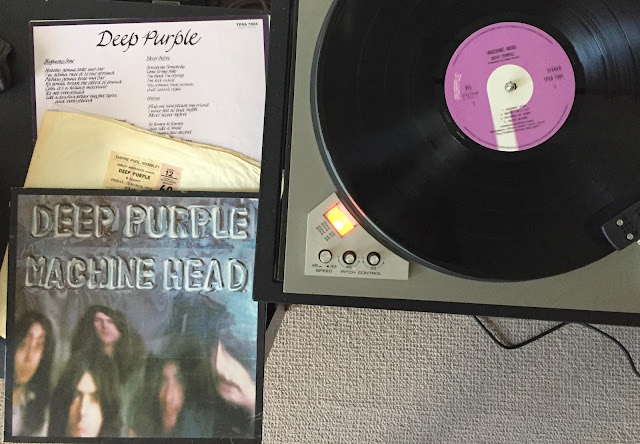
In December 1971, Deep Purple were in Switzerland to record what would become their classic album Machine Head. On December 4th they attended a show at the Montreux Casino, on the shore of Lake Geneva. During the show, by Frank Zappa’s band The Mothers Of Invention, a member of the audience fired a flare into the wooden rafters of the casino roof.

There is an audio recording of the concert where Zappa can be heard calmly telling the audience to head for the exits. The evacuation was completed safely and there was no loss of life. The casino building was totally ruined by the fire.

The Montreux Casino as it was

As the smoke drifted across the lake, Purple's bass guitarist Roger Glover thought of the title...

We all came out to Montreux
On the Lake Geneva shoreline
To make records with a mobile
We didn't have much time
Frank Zappa and the Mothers
Were at the best place around
But some stupid with a flare gun
Burned the place to the ground

Smoke on the water
Fire in the sky

FZ surveys the scene
Zappa’s band lost most of their gear in the fire. Deep Purple, who were scheduled to begin recording at the casino the next day, managed to avoid losing their equipment, but had lost their recording location.

With nowhere to make their album, Montreux’s music festival promoter Claude Nobs came to the band's rescue. Glover said, “He put all his problems aside. We had no place to record, so he arranged to have us move into a small theatre near the smouldering remains of the casino.”

The ruins of the Casino


They burned down the gambling house
It died with an awful sound
And Funky Claude was running in and out
Pulling kids out the ground

Whilst at the theatre, they started messing around with a new riff. "We were doing the first take of this new song – well, it wasn’t a song yet, it was just a jam with a kind of rough arrangement to it," said Glover.

What they didn’t know was that the police were outside banging on the door trying to get in and stop them playing. Apparently they were keeping the whole town awake. "Montreux was then a very sleepy town, populated mostly by old ladies,” quipped Glover.

Deep Purple recorded their classic album in a hotel corridor
It became clear the band were not welcome in the lakeside town, especially after the events of the fire. Rock bands meant trouble to the Swiss, but Nobs helped Purple find “a place to sweat”.

When it all was over
We had to find another place
But Swiss time was running out
It seemed that we would lose the race

Thanks to Funky Claude, they were able to secure a place where they could make some noise - The Grand Hotel.

Glover recalled, “It was closed for the winter. A cold sort of place, I mean it was freezing cold. We had a carpenter put a couple of walls up. We threw some mattresses against the windows, brought in a couple of industrial heaters. And we recorded there.”

 The Stones' mobile truck at the hotel
The Rolling Stones’ mobile recording truck was parked at the rear of the hotel. Engineer Martin Birch set up an intercom so he could communicate with the band in the hotel corridor. Here's Take 2 of Highway Star, the first track on the album.

"We were still short of a song, so it was suggested that we work up the song we had jammed at the theatre. It became a song about the adventure of coming to try and record, and the place burning down and ending up doing it in a hotel corridor."

We ended up at the Grand Hotel
It was empty, cold, and bare
But with the Rolling truck Stones thing just outside
Making our music there

Guitarist Ritchie Blackmore came up with the classic riff and in its simplicity, Blackmore has likened it to the famous introduction to Beethoven’s fifth symphony.

"What Beethoven does with just very few notes, that riff does too. But it’s got a hint of Eastern mysticism in it, just by the semitone lift. Instantly recognisable and yet like nothing else," said Glover.

The Grand Hotel, Montreux, November 2021
Blackmore also pointed out that everyone plays the famous riff wrong. Blackmore plays it in fourths, plucking two strings at a time, rather than block chording it.

Glover and singer Ian Gillan wrote the lyrics. "We never thought for a minute it was going to have the kind of future it has had,” said Glover. “We didn’t think that much of it. We put all our efforts into another song on the album, Never Before."

Purple"s run of hit singles in 1970 and '71 - Black Night, Fireball and Strange Kinda Woman - came to a halt with Never Before, one of the new tracks recorded in Montreux. For some reason it didn't sell. It probably didn't make the playlists on major radio stations, perhaps because it was a little different from what you'd expect of Purple; neither rock nor pop. 

The rebuilt Montreux Casino, November 2021
Nonetheless, the album sold well and Purple picked up further sales momentum when the live version of Smoke On The Water, from the album Made In Japan, was released in the US in 1973.

Given the limitations of space and comfort at the Grand Hotel, it is remarkable that Deep Purple were able to make such a great record as Machine Head. It showcases not only a consistently high quality of songwriting, but also a band that rocks (Highway StarSpace Truckin) and swings too (LazyMaybe I'm A Leo).  

And then there is Smoke On The Water - a riff they must be sick of playing after all these years. But for better or worse, it's what most people know them for. And it's got a great story behind it.

With a few red lights, a few old beds
We made a place to sweat
No matter what we get out of this
I know, I know we'll never forget Smoke on the water
Fire in the sky

The Lake Geneva shoreline, November 2021
Last month, my wife and I visited some friends in Vevey, the next big town along the lake from Montreux. 

We walked along the promenade, sampling the delights of the Christmas market in Montreux. We visited the rebuilt Casino, which houses the recording studio that was owned by Queen for many years. 

And there, on the water, was the same view of the Lake Geneva shoreline from the Machine Head album, minus the smoke.

IF YOU LIKE MY BLOG, PLEASE HIT THE FOLLOW BUTTON ON THE SIDE PANEL THANKS

See also on this blog:

1970 - Deep Purple Get Heavy with 'In Rock'

Most-viewed Youtube clips - Tommy Bolin live, 1976

There's a lot to like in the 'ZAPPA' movie

Electric Ladyland - The Genius of Jimi Hendrix

What Is Led Zeppelin's Best Acoustic Song?

The Who - Who's next - Lightning In A Bottle

Worth watching:
Rick Beato dissects Smoke On The Water


Sunday, 18 April 2021

Alice Cooper - back when he was genuinely scary

Following on from my recent blog about the Frank Zappa movie, it's time to reminisce about one of the bands he took under his wing in the late 1960s - Alice Cooper. 

Zappa gave the Alice Cooper group a break when no one else would.

The group had moved From Phoenix, Arizona to Los Angeles in 1967 to make the big time, or so they thought. 

Zappa saw them live a few times at the Whisky A-Go-Go in 1968 and saw something within their shambolic stage act that he might be able to work with. He told them to come to his house to audition. They turned up at 7am one morning. Frank had meant for them to come at 7pm - he was still in bed. 

Not a nice way to wake up, because by all accounts the Alice Cooper group were pretty horrible to listen to, and fairly intimating too. They had a real knack for emptying a room in no time at all, said their singer.

Alice Cooper and Frank Zappa, 1968
Alice recalled that Zappa came to a show: "We scared the hell out of the audience - they were all on acid. We looked like we'd just come up out of the ground, and we didn't mind a little violence onstage. That audience couldn't get out of the room fast enough. It was like somebody yelled "FIRE!" 

There were three people left standing. Frank said, "Anybody that can clear a room that quick, I've got to sign."

The resulting records on Frank's Straight label, Pretties for You and Easy Action, bore little of the production values displayed on their later records. Sales were slim.

Zappa's patronage took them nowhere. The band felt they were out of step with the laid back music culture in LA. "They were all on acid and we were drinking beer," said Alice. So in 1970 they moved to Detroit, where Alice was from. 

"Told her that I came from Detroit city
- and I played guitar in a long-haired rock 'n' roll band."

Love It To Death, 1971
Alice Cooper the band were a close-knit gang and certainly looked the part, with their mix of glam and Rolling Stones early 70s-style chic. They just needed the right producer to deliver on their potential. 

That's when the group hooked up with producer Bob Ezrin and refined their 'theatre of the grotesque' stage act, complete with guillotines, electric chairs, fake blood, reptiles and mutilated dolls.

Ezrin's productions were all about drama and he worked at convincing the band to refine their stage act into more polished songs. He also drafted in some sessions musicians to bolster the sound.

And just like that, they had a US hit single, I'm Eighteen in late 1970 and early '71. It was enough to convince Warner Brothers to offer the group a budget for the first of their classic run of albums, Love It To Death

Touring America in the summer of 1971, the band really began to up the theatrics, with Alice appearing in a straitjacket during The Ballad of Dwight Fry and being sent to the electric chair in Black Juju

Killer, 1971

The band's popularity grew further with the release of the album Killer in late 1971. It contained a stronger more cohesive set of songs that have remained fan favorites. 

Side One is literally all Killer, no filler. Opening with the one-two punch of Under My Wheels and Be My Lover, followed by one of the bands most successful extended tracks, the eight minute Halo of Flies

Showing they could combine the Detroit rock styling with more complex arrangements, Ezrin topped it all off with typically grandiose production and string arrangements to enhance the drama. 

After the tension and release in Halo of Flies, side one closed with one of Alice and guitarist Michael Bruce's best co-compositions, Desperado

The Killer tour, 1972
I've always viewed these two songs as a one-two punch. The change of pace and mood of Desperado is the perfect complement to Halo of Flies and adds new depth to the album. Alice claimed he wrote it about The Doors' singer Jim Morrison, who died around the time the album was being made in 1971.

Controversy was never far away from Alice Cooper in this era, and that was just the way they wanted it. On Killer the song Dead Babies stirred up a heap of trouble. Despite the band's claim that the song was railing against child abuse, the guardians of the public morals decided it was nothing short of satanic. 

1972 calendar from Killer
Alice's notoriety had reached British shores by this point and when School's Out became a number one hit in 1972, there were calls by Mary Whitehouse and members of the British Parliament to have the group banned from the UK. 

Leo Abse MP described Alice Cooper's act as "the culture of the concentration camp. His incitement to infanticide and his commercial exploitation of masochism is evidently an attempt to teach our children to find their destiny in hate, not in love."

The establishment was outraged. A report in The Guardian newspaper in 1973 said, "It is the Cooper stage show which arouses alarm. I saw him perform in his home town of Detroit last month. Although the thick clouds of marijuana probably preserved me from too sadistic a reaction, wax babies were smashed and impaled on guitars. 

Disco 45, 1972
"Alice was beheaded and his bleeding neck and the bodies of shop-window mannequins were nuzzled and gnawed to the accompaniment of a throbbing, relentless tide of menacing rock music."

Of course, this only made fans even more determined to buy the group's records and concert tickets. 

Alice and Warner Brothers made the most of all this publicity. The School's Out LP came with the record wrapped around a pair of disposable knickers.

This raw live performance of the School's Out album track Public Animal #9 shows how the Alice Cooper sound and attitude influenced future punk Johnny Rotten, who once claimed that Killer was his favourite record. 

In the late summer of 1972, in the run-up to the US presidential election, Alice Cooper released the single Elected. The promotional video, seen on Top Of The Pops, showed Alice on the campaign trail, stepping out of a limousine in New York City and greeting potential voters in a white suit and tails and a top hat. 

His campaign message was simple and direct. At the end of the song he can heard proclaiming:
"And if I am elected, I promise the formation of a new party - A third party, the Wild Party!
I know we have problems. We got problems right here in Central City,
We have problems on the North, South, East and West,
New York City, Saint Louis, Philadelphia, Los Angeles, Detroit, Chicago,
Everybody has problems,
And personally, I don't care."
45s and the free flexi-disc from NME in 1973
 
Elected
, the 45, was slightly edited and had a different mix from the subsequent album version, with a grungier guitar sound. I can still remember the thrill of hearing that guitar intro blasting out at a local church disco.

The group's biggest selling album, Billion Dollar Babies, was previewed for fans in Britain by a promotional flexi-disc given away with the weekly music paper NME in February 1973. The free flexi included 'Slick Black Limousine' a track unavailable elsewhere.

Pretty much every song on Billion Dollar Babies was a big production number. Probably the most over-the-top was Unfinished Sweet, with Alice in the dentist's chair about to have his gums removed. Ezrin's orchestral arrangement was aptly melodramatic.

The album's finale was the outrageous and anthemic I Love The Dead, another song that would have had Mary Whitehouse tearing her hair out.

No one cared. Billion Dollar Babies was a number one album on both sides of the Atlantic. The record was packaged elaborately, including a billion dollar note. The band were headlining tours around the world and they looked the part, dressed up in white silk suits on the inside sleeve of the record. 

But by 1974 things began falling apart. There were disagreements over how much money was being spent on the stage shows. Alice wanted to go more in the theatrical direction, but the others wanted to get back to being a rock band. 

Meanwhile Alice was probably being encouraged by the record company to ditch the band and carry on as a solo artist, formally adopting the Alice Cooper name as his own.

Drugs and alcohol played their part in the downfall. Alice, nowadays teetotal, was back then never pictured without a beer in his hand. Lead guitarist Glen Buxton contributed less and less in the studio and was excluded altogether from the recording of the next record, Muscle Of Love

The crucial split came with Bob Ezrin. Mike Bruce and Ezrin clashed over the arrangement of one of the new songs and Ezrin quit. The band has lost their production wizard. The resultant album had fewer quality songs and less of the sparkle of the previous records. Bass player Dennis Dunaway said later: "We could tell that everything was being pulled out from underneath us. As hard as we tried to get it back to where it once was, we had that sinking feeling."

And that, sadly for the rest of the band, is where the story ended. A group that had worked for 10 years to make it was fairly suddenly cast adrift. Alice took the name and struck out on his own with Bob Ezrin back in the producer's chair. 

The first Alice Cooper solo album, Welcome To My Nightmare, gave him a platform to develop the Alice character and sustain his career to this day. 

But by leaving the band behind, he lost a degree of credibility. No longer scary, just cartoonish. Rolling Stone's review said that "without the wildness and drive the Cooper band had, the gimmicks on which Alice the performer must rely are flat and obvious."

Overall, the reviewers were generous about Welcome To My Nightmare. But a later review of Alice's solo career concluded that despite this promising start, "the majority of his subsequent releases were often not as focused and were of varying quality."

Alice Cooper interviewed  by Russell Harty, 1975

Dennis Dunaway on life in the Alice Cooper group

Eighteen and Black Juju, live 1971

Alice Cooper and Vincent Price perform The Black Widow, 1975

IF YOU LIKE MY BLOG, PLEASE HIT THE FOLLOW BUTTON ON THE SIDE PANEL THANKS

See also on this blog:

Slade, the 1970s Glam Rockers back at Number One

At Home With The Bolans, 1971

There's a lot to like in the ZAPPA movie

Friday, 26 March 2021

There's a lot to like in the 'ZAPPA' movie

The recently released movie about Frank Zappa was compiled using never-before-seen footage from his extensive music and video archive. It provides a level of detail that even uber-fans will find revealing. Those less familiar will also enjoy it, if they are open to learning about this unique composer.

Zappa remained a maverick throughout his life and wasn't afraid to confront the petty morals of those attempting to curtail his activities. Above all, he is deserving of greater recognition for the enormous catalogue of music he created - even if you or I don't care for some of it.
ZAPPA the movie, does him justice, highlighting his considerable talents not just as a rock musician, but as a composer of orchestral works.

Early in the film we see inside the massive Zappa tape archive which director Alex Winter had full access to in making ZAPPA. The project was crowd-funded (I contributed a modest amount), allowing the estate managers to back up and preserve all the old tapes.

FZ with his master tapes and other treasures
With unearthed home movies from the period we see how, from an early age, Frank saw himself as an outsider. After a childhood in Baltimore, his family lived in a series of small towns in California and this sense of cultural isolation contributed to his singular vision.

He was a contrarian from the outset, seeking out unusual and unpopular music - the uglier the better. He took inspiration from modern 20th century classical composers such as Varese and Stravinsky, particularly in the primitive early recordings he made with his group The Mothers Of Invention, and in his later orchestral pieces.

His earliest compositions were all classical in nature, he said, even if they didn't conform to most people's idea of classical music. As his percussionist Ruth Underwood says of the tune 'Oh No' in the movie: "This music could sit comfortably in a concert hall. It was a product of everything that was in him. But you couldn't really categorise it."

An early Mothers concert poster
This interpretation of 'Oh No' by Owen Adams is a great example of, as he says, the beauty and complexity of Zappa's music.

This wasn't rock and roll and it wasn't jazz. It was like psychedelic art with musical interludes, that could be anything from classical to avant-garde.

The early Mothers records, from 1966 to '68, such as Freak Out! and We're Only In It For the Money  were like musical collages, with tape looping and orchestral interludes laced into the more mainstream rock music of the period. 

If there was a lyrical thread running through his rock/jazz records, it was mostly to do with getting laid. This led naturally to many costly run-ins with the guardians of the public morals.

The movie includes film of the band's legendary residency at the Garrick Theatre in New York, where Frank would delight in toying with the audience.
On one occasion, Zappa brought a bunch of marines onto the stage and had them acting out a battle scene with plastic dolls.

"We were loud, we were coarse and we were strange," recalled Frank.


He
disbanded the original Mothers in the late 60s, saying that having a road band on a full-time basis was unsustainable. He concentrated for a while on solo albums, including many people's favourite, Hot Rats. He then regrouped the Mothers with different musicians and the singers Mark Volman and Howard Kaylan from the pop group The Turtles.

The cover of Overnite Sensation
In the mid 1970's, he produced probably his most consistent and enduring records for a wider audience, such as Overnite Sensation, Apostrophe and One Size Fits All. The smut quotient did not diminish.

By the late 70s, as one of the more astute musicians business-wise, it was only a matter of time before he fell out with his record company.

He and wife Gail set up one of the first truly independent record labels, Barking Pumpkin. His first album release under his own label, Sheikh Yerbouti, turned out to be one of his biggest sellers, allowing him to sustain his performing career and pursue his orchestral ambitions. 

The Mothers at The Whiskey in LA, 1967
My interest in this movie was in the treasures that lay in the vault. Overall, Winter and his editors did a good job of giving us (albeit short) glimpses of this material, including early home movies.

I appreciated the way they spent much of the first half of a two-hour movie on the earliest incarnations of the Mothers - from the 60s to the early 70s, which musically I think is far more interesting. 

The strange evolution of Zappa's music is brought to life with never-seen clips of his earliest musical exploits. Though I'd seen some of it before, it's fascinating, for example, to see extended footage of the Mothers evolving their bizarre act via a 5-month residency in 1967 at the Garrick Theatre in New York's Greenwich Village.

Ruth nails The Black Page
As the movie illustrates, Zappa was driven to write and compose. He toured regularly around the world until the late 1980s. The proof of his worth as a composer - and his skills as a band leader - are the sheer number of virtuoso musicians who came through his ranks. Only Miles Davis could beat him in that regard.

Ruth Underwood said of Frank, "there was always more music" He never stopped working and writing out manuscripts for the band to work on.  

There's a lovely moment in the movie where Underwood and drummer (and Zappa archivist) Joe Travers have a go at one of Frank's most difficult-to-play compositions, The Black Page. There's a look of surprise and joy on Ruth's face as she finishes playing and Travers exclaims "You fucking nailed it!". That's a measure of the challenge that Zappa set for his musicians.

Frank and Alice Cooper in 1969
Zappa nurtured other bands too, including his school friend Don Vliet, otherwise known as Captain Beefheart. He produced Beefheart's album Trout Mask Replica in 1969.

Frank was also the only one who would take a chance on the Alice Cooper group when they were starting out.

Alice said Zappa came to a show: "We scared the hell out of the audience - they were all on acid. We looked like we'd just come up out of the ground, and we didn't mind a little violence onstage. That audience couldn't get out of the room fast enough. It was like somebody yelled "FIRE!" There were three people left standing. Frank said, "Anybody that can clear a room that quick, I've got to sign."

Seeing the cover of We're Only In It For The Money  brought to life is another treat. Jimi Hendrix can be seen among the people appearing in the film of the cover shoot.

Jimi Hendrix at the cover shoot
The Beatles also feature in the movie, once when Frank complains how Paul McCartney was unwilling to help resolve any potential problems over the cover of We're Only In It For The Money - a pastiche of Sgt. Pepper. Frank was forced to reverse the cover when The Beatles failed to see the joke.

The Moptops appear again briefly in a clip of them arriving in the US on their first tour in 1964, which shows fans holding up signs saying 'Beatles Unfair to Bald Men' and 'Beatles are starving the barbers'. My, how times have changed.

Another highlight of the movie for me is seeing rare film of Frank going over a passage of written music with drummer Vinnie Colaiuta. It's unusual to see any drummer, let alone one of the greatest of all time, up close and in an informal setting working with Frank.

FZ conducting the Ensemble Modern
As the movie progresses, we learn more about Frank's clashes with the forces of political correctness. He was a lone voice in the fight against censorship of the record industry, on the basis that he was not beholden to anyone, unlike most artists.

We also get to understand more about his challenges in getting his classical compositions played live. Some orchestras proved incapable of playing his compositions to Frank's satisfaction. He said he'd rather not have them performed at all, than have them done badly.

Close to the end of his life, in 1992 we see him conducting a performance of the Yellow Shark by the Ensemble Modern, which Frank described as one of the most fulfilling projects of his career, and as the best representation of his orchestral works.

Zappa meets with Havel
Frank died of prostate cancer in 1993, working right to the end to complete written compositions. The movie does a good job of reflecting the frustrations of his final years, when he was embraced by political leaders in eastern Europe, while the US government tried to undermine his efforts. 

Zappa met with Czech leader Vaclav Havel, who led the country's Velvet Revolution and the collapse of the Soviet regime in 1989. The Bush administration's message to the Czechs was simple - you either deal with the US government, or you deal with Zappa.

The casual viewer of Zappa the movie will learn much about this unique character. I came away from it pleased that Alex Winter had done justice to the complex life and music of FZ.

If you want to see more from the early days, there is this Day In The Life clip available on YT.

https://twitter.com/zappamovie
https://www.instagram.com/zappamovie/

Steve Vai talks about the Zappa movie

Audio - The Mothers at The Garrick Theatre, New York, 1967

Mothers - Live at the Fillmore, San Francisco, 1970 

Frank Zappa & The Mothers - Montana, Live at the Roxy, LA, 1973

IF YOU LIKE MY BLOG, PLEASE HIT THE FOLLOW BUTTON ON THE SIDE PANEL THANKS

See also on this blog:
Zappa's album One Size Fits All reviewed in 1975

Unveiling a Frank Zappa statue in Baltimore - Dweezil plays live, 2010

Frank Zappa and Lowell George together, 1969