 |
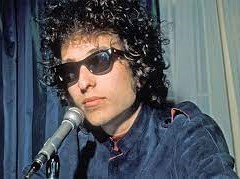
Cool Bob, 1966
|
Like many a 1960s classic album, Blonde On Blonde is a record that is very much of its time, but one that still resonates down the years as an important milestone in rock music.
It marked the end of an era for Dylan himself, the culmination of two years of intensive writing, recording and touring that could have turned him into another rock and roll casualty. He was too smart to fall into that trap, though. Or maybe he was just lucky.
In 1965, Bob Dylan had consolidated his move into electric music
with the album ‘Highway 61 Revisited’ and its iconic single ‘Like A Rolling Stone’. He had toured Europe, confronting the hostility towards his new electric
sound from folk purists who called him
Judas for abandoning the protest movement and his acoustic guitar.
In his contemporary
review of Blonde on Blonde for Crawdaddy magazine in July 1966, Paul
Williams had words for those who continued to boo Dylan at his live shows.
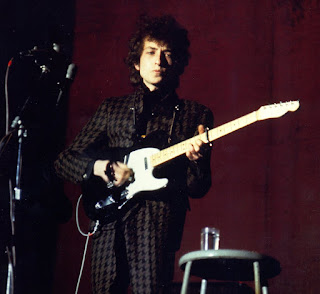 |
Electric Bob, cool suit
|
"As long as people persist in believing that Dylan should be playing his new songs on a folk guitar instead of with a band, they
will fail to realise that he is a creator, not a puppet, and a creator who has
now reached musical maturity. If you’re interested in what he’s saying, you
must listen to him on his own terms."
By the end of 1966, Dylan would be in hiding, burnt out from the road
and keen to embrace family life. But as the year opened, he was on top
of
the world commercially. He had sold 10 million records worldwide and had
begun
recording a double album (a first in the rock era) that would be the
culmination of his early 60s rise to stardom.
On Blonde On Blonde, in contrast to his previous albums, two
things stood out for Paul Williams: “the uniform high quality of the songs chosen
for this extra-long LP and the wonderful, wonderful accompaniments.”
Recording sessions had begun in New York in October 1965, but whatever Dylan was looking for, he wasn’t getting it from these
sessions. His producer Bob Johnston recognised that Bob wanted to craft an album with greater refinement than his previous efforts. Organist Al Kooper and guitarist Robbie Robertson were
retained from the New York dates and in early 1966, the sessions moved to the CBS studios in Nashville, using their highly experienced session players.
“Not only is Dylan’s present band easily the best backup
band in the country, but they appear able to read his mind,” said Williams. “On
this album, they almost inevitably do the right thing at the right time. They
do perfect justice to each of his songs, and that is by no means a minor
accomplishment.”
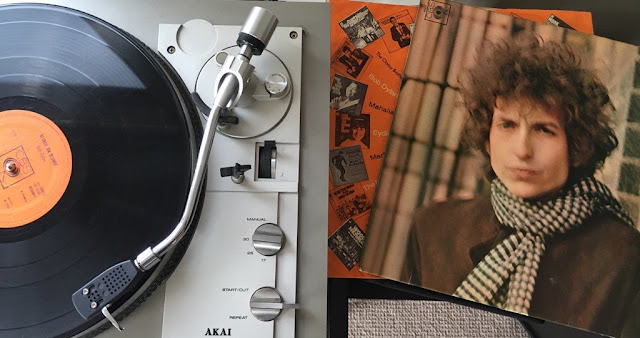 |
My vinyl copy is an original 1966 UK CBS version, with inner sleeves advertising
Andy Williams and Doris Day alongside
Dylan, The Byrds and Miles Davis.
|
At the first Nashville session on Valentine’s night, Dylan recorded
a keeper version of ‘Visions of Johanna’, side one track 3 of the original vinyl.
Dylan biographer Greil Marcus suggested the song had been written during the
blackout that shut down New York in November 1965, which might explain lines
like “the heat pipes just cough” and “lights flicker in the opposite loft”.
When people refer to this song as an example of Dylan’s
genius, it’s down to the atmosphere he creates with the lyrics and their
delivery.
"Inside the museums, infinity goes up on trial
Voices echo, 'this is what salvation must be like after
a while'
But Mona Lisa musta had the highway blues
You can tell by the way she smiles"
While folkies complained that he wouldn’t sing ‘Blowin’
In The Wind’ any more, rock fans puzzled over the meaning of these new words. Dylan's command of language and his own skewed and playful lyrics were a key part of the intrigue - and he wasn't about to enlighten anyone as to their meaning.
"Only
when it is amplified by music and declamation," wrote the poet Gerard
Malanga, "does Dylan's verse stand forth in all its living strength and
beauty. In the subtle distinction of its peculiar rhythm...an entirely
new language prevails."
On 'Memphis Blues Again', Dylan relates
specific episodes and emotions in his offhand, impressionistic manner.
Well, Shakespeare, he’s in the alley
With his pointed shoes and his bells
Speaking to some French girl
Who says she knows me well
And I would send a message
To find out if she’s talked
But the post office has been stolen
And the mailbox is locked
Oh, Mama, can this really be the end
To be stuck inside of Mobile
With the Memphis blues again
This track sounds fresh and full of bounce, which is amazing
considering it was Take 20, finally completed in the early hours of February 17.
Dylan did a lot of lyric writing in the studio,
so the musicians needed to be patient.
Contemporary reviews referred to Dylan as a poet - how he
"knew" and how he was "telling it like it is". But as NME writer Mick
Farren admitted in a retrospective mid-1970s assessment of Blonde
On Blonde, "If
Dylan was really telling it like it is, we'd all know exactly what he
was
talking about. We wouldn't have been sifting through his symbolism, in
the vain
attempt to find his particular Rosebud." That sifting has only intensified in the intervening 50 years.
 |
The gatefold of Blonde on Blonde and the NME reassessment by Mick Farren
|
It’s not just the words though. Credit must go to the
musicians for providing such sympathetic accompaniment. The keyboards and the guitar playing, the bass and
drums are all excellent. That must have been inspiring to Dylan himself, pushing
him to produce his best work.
“Blonde on Blonde is - in the quality of the
sound, the decisions as to what goes where, the mixing of the tracks, the
timing - one of the best-produced records I’ve ever heard. Producer Bob
Johnston deserves immortality at least,” said Williams in his ’66 review.
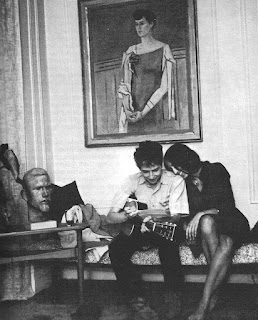 |
Bob and Joan Baez
|
There's a strong romantic thread running through much of the album. It's a key factor that made
Blonde On Blonde so powerful for the listener. Dylan’s love songs up to this point - like ‘It Ain’t Me Babe’
(“I'll only let you down”) or ‘Love Minus Zero/No Limit’ (“Valentines
can't buy her”) - had been less than tender.
Blonde On Blonde has a
handful of truly romantic songs that stand today as classics, where the tenderness outweighs
the bitterness; notably
I Want You,
Just Like A Woman and
Sad-Eyed Lady of the Lowlands.
The day after recording ‘Visions of Johanna’, the session
for Sad-Eyed Lady of the Lowlands began at 6 pm, but Dylan hadn’t finished the words. Finally, at 4 am, the musicians
assembled for a take.
This link has them working out an arrangement.
Though they were reasonably familiar with the song,
the band hadn’t appreciated it would run for almost 12 minutes. Drummer Kenny
Buttrey recalled they'd be looking at each other thinking, “man, this is it, this
is gonna be the last chorus and we've gotta put everything into it we can. We're
cracking up. I mean, we peaked five minutes ago.”
Part of the intrigue of the romantic songs on Blonde On
Blonde was who Dylan was writing about - it could often be Joan Baez, on ‘Sooner Or Later’ or ‘4th Time Around’, for example. Dylan
later acknowledged the debt he owed to Baez - who nurtured his career early on - but he did a poor job of repaying it in
1965, when Joan accompanied him to the UK.
You feel for her, watching the movie 'Don't Look Back'. the film about Dylan's UK tour in April 1965. By this time, Bob was already involved with Sara Lownds, but he hadn't told Joan. It was Sara, while working at the film production division of Time Life, who had
introduced Dylan to D.A. Pennebaker, the director of Don't Look Back. It must have been humiliating for Baez, realising she'd made a big mistake in coming on that tour.
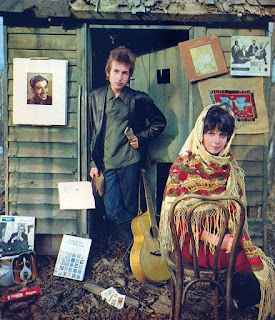 |
Sara poses for an unused version
of the Highway 61 album cover
|
.Bob would later say he was just trying to deal with the craziness of his
life at that point; and it was crazy. Joan should never have gone with
him to the UK. She described it as hell (everyone else was on drugs -
she was straight). And Bob didn't - as she had expected - reciprocate
Joan's generosity by inviting her onstage to perform with him.
Bob and Sara married in secret in November 1965. On ‘Sad-Eyed Lady of
the Lowlands’, it was his new wife he was serenading.
In his book 'Bob Dylan - An illustrated
history', Michael Gross called Blonde On Blonde "letter-perfect rock and roll.
Here was an album with a song that lasted a whole side. The symbolism was
Dylan's but the situations were everyone's. If any one disc recorded in the
Sixties can stand as a psycho-historical recreation of the times, this is
it.
"With its passionate
love songs and descents into Dylan's dramatic, urban landscape, is not an album
to pin down. Like the ‘ghost of electricity, howling in the bones of her face,’
it is more something to feel.”
The first single from Blonde On Blonde in April 1966 saw Dylan being as plain as could be about smoking
marijuana, while also deflecting to avoid censure. Knowing that a song called
‘Everybody Must Get Stoned’ might be banned before it even got out of the traps,
he called the song ‘Rainy Day Women #12 & 35’.
In The
Rolling Thunder Logbook, Sam Shepard quotes a character called Johnny Dark saying, “I couldn’t
believe it the first time I saw ‘Everybody must get stoned’ on the jukebox. I
mean there it was, right in front of everybody. Right there in the restaurant. I couldn’t believe you could play
that kind of stuff in public while you were eating your cheeseburger.”
Regardless of the cryptic title, it’s a wonder the song wasn’t banned
anyway. It did inevitably fall foul of conservative programmers at some radio
stations in the US and it was excluded from playlists at the BBC. But exposure on
pirate radio stations was sufficient to see it rise to No. 7 in the UK. It made it all the way to No. 2 in the US.
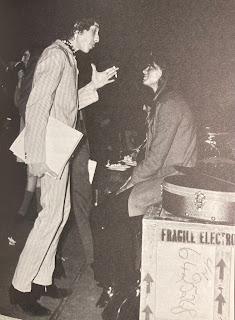 |
With Francoise Hardy, 1966
|
Blonde On Blonde was so entwined with the unique circumstances
of the sixties – the flowering of youth culture and rebellion against the cultural norms of the time - that sober reflection was difficult
for those who had lived it.
"One of the main problems approaching Blonde On Blonde after
all this time (my italics) is the temptation to take the whole thing far
too reverently," said Farren in 1976.
Indeed, so here we are, another fifty years
down the track and the album is still resonating.
The playfulness and wilful surrealism of some of Dylan's imagery
doesn’t detract from the power and fascination of this record. Even
as a teenager, I could tell this was something to get lost in. Blonde On
Blonde was the first Bob Dylan album I bought and it was another of those records that fired my imagination. Did I get the full message
on those first listens? Certainly not, but what I did hear was an atmosphere
and a sense that this music really had depth to it. I was tapping into an
unattainable bohemian lifestyle.
In his book ‘The Ballad of Bob Dylan’, Daniel Mark Epstein
described seeing Dylan’s comeback show at Madison Square Garden in 1974. “Now,
at the age of 25, I could understand lyrics that meant little to me when I
heard them at 17. Poetry grows with you.”
In the year when punk rock broke through in the UK, Farren was still in awe of Dylan's achievement 10 years earlier.
"It is certainly Bob Dylan's finest hour and there are
less than a handful of other works that can seriously challenge it for the
title of the greatest rock album of all time."
In fact, a year earlier, the NME writers had judged it to be,
in their collective wisdom, the second greatest album ever, after Sgt Pepper.
In April
1966, Dylan’s friend Richard Fariña died in a motorcycle accident in California,
just as he was launching his first novel. It was his partner Mimi Baez’s 21st
birthday. Tragic in every way. Three months later, Dylan came off his bike near
his home in Woodstock, New York. He knew he could have died on his
motorcycle, as Fariña had.
Ironically, the accident offered him the perfect
excuse to go into hiding.
Dylan wrote,
in his memoir, Chronicles, Vol 1: “I had been in a motorcycle accident and I’d
been hurt, but I recovered. Truth was that I wanted to get out of the rat race.
Having children changed my life and segregated me from just about everybody and
everything that was going on. Outside of my family, nothing held any real
interest for me and I was seeing everything through different glasses.”
In his excellent
book ‘Positively 4th Street’, about how the lives of Bob, Joan, Mimi and Richard had intertwined, David Hadju wrote: “For a year and a half after the
accident, Dylan stayed in seclusion in Woodstock, while rock musicians absorbed
and drew upon his ideas.
“The trio
of records uniting poetry with elements of folk and rock and roll – Bringing It
All Back Home, Highway 61 Revisited and the double Blonde On Blonde, came to be
acknowledged as pop masterworks and charted a whole new style of music.
“When
Dylan began making music again, it was wholly for his own pleasure.”
He made very few public appearances once Blonde On Blonde was released and did not tour again
for almost eight years.
Here's Dylan on the 1966 UK tour, singing 'Visions of Johanna' unaccompanied.
IF YOU LIKE MY BLOG, PLEASE HIT THE FOLLOW BUTTON ON THE SIDE PANEL THANKS
Also on this Blog:


