Monday, 24 August 2020

Memories of the Reading Festival 1975

In amongst the old brown suitcase full of music memorabilia from my youth is quite a bit of stuff from Reading Rock '75.

I even have my festival t-shirt, which has somehow survived.

The 1975 Reading Festival featured a wide range of music and a few bands at the top of their game, including Yes and Hawkwind.

It was probably the last of the classic rock/prog era festivals, before heavy metal and new wave took over. It was also notable for featuring bands who became much bigger sometime later, like Thin Lizzy, Supertramp, Judas Priest and Joan Armatrading.

The denim-clad hordes descended on the Thames-side festival site on the August Bank Holiday of 1975. It was typically squally bank holiday weather and that played its part, not least for fans of the Saturday night headliners, Yes, who endured a heavy rainstorm. On Sunday, though, the weather was warm and sunny all day, culminating in a blistering afternoon of rock guitar from John McLaughlin, Robin Trower and Wishbone Ash.
Shirts off - it didn't rain all the time!
On the festival site, the atmosphere was largely peaceful amongst the crowd of probably around 50,000 people.

But this was still the era when the hardcore freaks believed that bands should be playing for free - anything else was a sell-out, man! So there was a degree of suspicion and cynicism among the more experienced festival goers.

One of the regular conversations heard through the weekend was who was going to be at the free festival at Watchfield the following week. The hardcore freaks were all going to be there and Hawkwind were headlining. See the report by Allan Jones at the end of this article for more on that.
The two-stage set up at Reading

Onstage at Reading, there were several musical highlights for me. The '75 festival had a strong line-up, but you can see from my crossings-out on this flyer that Richard & Linda Thompson and Lou Reed were no-shows.

from the Festival newspaper
Here are the highlights for me, with links to audio and video where available:

HAWKWIND
The headliners on the Friday night, they were suitably loud, spacey and heavy - a mind-expanding experience.

Singer and lyricist Robert Calvert made a guest appearance at Reading, after which he chose to rejoin the band as a full-time lead vocalist.
Bob Calvert

They started out playing Warrior On The Edge of Time and then played Psychedelic Warlords Disappear In Smoke and Master Of The Universe.
Bob Calvert wasn't much of a singer, but he was the perfect frontman for Hawkwind, chanting his space poetry.

"In the event of sonic attack...!"

As the official programme noted in very un-PC terms, "even if you don't like the music, there's the ample frontage of Stacia to keep you occupied, as she cavorts about the stage".
Simon King's impressive drumkit
Visuals were always a large part of the Hawkwind experience, with psychedelic lighting provided by Liquid Len and the Lensmen. Stacia had joined Hawkwind in 1971 as a dancer, typically performing topless and wearing body paint.
Stacia having a bit of a cavort

Reading '75 was the end of an era, though, as this was the amazonian dancer's last gig with the band.

The Melody Maker reviewer was unimpressed, describing Stacia "stomping around with all the grace of the Statue of Liberty animated by Ray Harryhausen on an off-day."

Their encore was the much-anticipated Silver Machine and then, as midnight approached, Dave Brock wished the audience a good night and told them to "smoke plenty of good dope".

The reviewer concluded that "The Hawks were surprisingly tight and well-disciplined. One would suggest this was one of their better performances. Simon House, on violin and keyboards, displayed a fine lyrical mastery that proved an excellent counterbalance to the rumblings of Nik Turner and the rest of the band."

Judge for yourself. Here's the full set they played at Reading

Second on the bill on Friday were Dr. Feelgood. They warmed up the crowd with a typically high energy set. I'd seen them earlier in the year at Brunel University, so knew what to expect. We were a bit too far away to get the full effect - the two stage set-up meant you had to make a choice if you wanted a good position for the headliners. The Melody Maker review (see the scans at the end of this blog) reckoned they were one of the festival highlights. Here's some film of them just a month before the festival.

YES - Saturday night
As Hawkwind had done the previous evening, Yes kept us waiting, but eventually put on a show worthy of festival headliners, complete with an elaborate stage set designed by album cover artist Roger Dean.
Rick Wakeman had left the band earlier in 1975, after a series of disagreements over what he saw as the over-indulgent music on their last album Tales From Topographic Oceans.

His replacement, Swiss keyboard whizz Patrick Moraz, brought a similarly showy and virtuoso style to the music. They began their set at Reading with the track Soundchaser from their new album Relayer. The set included many of their most popular favourites, such as I've Seen All Good People, And You and I and Close To The Edge.
YES played on through the rain
Unfortunately for us, as the set progressed, it began to rain and became torrential by the end of their set, as laser beams pierced through the deluge. "Silvery specks of rain cascaded through the green pencil beams and the soaked hordes roared their defiance against elements," said the MM review.

"Until the rain, Yes played magnificently. They played on regardless, with commendable courage and they were greeted with tumultuous cheers.

"And You And I was exceptional, with fine country guitar work from Steve Howe."

I have a bootleg CD of it, bought in Japan several years ago. Jon Anderson thanks the audience profusely for braving the conditions.

My clip featured here gives you some idea of how it looked. And here's a reasonable audio of it. For a better idea of their set from this time, check out the Live at QPR films that are fairly easy to find.

John McLaughlin at Reading
The Mahavishnu Orchestra featuring John McLaughlin - Sunday Afternoon
This was a later version of Mahavishnu, stripped down to a four piece featuring Narada Michael Walden on drums, Ralphe Armstrong on bass and Stu Goldberg on keyboards.

Although the band had changed, much of the material they played was familiar to fans of the first two Mahavishnu albums, The Inner Mounting Flame and Birds of Fire.

They began their set with Meeting Of The Spirits, which was as frenetic as ever. The MM reviewer was surprised how animated McLaughlin appeared: "Stomping about the stage like a heavy metal kid rather than the darling of the jazz rock avant garde, face bearing a smile that was positively beatific, except when he was wringing out those deliciously agonising galaxies of notes on his guitar."

Here's a link to the MO's set at Reading.

The sun was out and there was a good vibe in the crowd. Festival DJ John Peel played Cream's Born Under A Bad Sign and next up on the left hand stage was the Robin Trower band.
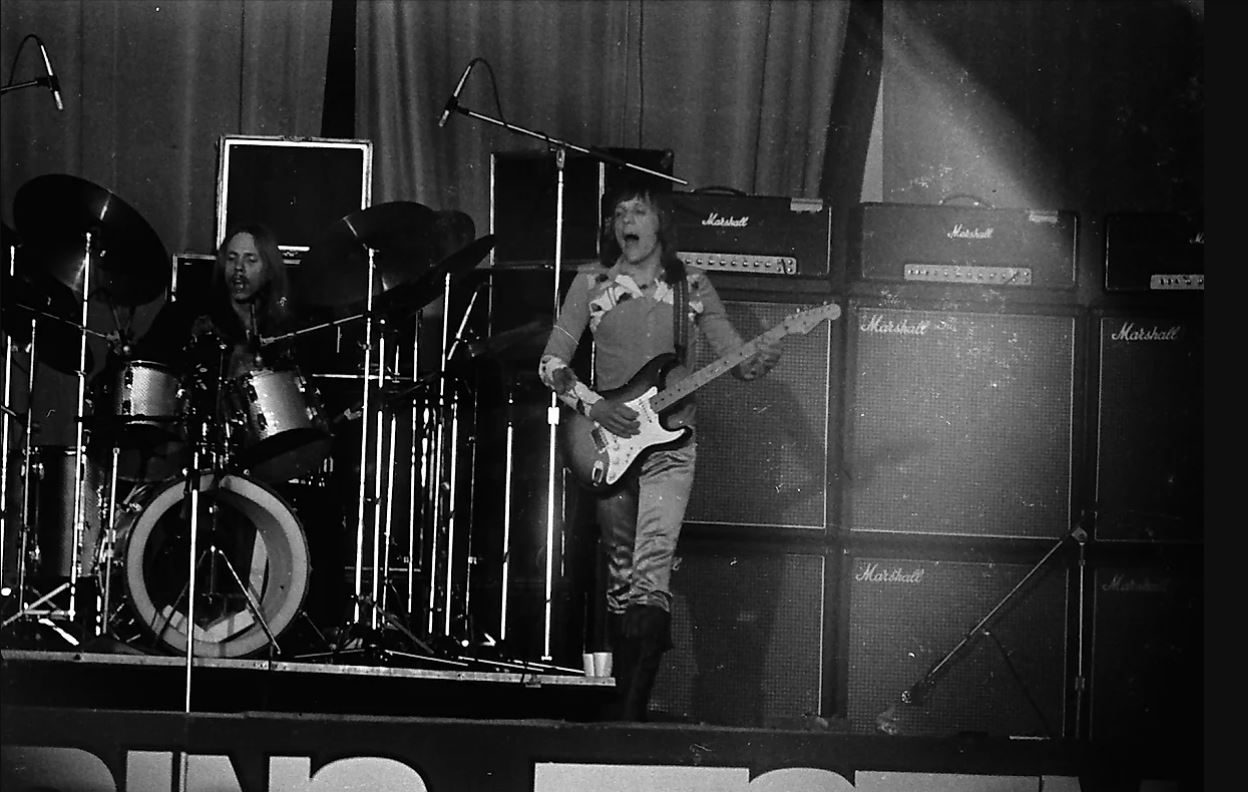
Robin Trower and drummer Bill Lordan at Reading
This was the high point of the Sunday afternoon and perhaps the whole weekend. I have this memory of the crowd getting in such a frenzy – it was a lovely sunny afternoon and a kind of delirium came over the crowd during Trower’s set. 

At the climax of one of the songs, a great wave of cheering could be heard as a rubbish fight broke out across a no-man’s land puddle of mud towards the back of the crowd. Or maybe they were just chucking everything into the void. I just remember this cloud of paper and empty bottles suspended in the air, the crowd seemingly spurred on by the excitement of the music.
MM hails Trower and Yes

Trower's set was drawn from the first three albums, particularly the classic Bridge of Sighs. Another highlight was always Trower's tribute to 'the man', the song Daydream, dedicated to Jimi Hendrix.


Trower had been saddled with being a Hendrix imitator and the MM's reviewer said he still sounded like Jimi. "Not an imitator, you'll note, but if you close your eyes and just listen to the chops, feel the chord sequences in your gut, it might well be James Marshall Hendrix reincarnated."

Trower proved that the heavy power trio had far from run out of steam, said the review. "I would not have believed it possible for such limited instrumentation to keep one's interest alive for 90 minutes. But Trower did it, and of course they loved him for it, calling him back for two encores."

I've written a separate blog piece about the Robin Trower band who were close to their peak at this time, certainly in terms of the intensity of their playing. 

Here's a link to audio of Robin Trower's set at Reading: https://www.youtube.com/watch?v=Q8rRhH9uEFI

According to a fan of the band (in the comments below), Sunday night headliners Wishbone Ash were very late taking the stage owing to technical problems. I do remember there were problems and doubts even that they would appear, because the stage was dark for ages. It was a slightly disappointing end to a great day. No footage or boots that I can find of their show at Reading, possibly because the technical problems. But here's some film of them playing at Winterland in February '76.

from the festival newspaper
Thin Lizzy - This was early days for the Mark II Lizzy but they had already trademarked the twin guitar sound, with new guys Brian Robertson and Scott Gorham. Later on in 1977 and '78, Lizzy would hit the big time with Jailbreak and the Live & Dangerous album.

In 1975 though, they were still building up to that and went on mid-afternoon, playing songs from their current album Fighting. I'd heard them playing a session on the radio and, as a fan of the original band (I bought Whiskey In The Jar and The Rocker) I was interested to see how the new one compared.

John Peel announced them as "one of the best bands you're going to hear this weekend."

Of course, they were great. The template was set, Lynott leading the line with a swagger and bantering with the crowd. It may have taken them a while to get the crowd going, but eventually "the pounding of Brian Downey's two bass drums and the twin guitar leads backing Lynott' earthy vocals began to bite," said the MM.

Thin Lizzy at Reading '75

"Heavy riffs came flying, but it was 'I'm Still In Love With You', a slow piece, that helped relax the band and gave space for a fine solo by Brian Robertson."

Here's some brief film of that show tagged with a recording of it, for those who were there.

If that's too rough for your taste, here's a sample of their live set from that tour.

Supertramp - all dressed in white jumpsuits as I recall. They played a faithful rendition of the Crime of The Century album. It was raining though, and I remember ducking for cover at one point. It felt like I wasn't missing much, because Supertramp were not projecting any great spectacle to the crowd. It was just like listening to the album.

Here's audio of them playing School in 1975
and here's video of them playing Dreamer

UFO - Another band I was fond of at the time, they played before Dr. Feelgood on Friday evening.  Doctor Doctor has become a rock classic and in this clip, they are playing another, Rock Bottom in 1975

Soft Machine, were a treat for jazz rock fans. John Etheridge joined the band in early 1975, replacing Allan Holdsworth, the guitarist on their then current album Bundles. Etheridge told Jazzwise magazine, "Following Allan as the Soft Machine guitarist was demanding. I felt that I was one of the few people who could cope. I was quite proud of that.”

Although they didn't do much in the way of performance, a bit like Supertramp, I found their music was quite intriguing. The MM noted their set consisted mainly of songs from Bundles, "together with some rather nice material distinguished by good wind and guitar voicings and an excellent drum solo  by John Marshall."

Here is Etheridge with Soft Machine in 1975.

Judas Priest - I was a fan of their first album Rocka Rolla. This was well before their international fame in the 80s and Rob Halford's leather fixation. Halford had long hair at this time and the music was much more blues rock than the metal of later years. Good though. This is probably the earliest footage of them, live at Reading.

And for any diehard Judas Priest fans, here's a link to the audio of their set
https://www.youtube.com/watch?v=cjFRYutoJsE

Joan Armatrading
Gary Holton - stage left, standing on a
speaker, hones his acting skills

She was the opening act on Sunday. It was clear she had something special. A deep beguiling voice and some good songs. She was promoting a new album, Back To The Night.

"Joan announced she was going to sing some blues and the response from the crowd was immediate," said the MM. "By the time she finished with 'Back To The Night' she had raised them from their somnolence."

Not sure if I'd heard her before this, but she definitely made an impression.

The Heavy Metal Kids - They'd shortened their name to The Kids at this point. They were my mate Kev's favourite from the weekend, I think, because of singer Gary Holton's theatrics. It was apparent that Holton was a character,  even then, way before he appeared as one of the cast in Auf Wiedersehen, Pet.

The band were a lot tighter than their appearance here the previous year, said the reviewer. "They roared through 'Boogie Woogie', 'The Cops are Coming', 'Rock and Roll Man' and even a jokey chorus from the Bay City Rollers. Gary raced around the stage, gesticulating, posing and being just enough of a pain in the neck to arouse the ire of a whole coach load of rock writers."

As we trudged home on the bank holiday Monday, tired and hungry, a voice cried out from the distance: WALLY!!!

IF YOU LIKE MY BLOG, PLEASE HIT THE FOLLOW BUTTON ON THE SIDE PANEL THANKS

Also on this blog:

Steve Howe joins Yes, Rick Wakeman joins The Strawbs

The Yes Album - 50 years old and still sounding great

The Who Put The Boot In at Charlton FC, 1976

Five Days of High Drama at the Isle of Wight, 1970

The following week, the bikers and hardcore hippies convened at Watchfield

Sunday, 23 August 2020

Peter Gabriel's post-Genesis Evolution

Gabriel gets up close at Knebworth
When Peter Gabriel re-emerged in 1977 after his shock exit from Genesis, he knew he needed to find his feet as a solo performer.

By the end of the decade, his music had taken on a rockier edge, harnessing the spirit of the new wave. 

His early solo efforts were imbued more with the legacy of his progressive rock past, notably on the first solo album, Peter Gabriel.

For his return to recording after Genesis, Gabriel decided to work with American musicians and producer Bob Ezrin, best known for his work on Alice Cooper's albums such as Billion Dollar Babies, and later, Pink Floyd's The Wall.

PG at home, post-Genesis. Note the old masks
"At the time of the first album, I was nervous recording without the structure of a band and was happy to let Bob take a strong role" Gabriel told biographer Armando Gallo.

The record was much-anticipated by Genesis fans, many of whom were still getting over his leaving the band. The first single, Solsbury Hill, was a hit, rising to number 13 in the UK charts.
His first solo shows at the Roxy, Hollywood, April 1977

The song's lyrics are partly a reference to Gabriel's decision to leave Genesis, just as they appeared to be breaking into the Big Time.

He said Solsbury Hill was about "being prepared to lose what you have for what you might get. It's about letting go."
PG1

A second single, Modern Love, should also have been a hit, but somehow didn't make it onto the charts.

While he was happy with the first album, it was clear to Gabriel that he needed to take more control. Some of the record had been over-produced, in Ezrin's signature bombastic style. The closing track, Here Comes The Flood, for example, was a fan favourite, but Gabriel said he preferred the stripped-down version he recorded with Robert Fripp.


So he went in an entirely different direction, enlisting Fripp to produce the second album, Peter Gabriel. King Crimson were on hiatus at this time and Fripp had recently been working with David Bowie.

The second PG album was well-received and got into the top 10 of the UK album charts. But there was no hit single, despite a couple of strong contenders in On The Air and DIY.

PG2
For his opening live shows in the US, in April 1977, Gabriel used the core of the musicians from the Ezrin sessions. Anyone who saw Genesis touring The Lamb Lies Down On Broadway in 1975 would understandably have expected some elaborate stage costumes, but instead Gabriel chose to dress down. At the Roxy in Los Angeles, he wore a grey track suit.

Here's some original footage from those first shows at the Roxy. Notably, he does covers of Ain't That Peculiar and You Really Got Me, encoring with Back In NYC, from The Lamb.
Gabriel at Knebworth, September 1978

The live band included Fripp and bassist Tony Levin, who would become a Gabriel mainstay and a key part of the reformed King Crimson in 1981. Fripp is said to have performed all the shows from behind a speaker cabinet. He's certainly not visible on the clip linked to here.

Gabriel himself was disappointed with the second record. It wasn't the step forward he had wanted. He said of Fripp, "He's a wonderful player and a great producer with other people, but for me it didn't work out so well.
Climbing into the crowd at Knebworth...

"Bob Ezrin was thinking music-biz but Robert was anti-music biz, so I just went from one side to the other on the first two albums."

During 1978, Gabriel toured in Europe and the US, honing his new cropped-hair look with the high-vis orange vest, becoming a popular live act in the process.

Gabriel was signed up for the Knebworth festival in September 1978, on a bill with Frank Zappa, The Tubes, Boomtown Rats, Rockpile and Wilco Johnson.

...and climbing back up
Knebworth 1978
It was a lovely sunny day in Hertfordshire and Gabriel was clearly among friends. There were several 'Rael' flags in the crowd and one that proclaimed 'The Angel Gabriel'.

He didn't disappoint them, climbing up ladders and scaffolding and out into the crowd at various points, with a toy panda to sing 'Me and My Teddy Bear', as you do...

The set at Knebworth was comprised mostly of songs from the two solo albums, but included a new song, I Don't Remember, which appeared on his third album, Peter Gabriel. They also did a punk rock version of A Whiter Shade of Pale, with Gabriel playing the drums.
Getting his kicks behind the drums

The set finished with the uptempo rocker Modern Love and an encore of the Genesis classic, The Lamb Lies Down On Broadway. Here is the band in 1978 playing On The Air
and The Lamb Lies Down On Broadway

Around this time, Gabriel began experimenting with the stage diving that would evolve into the 'Lay your hands on me' track from the fourth album, Peter Gabriel.
An early stage dive
"When I am standing on stage, I can sense how far the performance is reaching the audience. Sometimes the audience appears like a large animal. When I walk off the stage (into the audience) I relate to the people one to one. I am vulnerable...on a good night I can lose myself totally."


On stage with Genesis in 1973
Gabriel finally found his sound on the third album, with the help of young engineers Steve Lillywhite and Hugh Padgham, whose experiments with the available studio technology Gabriel was happy to encourage.

PG3
Of the dry 'gated reverb' sound of the drums (played by Phil Collins) Gabriel said "it was originally Hugh Padgham's set-up and he should get credit for that.

"I remember the moment when I first heard the gated reverb. I stopped the session we were working on and said that I wanted to record that sound immediately for Intruder. I was certain that it was a landmark drum sound."

And so it proved, but not for Peter Gabriel. Instead, his old band mate took the sound for his own solo single, In The Air Tonight.

Gabriel wasn't best pleased, saying "I get angry when people say I have copied Phil's drum sound."

"Phil hadn't met Hugh before that session (on PG3). He then invited him to come and work on all of his records, which went on to become a massive international hit, in the way that 'Intruder' was never going to be."

On PG3, Gabriel worked with younger musicians from the new wave, including Paul Weller, XTC's Dave Gregory and John Ellis of The Vibrators. Gabriel continued to innovate throughout this period. His third and fourth albums are unique and groundbreaking works. He was also asked to create soundscapes and atmospheres for Alan Parker's film Birdy and for Martin Scorsese's The Last Temptation of Christ.

The 12" single release of Biko, from PG3
Gabriel wasn't afraid to use his platform to highlight human rights abuses and wrote 'Biko' in response to the death in South African police custody of the anti-apartheid activist Stephen Biko. The song was often used at the climax of Gabriel's live shows, encouraging the audience to chant in sympathy and comradeship.

He was an early adopter of the emerging digital studio technology, that allowed him to sample found sounds and indulge the fantastical imagery he first explored with Genesis. This edition of the South Bank Show has footage of him working on his fourth album and the primitive computer tech then available. 

Much of the inspiration for the new sounds Gabriel was creating came from African tribal rhythms and melodies. His respect for the unique character of what came to be known as 'World Music' led him to curate the first WOMAD festival in 1982. Many people who attend WOMAD events today around the world probably don't appreciate that it was Peter Gabriel who started it all. 

It is quite an achievement to create new sounds and remain true to your artistic goals, while remaining accessible to a wider audience. Ultimately, it's a testament to the quality of the music. The fourth Peter Gabriel album represents the high water mark for phase one of PG's solo career. He would take it to another level visually and commercial with his next album, So

The majority of photos in this piece are from Armando Gallo's book Peter Gabriel, published by Omnibus Press in 1986.

IF YOU LIKE MY BLOG, PLEASE HIT THE FOLLOW BUTTON ON THE SIDE PANEL THANKS

See also on this blog:
Genesis On Tour in 1975 - Peter Gabriel Quits

https://bangnzdrum.blogspot.com/2012/07/coming-soon-gabriels-cosmic-juice.html 


And here's a broad-ranging long interview with Gabriel that's worth a read.


Thursday, 6 August 2020

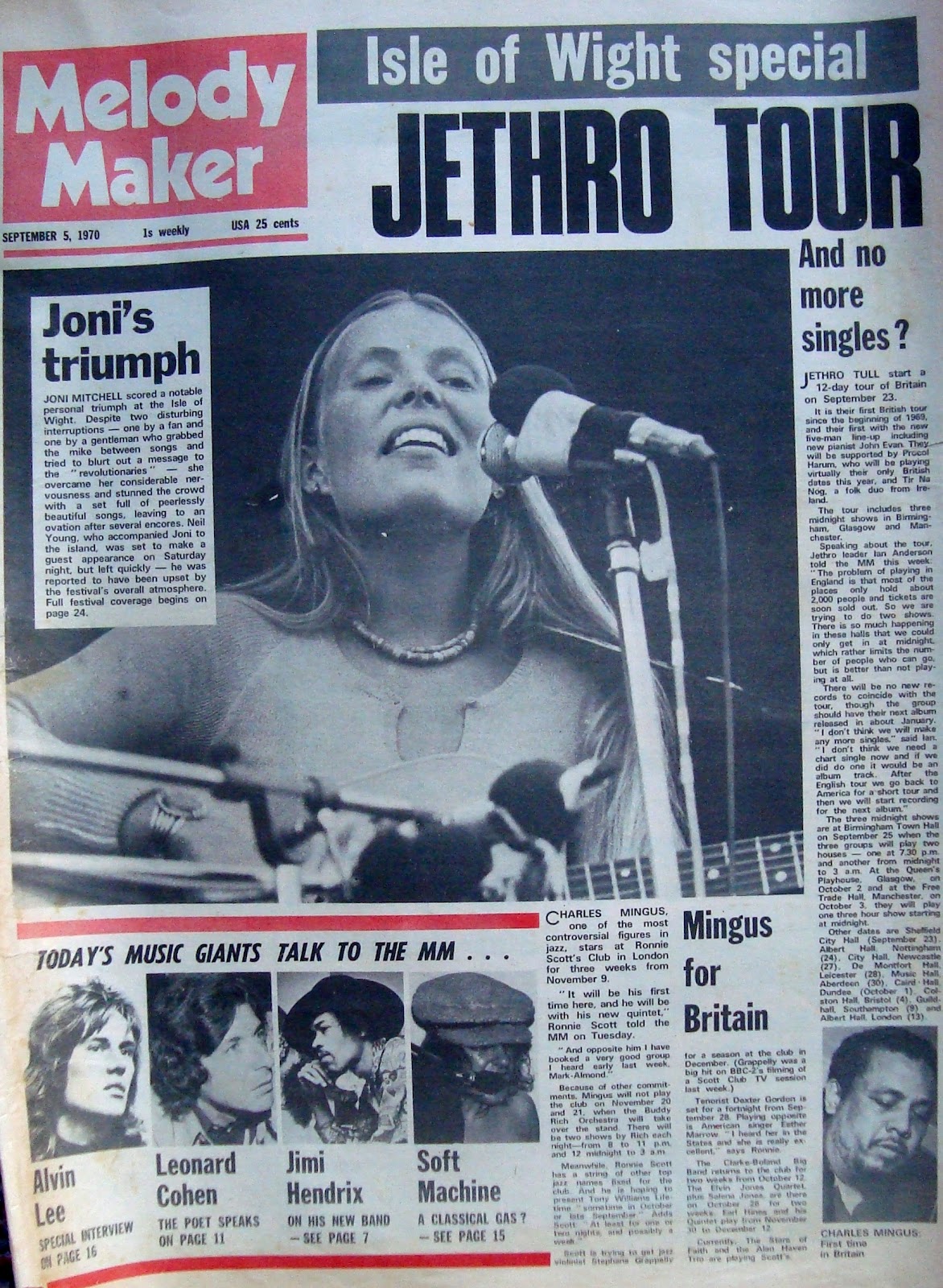
Joni Mitchell tames the tiger at the Isle of Wight 1970


Persuaded to go on earlier than planned, when no one else would, Joni Mitchell got a lot of credit for hanging in there at the Isle of Wight festival, 50 years ago in August 1970.

In an impressive display of composure, Joni survived an initially restless crowd and a stage invasion early in her set. By the end she was given a standing ovation by the estimated 600,000 crowd and was called back for an encore.

The tension in the crowd was caused by an us-and-them anti-establishment vibe from the thousands of non-ticket holders camped on the hillside overlooking the festival. The free festival anarchists among them did their best to undermine the good vibes, bringing down fences and clashing with police. 
The massive crowd at the IOW festival

In the midst of this, and clearly nervous at the prospect, Joni took the stage.

Her IOW show is remarkable because it demonstrates not only Joni's qualities as an exceptional songwriter and performer, but her determination to win over a hostile crowd.

Joni was visibly upset by the bad vibes from a section of the crowd, some of whom just wanted to hear the rock bands. Then there were the freeloaders, who thought it was all too corporate and should be put on for nothing.

She admits, in the interview accompanying the film of her IOW show, Both Sides Now, that she wanted to run, but didn't feel like she could.
An unwelcome interruption

To her great credit, she toughed it out, enduring a stage invasion by one of the disgruntled hippies and telling the audience at one point that they were behaving like unruly tourists.

Joni scolds the audience
As one of the people who commented on my Facebook link to this blog noted, "She gets passionate!" 

"Will ya listen a minute!!," she yells at the crowd. 

"A lot of people get up here and it's fun, you know? But you've got your life wrapped up in it. It's very difficult to come out here and lay something down....Give us some respect!".

After that, she noted that the crowd settled down, as if a different mood had passed back through the crowd from the front rows. She had won them over with her "peerlessly beautiful songs" - as the Melody Maker report put it - even getting called back for an encore.

Neil Young had also planned to appear, but he didn't like the festival vibe and retreated. Other performers, notably Kris Kristofferson, survived a hostile reception and he even returned for a second show later in the weekend.

The trouble at the festival shouldn't detract from the fact that this was one of the great musical gatherings of the time - certainly one the biggest, larger than Woodstock it is claimed.

The festival featured landmark performances by some of the top bands of the time, including The Who, Jimi Hendrix and Free, and several of the acts that had been highlights of the Woodstock festival the previous year, including Sly & The Family Stone, Ten Years After, Joan Baez and Richie Havens. Emerson, Lake & Palmer made their debut there and Miles Davis's 38 minute set is held up as a prime example of his new electric jazz direction. All in all, as fine a collection of performances as you will find at any of the late 60s/early 70s festivals. 

IF YOU LIKE MY BLOG, PLEASE HIT THE FOLLOW BUTTON ON THE SIDE PANEL THANKS


Further reading on this blogsite:
Dylan, Joan and Joni on The Rolling Thunder Tour
https://bangnzdrum.blogspot.com/2019/07/five-reasons-why-you-should-watch-bob.html


Court and Spark - Joni Mitchell interview from 1974
https://bangnzdrum.blogspot.com/2019/01/court-and-spark-joni-mitchell-interview.html  


Joni Mitchell - The Hissing of Summer Lawns

Joni Mitchell - Hejira
http://bangnzdrum.blogspot.co.nz/2012/06/joni-mitchell-in-1970s-3-hejira.html


Joni Mitchell - Don Juan's Reckless Daughter
https://bangnzdrum.blogspot.com/2012/08/joni-mitchell-in-1970s-4-don-juans.html