Sunday, 17 February 2019

June 1970 - Hendrix's 'Band of Gypsys' album reviewed by Melody Maker

Rockin' The Fillmore
The final album released by Jimi Hendrix in his lifetime was the live record 'Band of Gypsys'. Recorded on New Year's Eve 1969/70 at the Fillmore East in New York, the record showcased new material reflecting a more mature and soulful Hendrix, backed by his old army friend Billy Cox on bass and Buddy Miles on drums and vocals.

Jimi had lost a bit of momentum after the release of his masterpiece album Electric Ladyland in 1968. With manager Chas Chandler and bassist Noel Redding both departing during the EL sessions, which they saw as indulgent and directionless, Hendrix put a random bunch of musicians together for his performance at Woodstock in August 1969. They were loosely billed as "Gypsy Sun and Rainbows" and Hendrix referred to them as “just a band of gypsies”.

Dec 1969 - click on the image to expand it
In this interview with Melody Maker in December 1969, Jimi talks about wanting to get the Experience back together and waiting on Noel and drummer Mitch Mitchell to agree.

In the meantime, he mentioned he was working on a recording for the Band of Gypsies project with Buddy Miles on drums and Billy Cox on bass.

Cox had played in a band with Jimi when they were both in the US army and he joined Hendrix for his performance at Woodstock in August 1969.

Buddy Miles had played on the Electric Ladyland two-part track Rainy Day, Dream Away and Still Raining, Still Dreaming and the Band of Gypsies material reflected this slightly more funky approach, though with less of the humour and lightness evident on EL. 
 
Hendrix’s business affairs were complicated by the fact he was contracted to provide an album to a former manager, Ed Chalpin and his company PPX Enterprises. With Cox and Miles now in tow, Hendrix was encouraged by his manager Mike Jeffrey to work on material that could be used to settle the contract with Chalpin. 

The Band of Gypsys - Hendrix, Miles and Cox

Bill Graham booked Hendrix to appear at the Fillmore over New Year’s and plans were made to record the shows. The recordings were not perfect. Hendrix had problems with mild feedback and he admitted he was out of tune on some numbers. Nonetheless, his playing is still remarkable and the album's standout track, Machine Gun, bears all the hallmarks of his iconic performance of the Star-Spangled Banner at Woodstock. 
Band of brothers

Hendrix dedicated Machine Gun "to all the soldiers that are fighting in Chicago and Milwaukee and New York, oh yes, and all the soldiers fighting in Vietnam". The combination of his wailing and swooping guitar and Miles' rat-a-tat-tat drums give the track a haunting power that few other rock artists could get close to at that time. 

But during the two-night run at the Fillmore Jimi couldn't resist showing off and Bill Graham had harsh worlds for him after the first set on the second night.
 
When Hendrix asked him during the intermission what he thought, Graham said, "You're Jimi Hendrix and anything you do is taken as gospel because of who you are. You humped the guitar, you played it with your teeth; you stuck it behind your back. You just forgot to play."

Stunned, Jimi went back on stage for the second show and really played. The incandescent version of Machine Gun on Band of Gypsys was recorded at that show. 

Hendrix went up to Graham when he came off stage and said, "Alright motherfucker? That good enough for you?" 

He wheeled around to the stage for the encore and did, in Graham's words, "fifteen minutes of the greatest shtick you'd ever want to see." grinding up against his Strat and all his old showboating tricks. 

"At one point he looked to the side of the stage and stuck his tongue out at me," said Graham. "It was very, very funny."

UK ad in June '70
The contractual obligation nature of Band of Gypsys cast an unhappy shade over the whole episode though, despite the album being well-received on release in March 1970 (in the US). It became his best-selling album since his debut ‘Are You Experienced’.

An ongoing dispute between Chalpin and Hendrix’s management meant that the album wasn’t released in the UK for another three months.

Plans were made to take it on the road, but it didn’t last long. A concert at Madison Square Garden on January 28 1970, ended prematurely after just two numbers. 

Just 'Hendrix' - contractual obligation honoured
Observers at the show, including other performers such as Johnny Winter, commented on how down and detached Hendrix appeared. There were a lot of rumours about the effect drugs were having on him.

There were also tensions between Hendrix and Buddy Miles, with the latter reluctant to play second fiddle. Whatever the truth, the band dissolved right then and Hendrix was encouraged to reconvene the Experience, with Cox on bass replacing Noel Redding. 

What we have left is a reminder that on his day, Jimi Hendrix was still way ahead of everyone else in terms of imagination on the guitar. That he couldn’t sustain the high quality he established from 1967 and '68 onwards is perhaps not surprising.
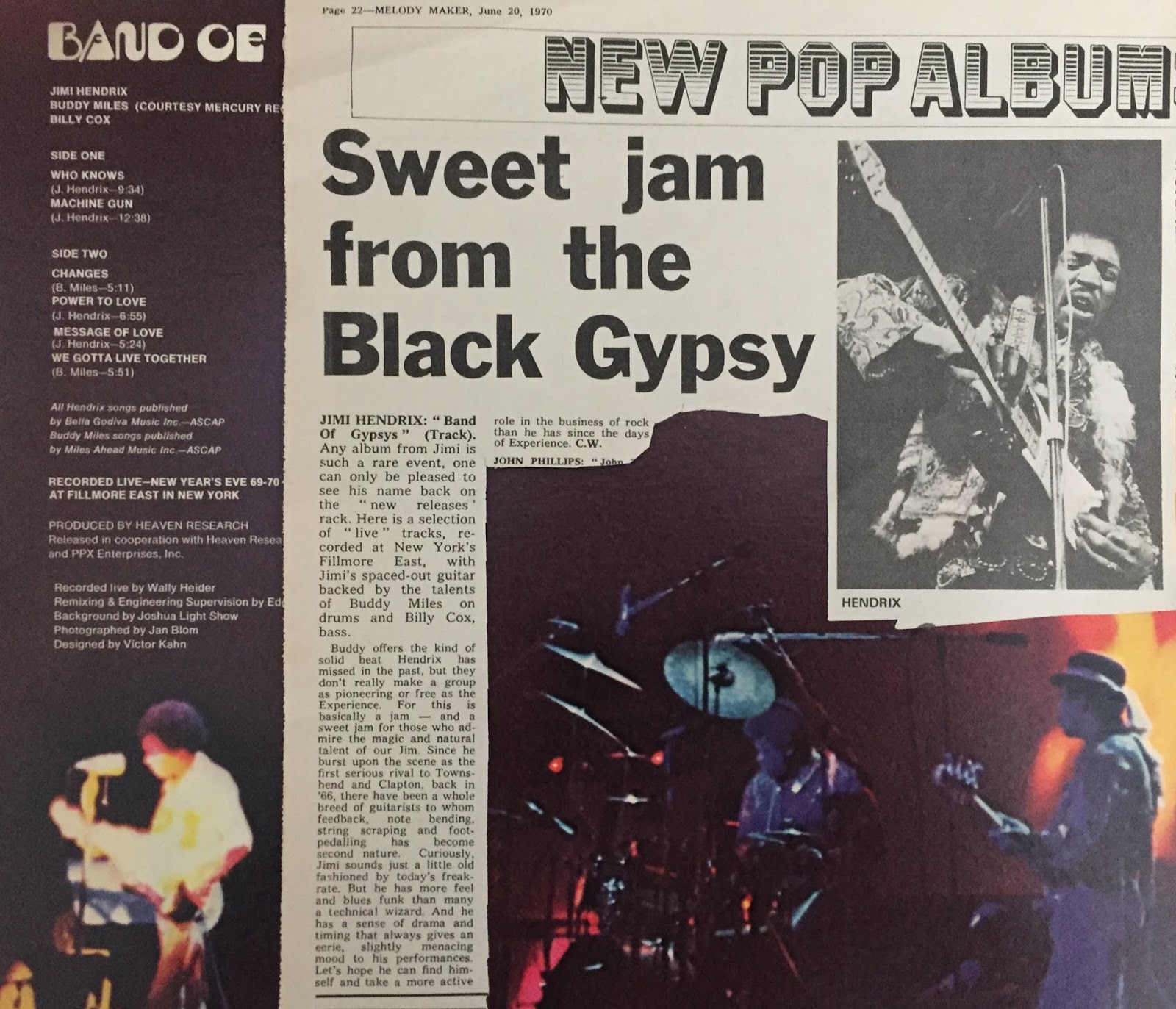

In his album review, Melody Maker's reviewer Chris Welch noted that Hendrix's playing is at times restrained and even "old-fashioned". But he still has "a sense of drama that gives an eerie slightly menacing mood to his performance".

Below is a clip containing interviews and footage of the band playing "Who Knows", the first track of the album. The music is quite different from the Experience and funkier, for sure. But I don't buy the narrative that the Band of Gypsys documentary is putting across, saying this was the real Jimi because he was playing with black guys. If the black community got off on it more than the Experience albums, that's understandable. Producer Eddie Kramer has it right though - the albums are just different and that reflects the breadth of Jimi's abilities and his musical vision. He could have gone anywhere musically, he was that talented.

Here's a non-album version of Power of Soul, from the first show at the Fillmore.
and this film has recently surfaced of the new year's celebration and extracts from the first show at the Fillmore.
The gatefold inside cover of the original north American release of Band of Gypsys

IF YOU LIKE MY BLOG, PLEASE HIT THE FOLLOW BUTTON ON THE SIDE PANEL THANKS

See also on this blog:

Jimi Hendrix wows Monterey 1967


Wednesday, 23 January 2019

Court and Spark - Joni Mitchell interview from 1974

Joni Mitchell's sixth album, Court and Spark was released 45 years ago. I recently unearthed this interview from the US pop magazine 'Raves', which appeared in June 1974. In it, Joni talks about the evolution of her songwriting craft and her ongoing sense of loneliness.

The interviewer paints Joni as a tragic Garbo-like figure who had retreated from the LA music scene for some time, only recently re-emerging with her new album and a tour that took in a series of dates in London.

Joni had changed and indicated she had undergone "a painful transition" - "I was too close to my own work," she said. She took to the psychiatrist's couch - "I was practically catatonic," but that provided no solution.

She found some answers in the writing of German novelist Hermann Hesse. As she skimmed the book Narcissus and Goldmund she ran across a passage in which Narcissus the priest does not reproach Goldmund for his lack of insight into himself. Instead, he advises him to 'get his life in focus'.


Travel also broadened her mind and ultimately she "gained a perspective and distance on most of my songs."

She emerges, said the reviewer, "as a talented entertainer, rather than the emotional registrar of experiences."

Court and Spark marked the beginning of the most musically fulfilling period of her career. The confidence shines through in the performances from the London shows.

Joni embraced the opportunity of working with talented jazz players like Tom Scott, John Guerin and Robben Ford.

The results, in her next album, would blow away any notion that she was just a confessional singer/songwriter.


But that's another story, told here:
https://bangnzdrum.blogspot.com/2012/06/joni-in-70s-2-hissing-of-summer-lawns.html


Here's an excerpt from the 1974 London concert with Tom Scott and the LA Express:

IF YOU LIKE MY BLOG, PLEASE HIT THE FOLLOW BUTTON ON THE SIDE PANEL THANKS

Also on this blog:
Joni Mitchell in the 70s - Court and Spark 
http://bangnzdrum.blogspot.co.nz/2012_05_01_archive.html

Joni Mitchell in the 70s - The Hissing of Summer Lawns
http://bangnzdrum.blogspot.co.nz/2012/06/joni-in-70s-2-hissing-of-summer-lawns.html


Joni Mitchell in the 70s - Don Juan's Reckless Daughter

Joni Mitchell tames the tiger at the Isle of Wight 1970
https://bangnzdrum.blogspot.com/2020/08/joni-mitchell-tames-tiger-at-isle-of.html

Joni Mitchell's Dog Eat Dog and a chance meeting with Thomas Dolby
https://bangnzdrum.blogspot.com/2023/02/joni-mitchells-dog-eat-dog-and-chance.html

Monday, 5 November 2018

March 1973 - 'Dark Side of the Moon' enters the charts

The UK pop charts from March 1973. Pink Floyd’s Dark Side of the Moon makes its first appearance in the album chart. It stayed there for the next 10 years, but apparently it never made it to Number 1.

It was the album that came to define progressive rock in the 1970s, with the iconic prism cover and production values that must have shifted hi-fis and headphones by the million. 

The ultimate concept album, Dark Side of the Moon covers the span of birth and death, touching on key themes of time, love, death, war and madness. 

Responses to questions on these topics - from staff at Abbey Road studios and the band’s crew - are weaved into the narrative. Each song merges into the next, giving the album a seamless flow that transported listeners, some of whom were lucky enough to hear the music on quality stereo systems, or on headphones. This was the age when hi-fi was becoming more accessible. Dark Side as the demonstration disc of choice for many years afterwards.

 I was lucky enough to see them perform Dark Side Of The Moon live in 1974 at the Empire Pool, Wembley. You can see the ticket at the top of my blog. The concert was in two parts; the first half was them road-testing songs that would appear on their next two albums, Wish You Were Here and Animals, including an early version of Shine On You Crazy Diamond

Part two of the show was Dark Side played in its entirety, complemented by visuals projected onto a circular screen, many of which can be seen in the Classic Albums programme about DSOTM.

They encored with Echoes, from the album Meddle, which is still one of my favourite pieces by Pink Floyd. 

The singles chart in 1973 was the usual mix of the cool and the seriously uncool. The notable aspect is the high proportion of soul artists, including Roberta Flack, the Detroit Emeralds, Timmy Thomas, Jimmy Helms, the O'Jays and Gladys Knight.

The albums list contains quite a few all-time classics, including Stevie Wonder's Talking Book, Bowie's Ziggy Stardust, Moving Waves by Focus, Holland by the Beach Boys and Bridge Over Troubled Water by Simon & Garfunkel. 

IF YOU LIKE MY BLOG, PLEASE HIT THE FOLLOW BUTTON ON THE SIDE PANEL THANKS

Also on this blog:

Wish You Were Here - A Flawed Diamond

Pink Floyd On Tour - 1974 and 1977

Reviewing Pink Floyd - Their Mortal Remains at the V&A

Vegetable Man - Syd Barrett's last recordings with Pink Floyd

Tuesday, 30 October 2018

February 1970 - Bowie in obscurity, Mick Ronson joins Michael Chapman

Michael Chapman's album Fully Qualified Survivor had just been released on Harvest. It featured some classic Mick Ronson guitar, instantly recognisable now as the sound Ronson would soon deliver on David Bowie's album The Man Who Sold The World. But in February 1970, it would be hard to say who was the more successful of the two, Bowie or Ronson.

Mick Ronson in 1970

David was at this point involved in his Arts Lab project and had formed an electric band, The Hype, a vehicle for the new songs he had written, some of which would be heard on his next album, The Man Who Sold The World.

The Hype was Bowie with Tony Visconti on bass, Mick Ronson on guitar and John Cambridge on drums. Cambridge had been replaced by Ronson's mate Woody Woodmansey by the time they came to record TMWSTW in the late summer of 1970.

Here's a short clip of them performing the Velvet Underground's 'I'm Waiting For The Man' at the 'Atomic Sunrise' festival in February 1970.

They also did a radio session for the BBC's Sounds Of The Seventies the following month.

Bowie was still a long way (another two years) from seeing any more commercial success, after his lone hit Space Oddity in 1969. Mick Ronson, on the other hand, was not only helping Bowie forge a new sound, but was being picked up by various other emerging artists, including Michael Chapman and Elton John.

Here is Ronson to the fore on this track from Fully Qualified Survivor, 'Stranger in the Room

The common denominator between Chapman and Elton was producer Gus Dudgeon. Gus was so impressed with Ronson's playing on Fully Qualified Survivor, he recommended Elton John check him out for his forthcoming album Madman Across The Water.

Ronson did record some guitar for Elton's record, but it didn't make the final mix of the original album release. In fact, it didn't see the light of day until much later, when a CD reissue of the album featured out-take tracks, including the version of Madman with Ronson's guitar part.

Here it is: https://www.youtube.com/watch?v=CExEESuhhPg

Bowie on stage in 1970
Meanwhile, as the above page from the Melody Maker of the time shows, on Tuesday this week, Ronson had started gigging with Bowie and The Hype, who were booked to play at the White Bear pub in Hounslow! In the advert, they were billed as 'David Bowie's new electric band'.

It's fair to say The Hype were not well received by the critics. Bowie's questing for the right sound to reboot his career would take a few more twists, before he finally hit the big time with Ziggy Stardust in 1972.

He was at a particularly low point when he appeared at Glastonbury in 1971, but took encouragement from the reception at the festival, even though he was playing at dawn.

Bowie told how he was up all night smoking dope with Terry Reid and Linda Lewis. He took the stage at 5am, but nonetheless he seems to have captivated those who were awake.

Bowie at Glastonbury in 1971
Audio of his Glastonbury appearance exists, in which he thanks the audience for appreciating him, at a time when he was considering giving up playing live altogether:

"I just want to say that you’ve given me more pleasure than I’ve had in a good few months of working. I don’t do gigs any more because I got so pissed off with working, and dying a death every time I worked, and it’s really nice to have somebody appreciate me for a change.”
The Supermen: Mick, David and Woody, 1971
 
Here's some rare footage of Michael Chapman, live in Paris in 1970, with Rick Kemp on bass and Richie Dharma on drums - both of whom are mentioned in the above news item about Chapman teaming up with Ronson in the MM cutting, under 'Folk News'.

IF YOU LIKE MY BLOG, PLEASE HIT THE FOLLOW BUTTON ON THE SIDE PANEL THANKS